
The Forty-Second Branch (1977) preserves the early history of Selkirk’s Legion, highlighting its formation in 1926, struggles during the Great Depression, and strong role in supporting veterans and the community. Built through member memories, it shows how the branch survived financial hardship and a devastating 1935 fire. Overall, the Forty-Second Branch tells a story of perseverance, community service, and the lasting legacy of veterans in Selkirk.
The Selkirk Museum celebrates the Royal Canadian Legion’s history through The Forty-Second Branch, a book written by Malcolm Macfarlane in 1977. Macfarlane faced challenges in researching the Legion’s first fifty years due to incomplete records, relying on colorful memories from its members. The book captures the Legion’s formation, successes, struggles, and contributions to Selkirk.
As Lloyd Davies, the club president in 1977, wrote, “We hope you find this book enjoyable and informative and that someone when reading it 50 years in the future will find that our sons and our daughters took up the torch and kept the flame and faith burning as bright or brighter than we have done.”
To honor the original 50th anniversary project, the Selkirk Museum will highlight select stories and quotes from Macfarlane’s text in bold and italics, preserving the book’s legacy. Macfarlane himself described the project as “an ambitious thing and a worthy thing. It’s a gift to pass on to succeeding generations—a way of saying, this much we cared; this is how hard we tried.”
We have all seen veterans neatly attired for a formal event, some wearing a chest of medals signifying their participation in battles or acknowledging their bravery. To the onlooker, the medals may appear to be mere decorations, but they tell a story. Some were barely more than boys when they answered the call to serve. The fortunate proudly wear their medals but many of their comrades received them posthumously. An unknowing public may assume that all veterans were welcomed home and cared for by the government of the country that they risked their lives to protect. After the First World War, this was not to be.
“Believe it or not a Canadian veteran shipped home in 1915 with his leg blown off was expected to look after himself, his wife and three children on a pension of sixteen dollars a month. There is recorded the story of a veteran returning to Canada in that same year the victim of a gunshot wound and gassing, a total wreck, being presented in Halifax with a railway ticket to Winnipeg where he could receive his discharge. A railway ticket and absolutely nothing else for a four or five-day railway trip across the country. Had it not been for the interest of the train crew which gave him food and blankets, he would never have survived the journey.” (MacFarlane, 1977).
The indifferent treatment of the plight of veterans of the First World War by the federal government made veterans bitter and their fight with Ottawa long, but it resulted in a well-organized, articulate veterans’ movement that created the Royal Canadian Legion. The 42 Branch was part of the national Dominion Charter granted on the 17th of July 1926. Although the national organization had several name changes over the years, its original purpose to remember those who died in war, maintain a spirit of camaraderie among those who served, and extend aid to the needy members, remained steadfast. In Selkirk it was the story of perseverance by a small veterans’ organization. Its history and achievements under a time of high poverty and unemployment was remarkable.
Selkirk’s First Legion
“…it all began with Fred W. Law, a man of firm opinion, immense confidence and sound political connections. To go with all of these he had spectacular girth and was known, not unkindly, by Selkirk veterans as, “Fatty Law”. He ruled the Legion those first years with a blend of humor and temper to which, especially at election time, he added a goodly supply of hard liquor. Fred was the true founder of the Forty Second Branch, and he put his stamp on its activities right from day-one.” (MacFarlane, 1977).
“Fred Law was the first individual to make a major contribution to the Forty Second Branch. He was in effect the man who really launched it and nursed it through its first feeble years… without him the club might very well have closed its doors when The Great War Veterans Association was absorbed by the new Legion movement.” (MacFarlane, 1977).
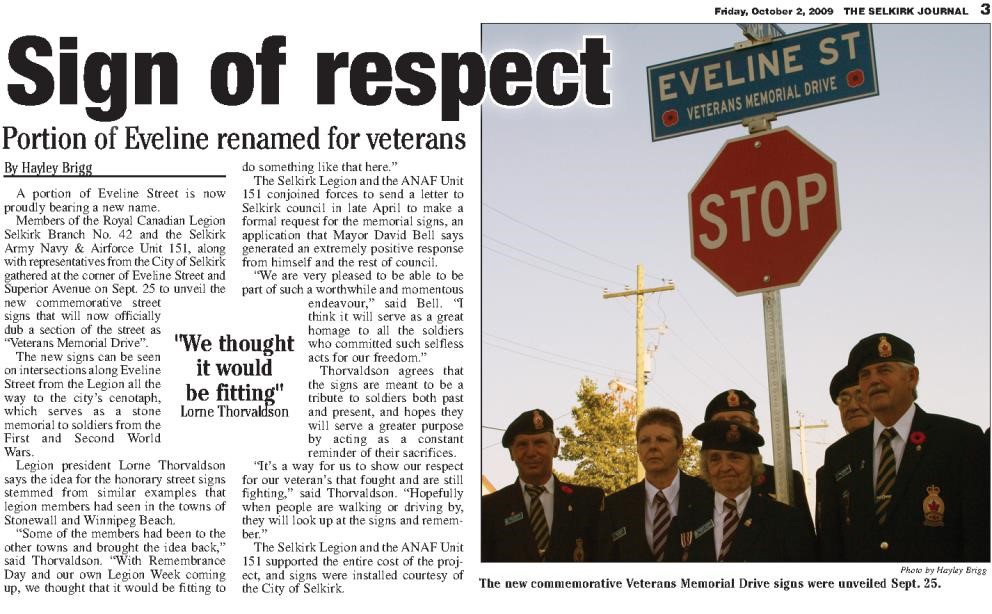
The Legion’s first home in Selkirk was an L shaped, white, shiplap building on the corner of Eveline Street and Superior Avenue. It was small and limited to providing a beverage room for members. The only entertainment was conversation. All other larger Legion gatherings occurred at the hotels or halls. From its official opening in the fall of 1927 to the financial market crash of 1929 and the Great Depression to follow, the 42 Branch limped along on the brink of financial ruin.
The Great Depression
Not all Selkirk residents supported the Legion as it was seen as a place for agitators and organizers who expected too much from the government and drank too much. Although the 42 Branch wasn’t known for its agitating and organizing, there was an element of truth, especially in the latter. 1930 ushered in the Great Depression, and after years of berating the federal government about their poor treatment of veterans, the Veterans War Allowance Act was passed relieving the plight of many veterans, including ones in Selkirk. The 42 Branch then turned its attention to providing social evenings including instrumental duets and dances. The community hall was used “because there wasn’t room to swing a cat in the club.” (MacFarlane, 1977). All proceeds earned were dedicated to the relief fund. “The Legion was in a bad way. So was the town and every single business in it. Survival was a form of progress. Unemployment a way of life.” (MacFarlane, 1977).
“The Forty Second Branch stayed open because there really wasn’t any point to closing it.” (MacFarlane, 1977).
“It was probably at this time that the ultimate method of keeping beer on tap was devised. The method in its most simple form was to borrow whatever the membership could cough up in the way of loose change and then go out and buy a keg of beer. When that was gone another scrape ‘round was made and another keg obtained. On really bad days I’m informed by old-timers, it was only possible to raise the price of a pail of beer.” (MacFarlane, 1977).
“The Ladies Auxiliary of the Selkirk Legion was launched in 1934 and since that time, as every member knows, it has been an integral part of the branch. There have been specific projects: Dances, teas, parties, fund raising campaigns, book drives, bingos, and picnics without number, a busy total to an awesome contribution. But while picnics and projects are vital to the life of the club it is the spirit of the Ladies Auxiliary and the very compatibility of this arm that makes it so important to Selkirk. Deep down every member knows this. The Ladies Auxiliary is one half of the club, and the half, if you think about it that keeps the whole in balance. Where indeed would we be without the ladies?” (MacFarlane, 1977).
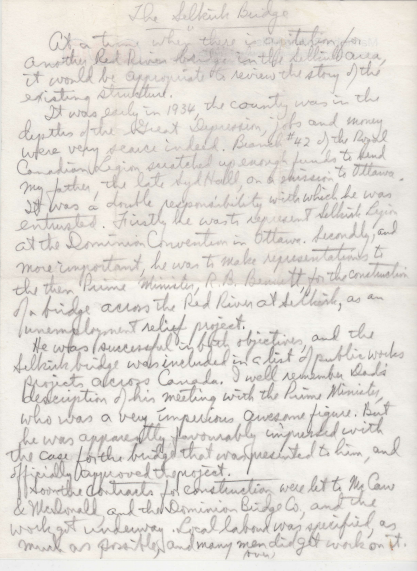
In 1934, despite low funds the Branch sent one Delegate, Mr. Syd Hall, to the national convention in Montreal. Hall was among the men that drafted the highly praised unemployment report, and he served on the committee that sponsored a resolution on peace and the League of Nations, the predecessor to the United Nations. Hall also stopped in Ottawa on his way home to talk to the Member of Parliament for Selkirk and the Prime Minister on relief problems in Selkirk. Hall returned to Selkirk and reported, “Among the proposals mentioned by Mr. Stitt (M.P. for Selkirk) which he hopes to get put through is the bridge at Selkirk, dredging and cribbing on a larger scale at the mouth of the river and other public works within the constituency as unemployed relief projects. Mr. Stitt assured Mr. Hall that he was doing everything possible to get his proposals through, and wished to assure the residents of Selkirk and district that he would leave no stone unturned to achieve this object.” (MacFarlane, 1977). The Dominion Command was so impressed with Hall that he was honored for his efforts by being appointed as a member of the Dominion Council of the Imperial Division of the Canadian Legion; an honor shared with his comrades at the 42 Branch.
Legion Christmas Party
The Branch continued to offer entertainment throughout the 1930s, with Christmas being of particular importance. “Over the years the Selkirk Legion’s Christmas party for the children has been a club highlight. During the lean years it had a special magic for young and old alike. It was a time of giving and enjoying the act of giving. For the children of veterans who had fallen on hard times it was often the only bright Christmas light, the only real moment in which they could experience the excitement and the wonder of the holiday season.
There were also many adults over the years who looked forward to Christmas and the generosity of the membership. Times were hard but for some they were close to impossible, and no one will ever be able to tally the countless gift and food hampers that went out to ease some veterans, and even non-veterans’ unhappy lot.” (MacFarlane, 1977). Christmas was followed by a New Year’s party that was the Branch’s opportunity to usher in the New Year with “an unabashed bash” for the members.
Clubhouse Setbacks
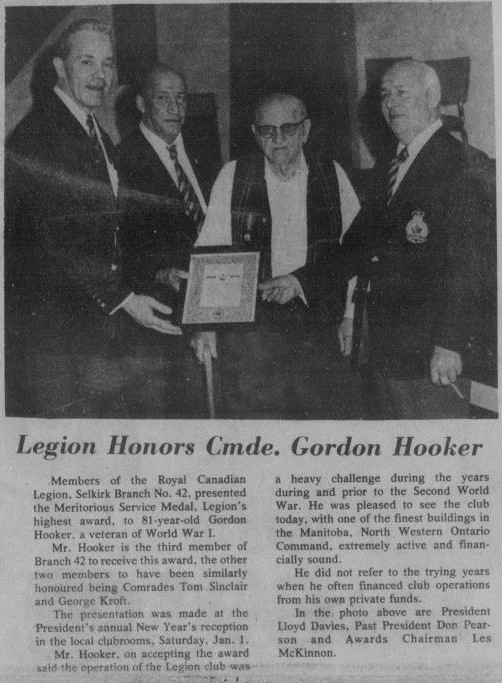
On the bitterly cold morning of January 1, 1935, the clubhouse for the 42 Branch burned to the ground. The firemen worked in shifts in windy -40c conditions hoping to prevent further spread to neighbouring buildings. Legion member and fireman, Gordon Hooker, showed concern over a large chimney in the burning building becoming more of a hazard as flames weakened the structure and high winds pressed on the chimney. “Gordon Hooker is not too clear on the specific details, but he does remember that at some point the chimney did collapse and as it fell portions of it struck him in the face. His injuries were unpleasant, and he was hospitalized for a short time. The scars are with him today. Gordon also remembers that the Legion gave the firemen a barrel of beer that night which he thought was a nice gesture. The only thing wrong with the gesture he recalls, the beer was warm.” (MacFarlane, 1977). The burning of the clubhouse in the height of the Great Depression was the kick that the 42 Branch didn’t need. But, despite non-existent funds and a small membership, the executive announced that temporary quarters would need to be found and plans for a new clubhouse would follow.
Community Affairs
As the decade progressed the economy continued to languish and rumblings about Mussolini and Hitler were appearing in the press. Canadian editorials started suggesting that the government spend more money on the reserve army. In 1938 a meeting of the Legion branches was hosted by the Selkirk Legion. “The very interesting thing about this meeting is that it is the first time we have a record of the District stating publicly that Legion branches were now becoming more involved in community affairs not necessarily affecting the individual veterans but of the benefit to the community at large. It was also reported at that meeting that membership throughout the entire area was up. This was perhaps most noticeable in the Selkirk Legion.” (MacFarlane, 1977). At the closing of the meeting it was stated, “No man is too big and no man is too small to be a member of the Canadian Legion, so long as he qualified himself for membership by serving the empire when the empire needed him in time of war”. (MacFarlane, 1977).
Curious to learn more about the Selkirk Royal Canadian Legion? Check out part two of the exhibit.
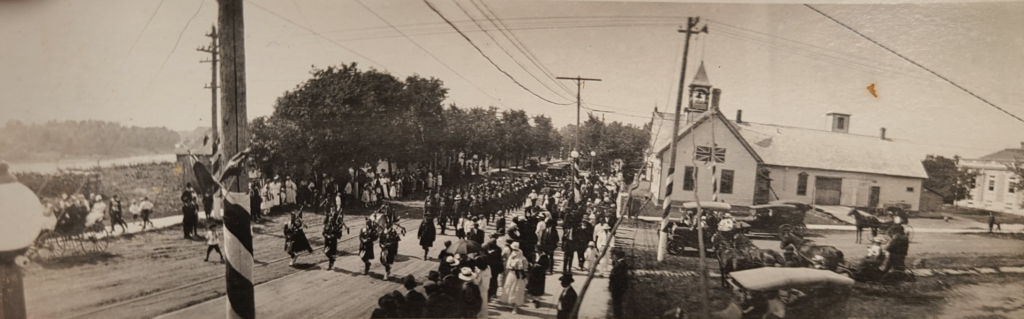
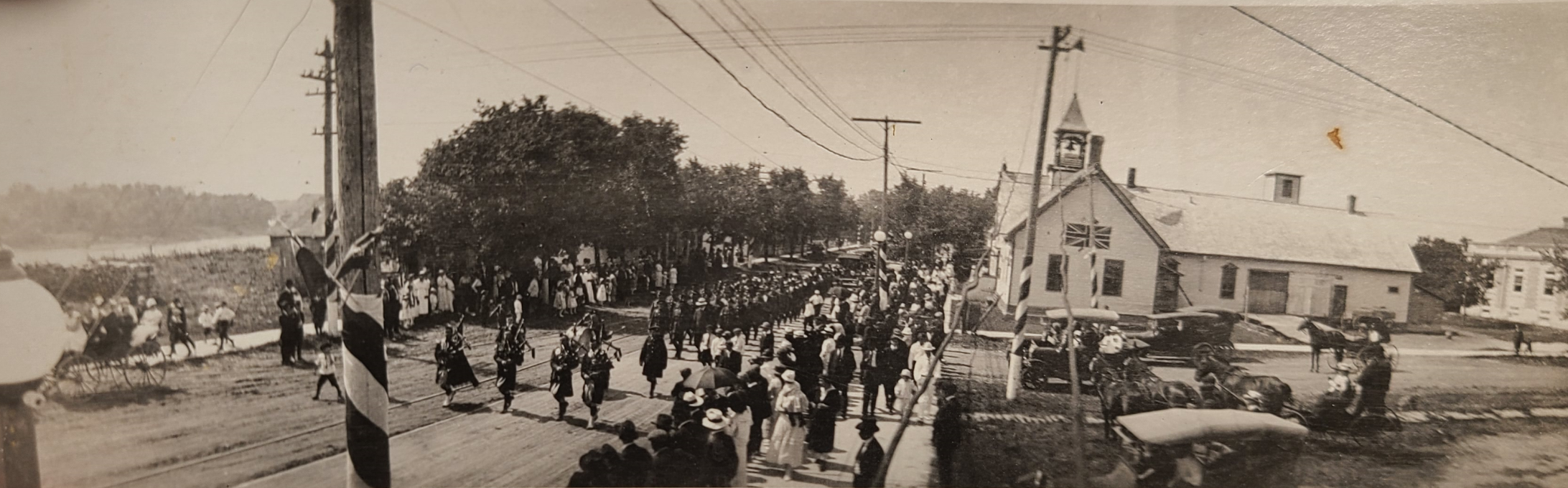
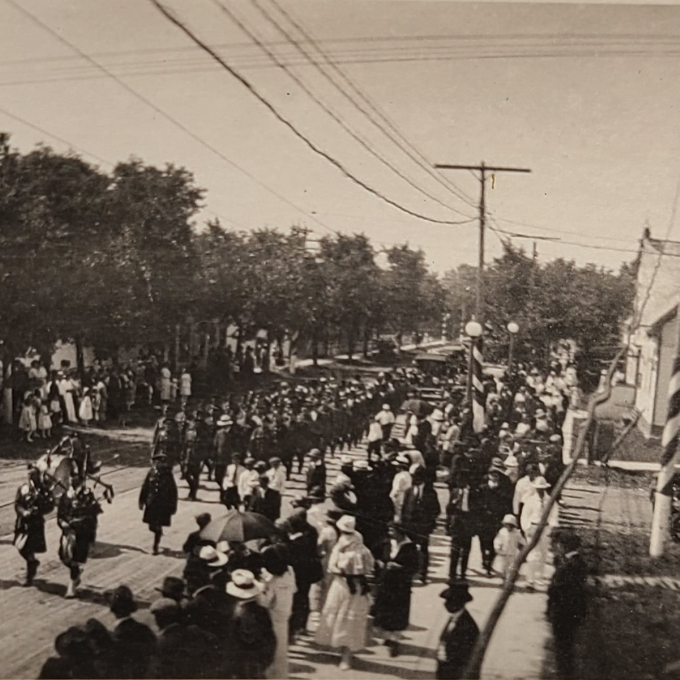 Bagpipe Players and Veterans Marching Down Eveline, 1919, Selkirk Museum Collection

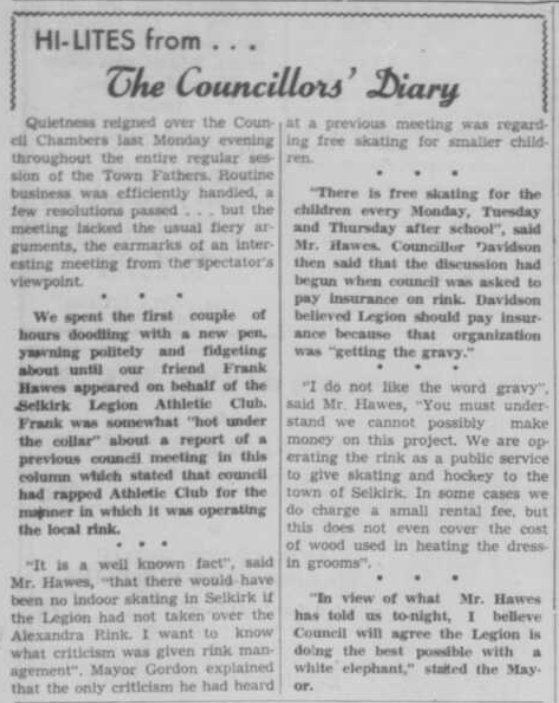
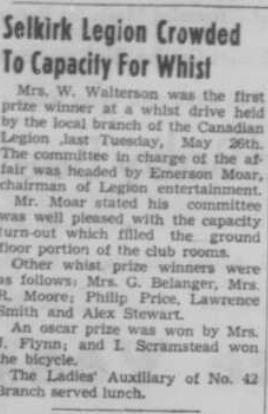
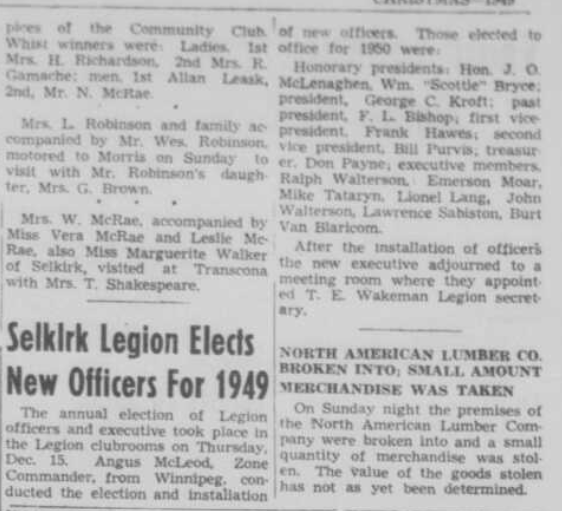


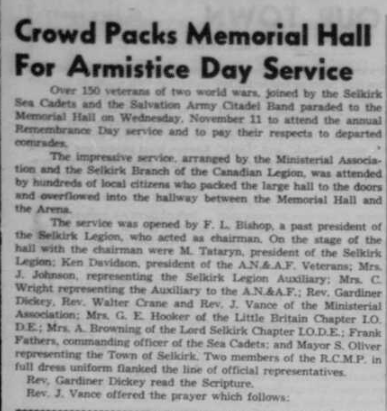
Sources
Selkirk Enterprise, October 12, 1977
Macfarlane, Malcolm Macleod, The Forty-Second Branch: The Royal Canadian Legion, Branch 42, Selkirk, Manitoba, Canada, (Gordon Publishers, Selkirk, MB), 1977
Selkirk Journal, 1999, 2002, 2003, 2007, 2010, 2012, 2014, 2017
Winnipeg Free Press, May 27, 1983
www.legion.ca