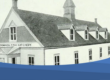
In February 1946, a group of community members in Selkirk banded together and formed the Selkirk and District Memorial Committee. This Committee was led by their Chairman, Louis G. Howard. The main objective of the committee was to decide on a place to create a memorial for the servicemen and women of the region who were killed during World War I, World War II, the Boer War, and later, the Korean War. The committee, in response to this effort, decided to build Memorial Hall, located on Jemima Street.
The sod turning ceremony to build Memorial Hall took place on September 21, 1951. Construction of the hall was undertaken by Architect Company Prain and Ward, which was led by Edgar Prain and James Thomas Laurence “Laurie” Ward. Construction went smoothly, and the completed hall included a modest chapel inside.
The Memorial Chapel was opened in tandem with Memorial Hall. Memorial Chapel was dedicated on the evening of January 17, 1952, at the same time as Memorial Hall. The dedication was attended by community members, Town of Selkirk staff, veterans’ organizations and the Selkirk and District Memorial Committee. Wreaths were hung by the various organizations that were in attendance and Reverend R. N. R. Holmes, a Naval Chaplain who served in World War II, performed the blessing.
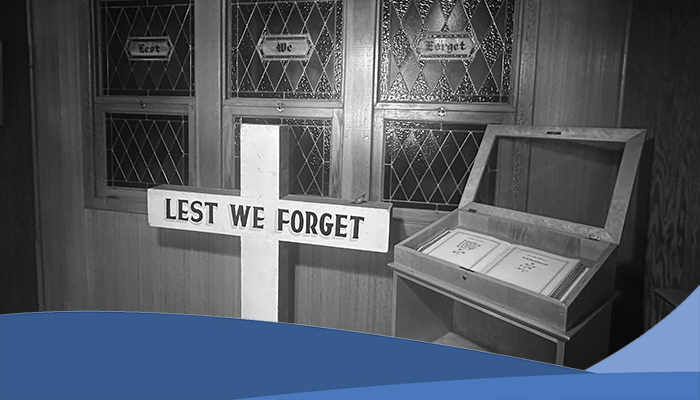
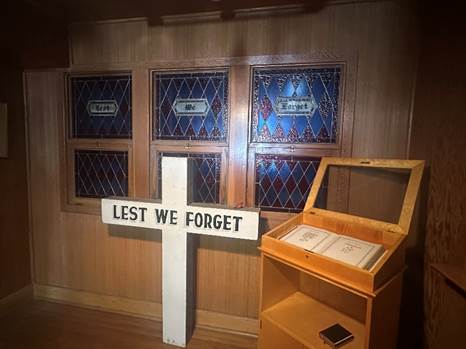
Memorial Chapel was described in newspapers at the time as a quiet chapel that could be used for meditation for those who need it. The chapel is a small room with one small pew located by the door into the chapel. The pew faces a large white cross that is titled, “Lest We Forget”. Behind the white cross, there are three stained glass windows that also bear the words, “Lest We Forget”. The stained-glass windows are made up of red and blue diamond shapes that lie in alternating patterns. The words, “Lest We Forget” are on white horizontal pieces that are on the top window. There are latches on each of the three windows which allow the bottom of the window to open. This most likely would have led to the outside so the sun would shine through these windows until the Soup kitchen was added to Memorial Hall in later years.
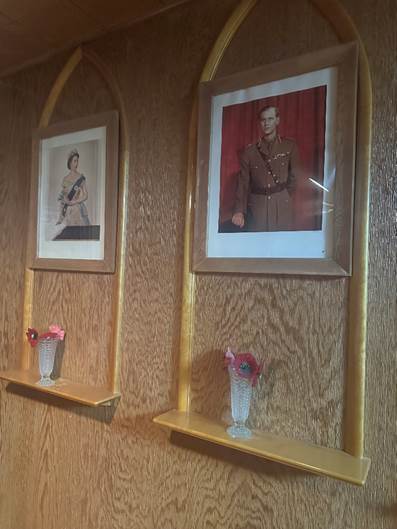
On the side walls of the chapel, there are remnants of a more Gothic style in architecture, such as the wooden arches that are on the wall. Each arch has a small crystal vase, which was used to hold flowers. On the right-hand wall, there are two arches which contain the images of Queen Elizabeth II and Prince Philip.
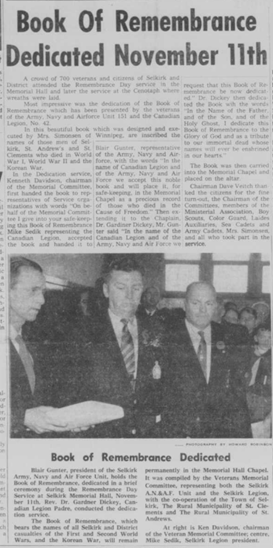
Memorial Chapel contains a small glass case that holds a Book of Remembrance compiled by the Selkirk and District Memorial Committee. This book holds the names of all of the fallen servicemen and women from World War I, World War II and the Korean War. The book was rededicated to Memorial Chapel on Remembrance Day in 1959 after the names of servicemen and women who served in the Korean War were added.
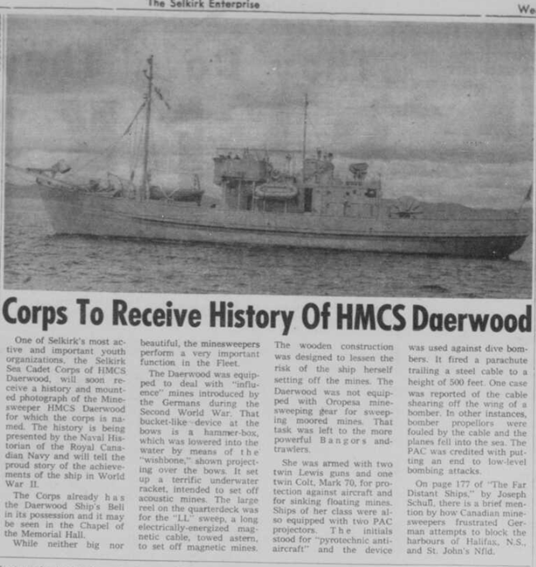
In July 1959, the Selkirk Sea Cadet Corps of HMCS Daerwood received the bell from the ship HMCS Daerwood, which was a minesweeper in World War II. The Corps decided to showcase the bell in Memorial Chapel as a tribute to the history of mine-sweeper ships during World War II. The bell was eventually given to the Naval Museum at the HMCS Chippawa building located at 1 Navy Way.
The HMCS Daerwood was built at Vancouver Shipyards Ltd. in Vancouver, BC and was commissioned on April 22, 1944. The name Daerwood was chosen to honour Selkirk by the Royal Canadian Navy, as the British Navy already had a ship named Selkirk.
Another piece of military history that can be found in Memorial Hall, right outside Memorial Chapel, is a plaque that is dedicated to the 108th Battalion, the infantry unit of the Great War Canadian Expeditionary Force. This is a bronze tablet that was created to honour the 161 members of the 108th Battalion who died in World War I. Originally, this bronze tablet was unveiled at the Carnegie Library in Selkirk in August 1923 by Mayor Peter James Smith and Senator Colonel George Henry Bradbury. The Battalion had been stationed in Selkirk for several months with the purpose of recruiting soldiers throughout Manitoba.
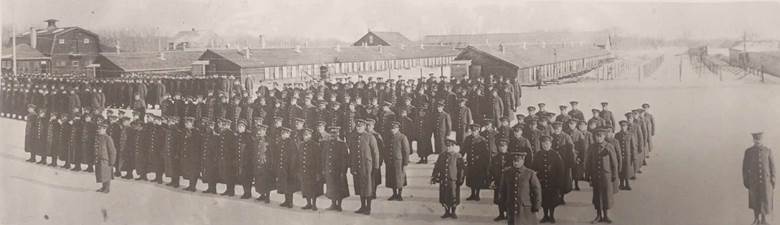
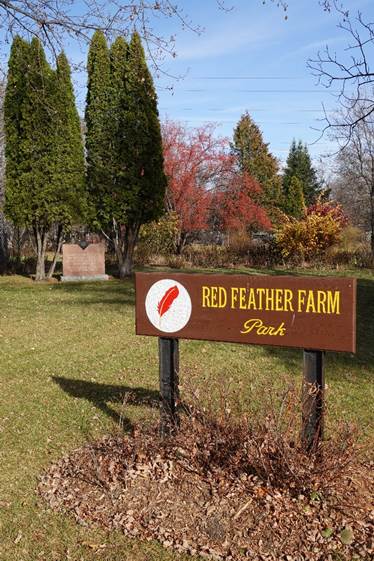
The 108th Battalion is associated with Red Feather Farm. While the battalion was gaining new recruits, the recruits stayed at Red Feather Farm in Selkirk to receive their initial training before being sent to Camp Hughes. Red Feather Farm is located at 163 Edstan Place and was once a 37-acre farm. Portions of the land were sold off over the years, and what remains is now a park.
Use of Memorial Chapel in Memorial Hall began to decline in 1960, with fewer and fewer Remembrance Day ceremonies being held in this location. Though it is rarely used today, the chapel still holds an important place in how Selkirk has chosen to remember those who served in World War I, World War II, and the Korean War.
Memorial Hall Chapel Collection
Sources
Memorial Hall, Selkirk Museum
Manitoba Business: Prain and Ward / Ward and Macdonald / Macdonald Cockburn McLeod and McFeetors / MCM Architects, Manitoba Historical Society Archives
Historic Sites of Manitoba: 108 Battalion War Memorial (376 Jemima Street, Selkirk), Manitoba Historical Society Archives
108th Battalion, Selkirk Museum
Red Feather Farm, Selkirk Museum
HMCS Daerwood, Naval Museum Manitoba
HMCS Daerwood, Government of Canada
Selkirk Enterprise, September 1957
Selkirk Enterprise, September 1951
Selkirk Enterprise, October 1951
Selkirk Enterprise, July 1959
Selkirk Enterprise, January 1952
Selkirk Enterprise, May 1950
Selkirk Enterprise, October 1950
Selkirk Enterprise, November 1959
Selkirk Enterprise, October 1953
Selkirk Enterprise, November 1953
Selkirk Enterprise, March 1954
Selkirk Journal, December 2002
Selkirk Journal, September 1990