
Knox Presbyterian Church began in a modest log-and-plaster cabin with a thatched roof that was purchased for $50. The congregation grew quickly, and by 1880, they raised $1,650, with Richard Dixon beginning the construction of a larger church.
The current church was designed in 1903 by Samuel Hooper, and the construction began in 1904. The church’s reconstruction addressed the issues surrounding the early foundations on which the church sat. The reconstruction replaced the old fieldstone with a stronger stone foundation. The contractors kept much of the original woodwork from the church and installed two large stained-glass windows. After installation, one window was dedicated in memory of William Gibbs. William Gibbs was known for being one of two bakers in Selkirk during the late 1800’s, aside from this he was a member and elder of Knox Presbyterian Church. The other window is dedicated to the memory of Laurence (also spelt Lawrence) and Ann Moncrieff. Laurence and Ann were early members of the Knox Presbyterian Church, Laurence is also remembers as being connected for many years with the Hudson’s Bay Company with his service mainly being centred in York Factory. The Moncrieff family moved to St. Andrews in 1875.
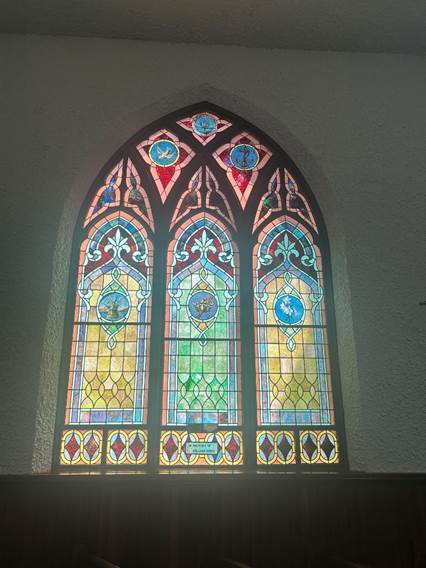
The window dedicated to William Gibbs contains 17 different panels, which vary in size from large to small. The larger panels in the center of the window have arched tops with a floral design of darker blues, lighter blues and reds. The three center panels mirror one another. The middle panel is mainly green glass, with the two outer panels being mainly yellow. Closer to the top of these panels, there are three ornate circular images. The three images are of a bushel of grain, a crown with a cross through it, and Easter lilies. The very top of the window also includes three more designs, the first being a dove, the second being an image of the burning bush with the Latin phrase “Nec Tamen Consumebatur” which is translates to “And yes it was not consumed.” The final image is that of an anchor with a rope tied around it. The colours that are used for the window are translucent, which allows light through without allowing the view of the outside world into the chapel.
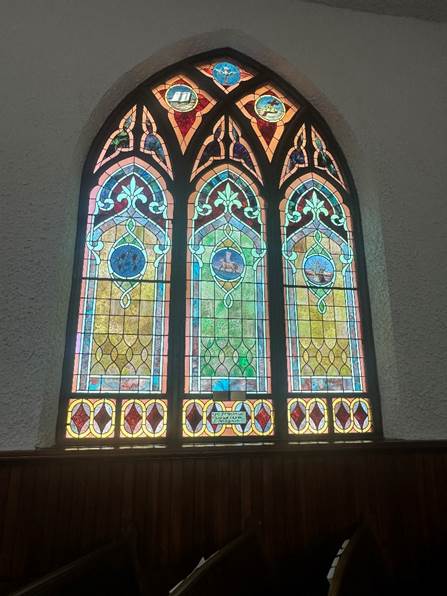
The window dedicated to Laurence & Ann Moncrieff is designed in a similar way as the window dedicated to William Gibbs. The imagery on this window is slightly different than the imagery on the other. The top three images on this window are an open book, the next is a dove with what looks like a ray of light shining from it and the crown with the cross through it. In the middle panels, the images are four bunches of grapes on vines, a lamb holding a flay with a cross on it and a bushel of grain.
Both stained glass windows have small metal plaques that explain that the windows were created in memorium. The plaques also list their original installation date of 1904 and their restoration dates of 1981. Specific donor details are also included under the windows. The window in memory of William Gibbs has two small plaques that are side by side, one explains that it had been restored via the donations of the Memorial Fund. The other plaque beside the first notes that the upper nine panels were restored in 2017 with donations from the Sir Thomas Cropo Foundation Inc., the Thomas Sill Foundation Inc., and the Selkirk & District Community Foundation. The other window dedicated to Laurence and Ann Moncrieff has two plaques as well, the first plaque reads that it was installed in 1904 and restored through the generous contributions of Anna Hovey and Knox Memorial Fund in 1980.The second plaque beside the first on this window explains the funding for the restoration of the window in 2017 by the same companies who restored the window dedicated to William Gibbs.
In the 1960s, Knox Presbyterian Church would undergo some more renovations. During these renovations, Knox Church commissioned Leo Mol, born Leonial Molodozhanyn in Ukraine in 1915. Mol emigrated to Winnipeg in 1949, where he worked as a ceramic artist, painter, and stained-glass artist. Over his career, Leo designed over 80 stained glass windows for churches all over Manitoba, with Knox Church being one of those Churches.
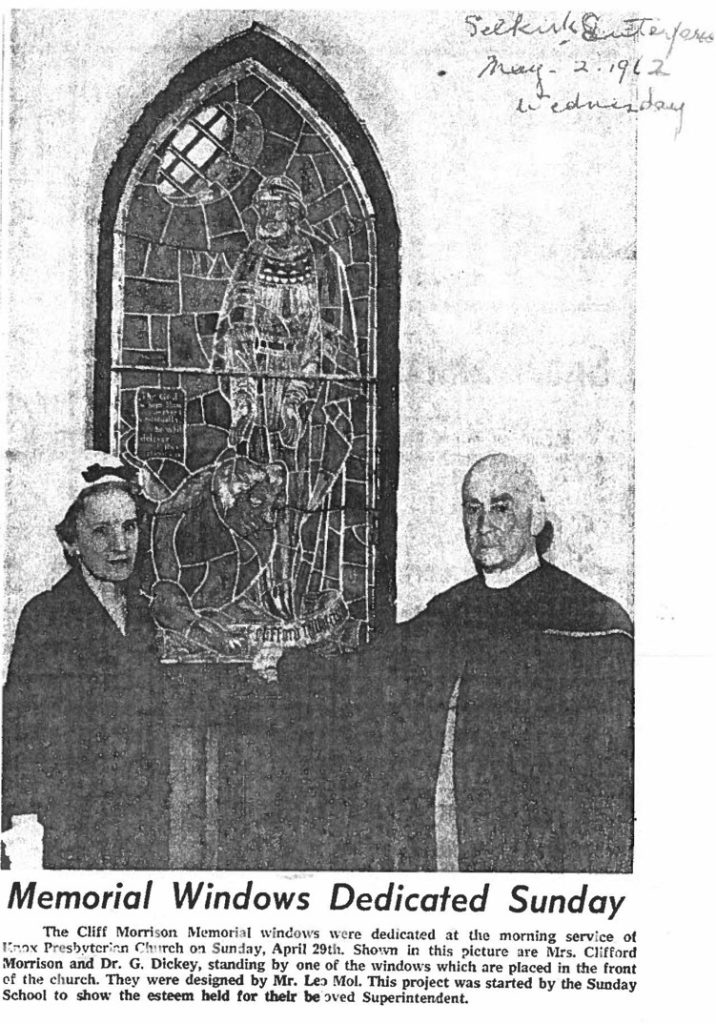
For Knox Presbyterian Church, Leo Mol designed 3 smaller stained glass windows, one of which is his design called “Daniel in the Lions Den”, another is called “The Good Shepard”, the third window does not have a known official title but contains an image of three angels. The window “Daniel in the Lions Den” and the Three Angels window are both dedicated to Clifford C. Morrison. Clifford Morrison was born in East Selkirk, and Clifford’s involvement with Knox Church would start with his marriage. Clifford was an active lifelong member of Knox Church through his roles as an elder at the church, a member of the board of Managers, Superintendent of the Sunday school, and an active member of the Young People’s work. Clifford participated in the church choir, where he led his favourite hymn, “Dare to be Daniel.” This inspired the Daniel in the Lions’ den window.
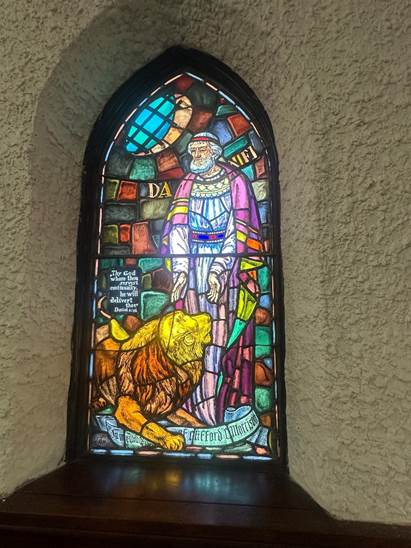

The “Good Shepard” window was dedicated to Dr. Gardiner Dickey, who was a former minister of Knox Presbyterian Church. Gardiner Dickey was born in Belfast, Northern Ireland in 1889 and came to Canada as a young man. He received his B.D. from Knox College in 1928, and in 1941 he earned his PhD from the American Theological Seminary. He went through several ministerial positions before coming to Selkirk. Dr. Dickey was the minister of Knox Church from 1944 until he died in 1963. He lived just west of the church in a large grey house known among parishioners as “The Manse.” The window that Leo Mol had created for Dr. Dickey is strategically placed to face the direction of his old home.
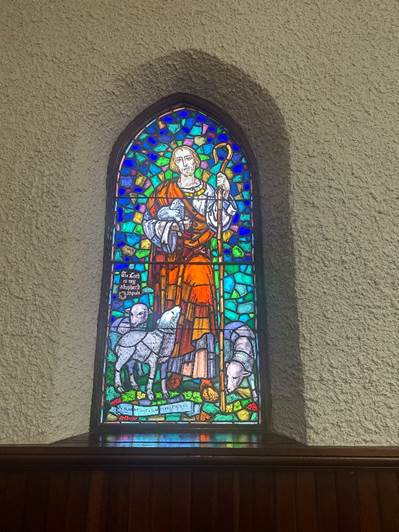
The windows that were made by Leo Mol are all ornately detailed with bright and vibrant colours. Though smaller in size, these stained-glass windows reflect a newer design style for Knox Church.
Sources:
Knox Presbyterian Church 125th Anniversary by Dr. Ralph Roberson and Joy Laye
Memorable Manitobans: Leo Mol (1915-2009), Manitoba Historical Society
Memorable Manitobans: John James Moncrieff (1866-1939), Manitoba Historical Society
Selkirk Enterprise, 1952