
Stained glass windows have been a part of the histories of churches since around the 7th century. Much like the rest of the world, stained glass windows have also gone through changes in their construction, what they represent, and how they are displayed!
Christ Church, located at 227 McLean Ave, has a long and rich history. The church itself is beautifully designed and contains carefully crafted and beautiful stained-glass windows. The oldest window in Christ church was made in 1900, potentially by Joseph McCausland, a well-known stained-glass window designer and manufacturer from Toronto. This window is called the Good Shepherd Window and is located above the entrance into the church.
The window is beautifully designed with an arch that highlights the image inside. This arch symbolizes the timelessness of biblical lessons. The background of the window is tinted with various colours of blues, greens, browns and pinks.

Ornately crafted, this window depicts Jesus carrying a lamb and a shepherd’s hook. There are three sheep at his feet. Behind the central figures, there are rolling hills of green with trees and shrubbery. In the top right-hand panel, there is an intricately detailed building, impressive for such a small image. The main figure in this window is vibrantly dressed in red and blue robes, making him stand out against the softer palette of the background.

Later windows created for Christ Church were designed and made by Ernest Ashcroft in consultation with the parishioners of Christ Church. Ernest Ashcroft was an internationally known stained glass window creator. He designed six stained-glass windows for Christ Church, including the Pentecost Window, the Advent Window, the Lenten Window, the Christmas Window, the Epiphany Window, and the Easter Window.
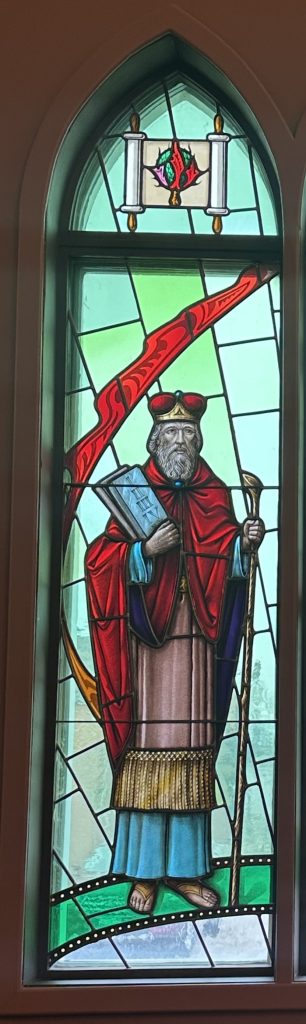
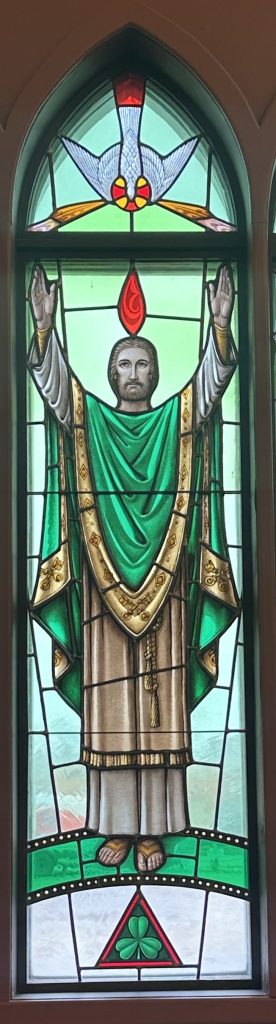
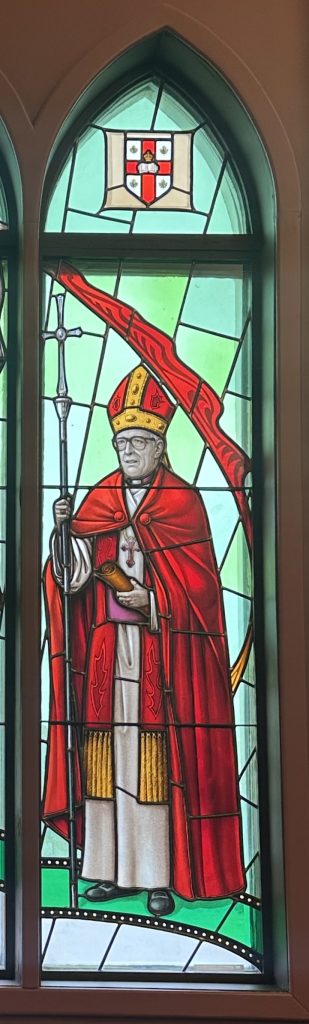
The Pentecost Window contains three main figures: Moses on the left, Peter in the middle, and Archbishop Edward Scott on the right. The background is a vibrant light green, with the three men standing on a darker green base. Above all three men in an arching shape is the Flames of the Pentecost. The image was taken from a painting that was done by a parishioner, Clarence (Clar) Brady, where the flames represent the presence and gifts of God.
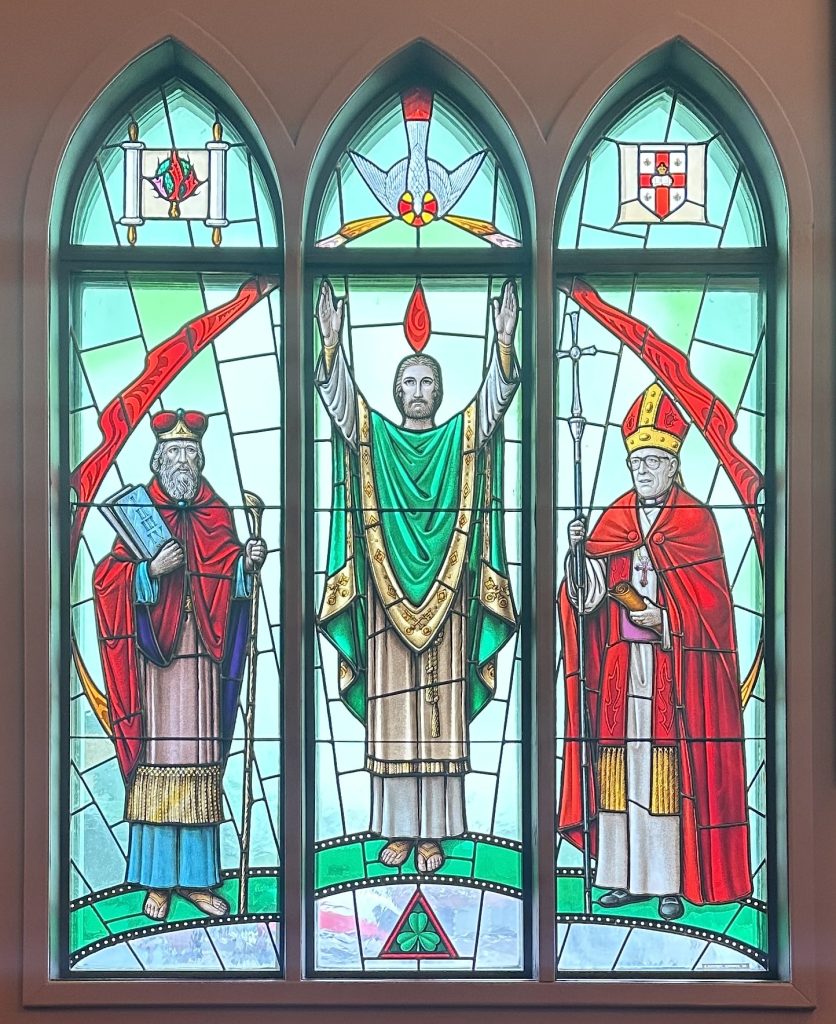
Moses is depicted holding the 10 commandments in one arm and his walking stick in the other. He wears a cloak of red, and his clothes are blue and yellow. On top of his head is a crown or cap, and above him is a scroll depicting the burning bush through which God spoke to him. The walking stick that Moses carries is meant to represent his authority and calling.
The middle figure is Peter, who is remembered as the spokesperson for the disciples of Jesus. He is pictured with his hands up and wearing robes of green, gold, and white. A gold border on his robe features keys, symbolizing the keys to the kingdom and signifying repentance and absolution. Above him is pictured a dove, which is meant to signify the Holy Spirit. Below Peter is a three-leaf clover.
Archbishop Edward Scott was the primate of the Anglican Church of Canada between 1971-1986. He was well recognized in the community for his service to the Anglican church and was awarded the Pearson Peace Prize medal in 1988. In the window, he is depicted wearing his archbishop’s robes, holding the primate’s cross and a scroll, which represent faithfulness and wisdom. Above him is a shield, this shield represents the Anglican Church of Canada.
The Advent Window
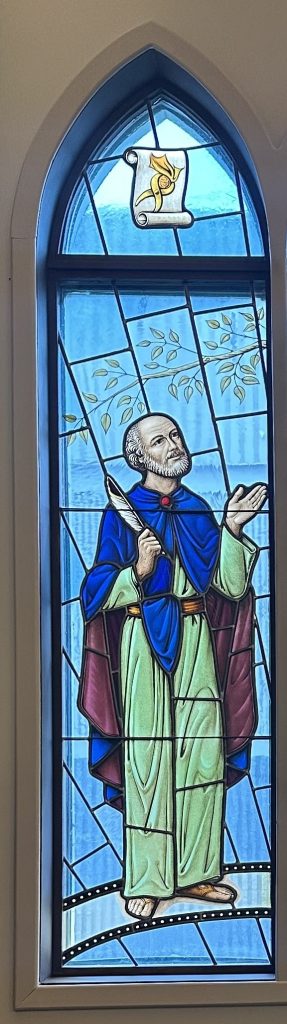
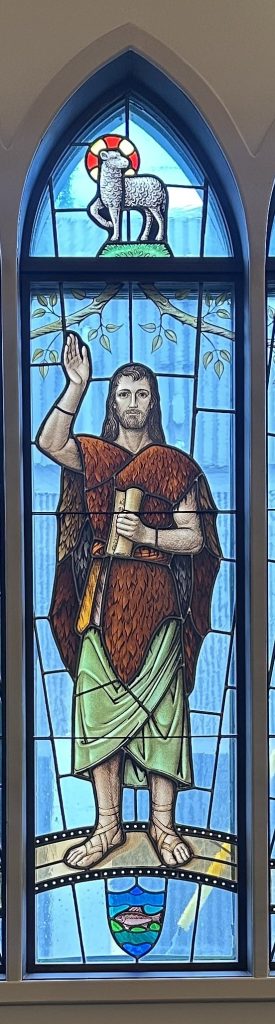
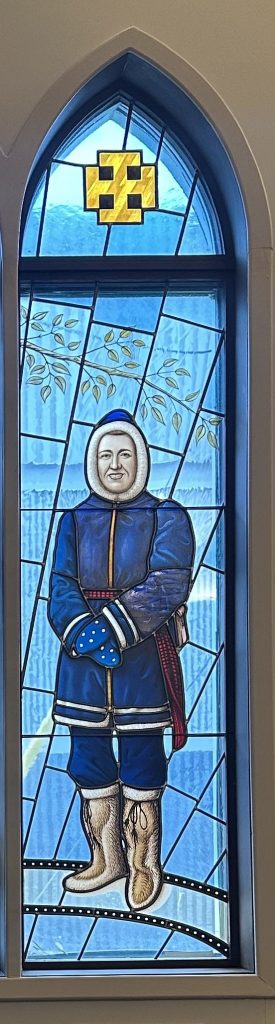
The Advent Window’s theme is to showcase those who had been called to prepare for Christ’s coming. Pictured on this stained glass are the three figures: Isaiah, John the Baptist, and Alice Mitchell. The background of this window is a light blue with some white in it, which almost resembles the sky on a sunny day. Above all three figures is an arching vine. This was inspired by the biblical quote, “I am the vine. You are the branches.”
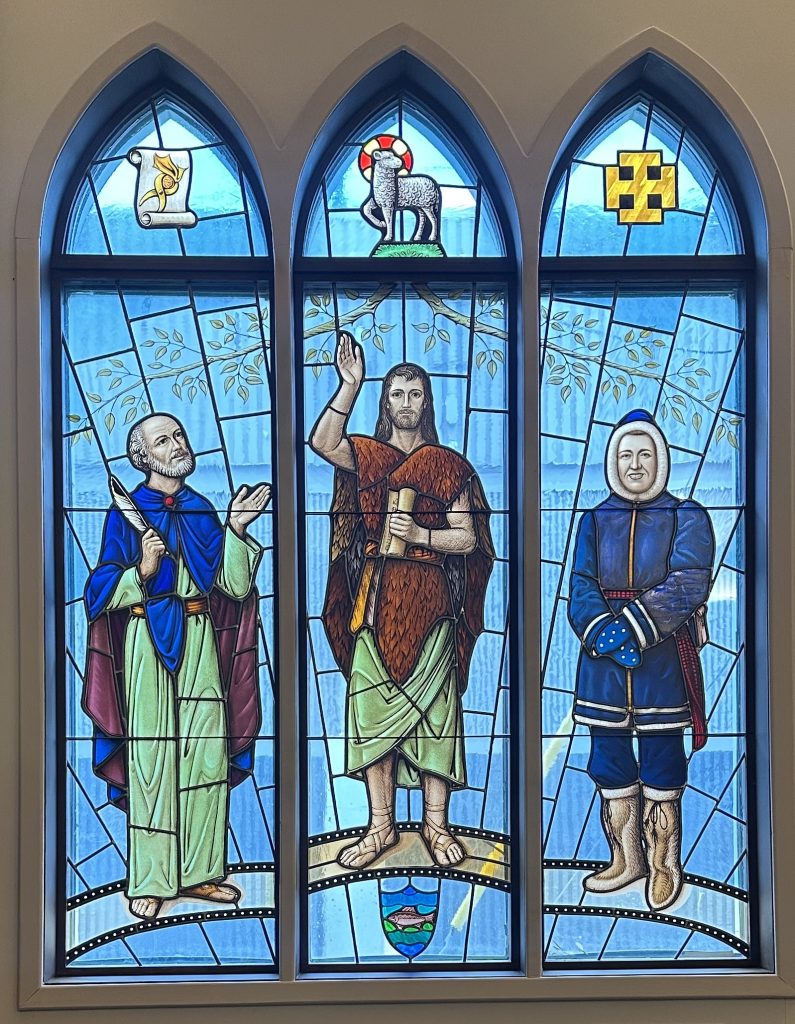
The panel with Isaiah pictures him wearing green with a rich robe of blue and red. His eyes are aimed at the sky. In his hands he holds a quill. Isaiah was the prophet who had foretold the birth of Christ. Above him is a scroll, on this scroll is the image of tongs holding a burning piece of coal, this represents the coal that had touched Isaiah’s lips to show he had been purified and was doing God’s work.
John the Baptist is pictured in the middle of the window. He was the one to baptize Jesus. He is pictured wearing robes of green with a brown hide covering his shoulders. One of his hands points above him while the other remains in front holding a scroll. The image above, John is a lamb, this is a symbol of Christ. Below, John is the image of a fish which is meant to represent discipleship with the water above the fish representing baptism.
Alice Mitchell is depicted on the opposite side of John the Baptist. She trained as a nurse in Winnipeg and served during World War II. In her panel, she is shown wearing a traditional blue Inuit parka along with caribou or reindeer mukluks. Above her is the Potent Cross, a symbol of healing that was also used by the Women’s Auxiliary. The Women of Christ Church supported Alice during her service in Northern Manitoba, which is why she is honored in this depiction.
The Lenten Window
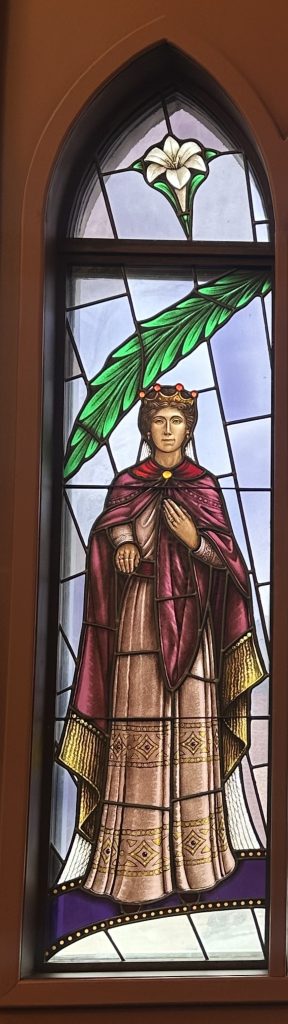
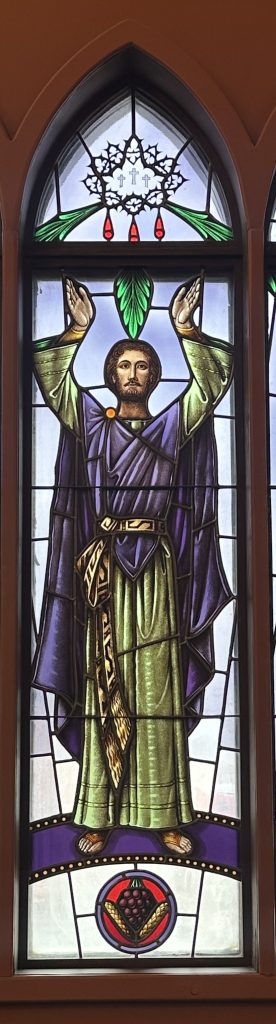
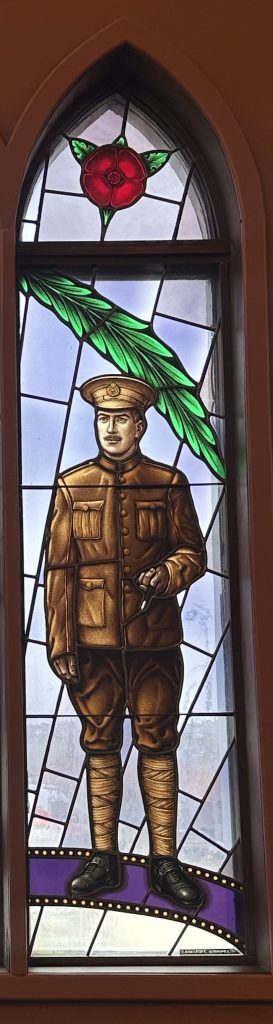
The main theme of the Lenten Window is the period of Lent. This window represents the sacrifices of Jesus in life and death. Three figures are represented on this window as well, the First is Esther who became the wife of the Persian King Ahasuerus (also known as Xerxes I), the second figure is Stephen, and the final figure is Roy Gilhuly. The background of this window is a mixture of rich purples, pinks and blues, reminiscent of the sun setting. Above all three figures is an arch of palm branches which are meant to remind parishioners of Jesus entering Jerusalem on Palm Sunday.
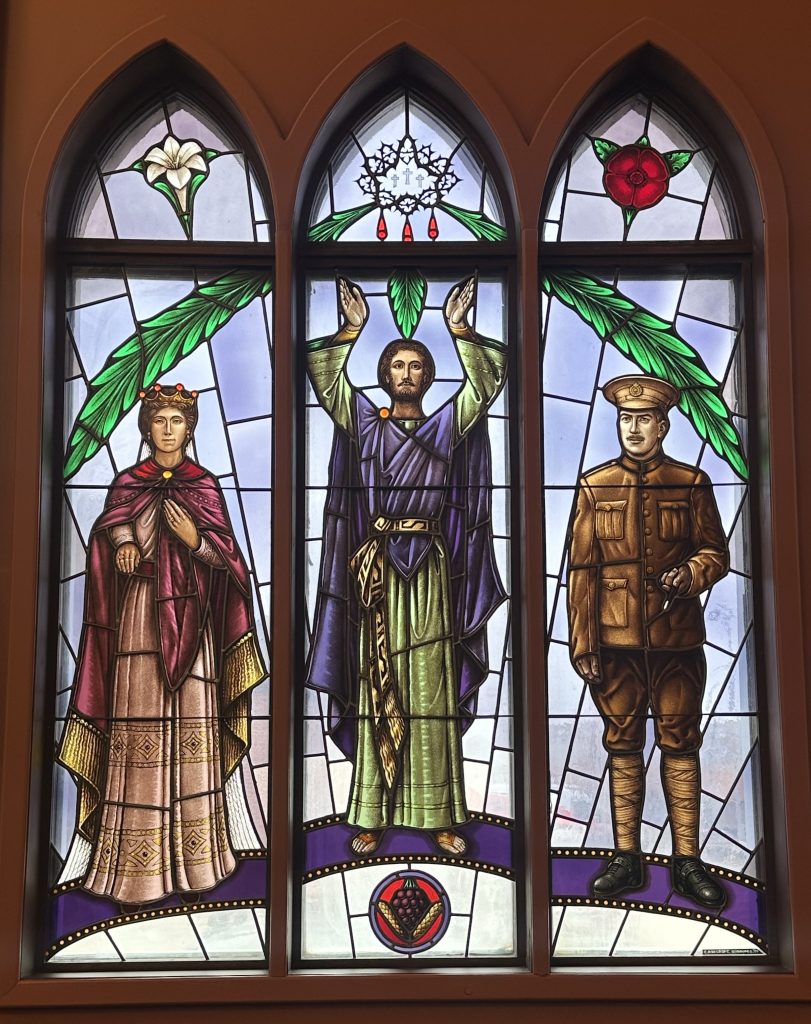
The first panel depicts Esther, a Jewish woman who took a great risk to grant her people freedom from her husband’s rule. She is depicted in a peach-coloured dress with red cloak with a crown on her head. One hand is held to her chest while the other is held out toward the viewers. Above her head is an Easter lily symbolizing life emerging from death, as Easter lilies bloom in spring from their bulbs.
The middle panel depicts Stephen, who had been appointed by the apostles to look after the poor. He was stoned to death after being accused of preaching disobedience to the ten commandments. In his panel, Stephen is depicted in robes of green and purple. Both of his hands are held above his head. Pictured above him are three crosses and a crown of thorns, which represent the crucifixion of Jesus on Good Friday. Below him is the image of grapes and wheat, these are meant to represent the Eucharist, which was instituted on Maundy Thursday by Jesus.
The final panel pictures Roy Gilhuly, who had been a member of Christ Church. He served in World War I and was the first person from Selkirk to die in battle when he was just 26. He is depicted wearing his military uniform. Above him is a poppy, which is the universal symbol of remembrance for those who died serving their country.
The Christmas Window
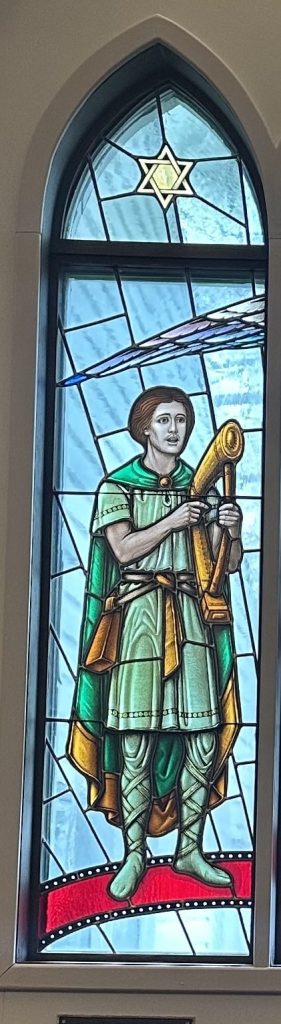
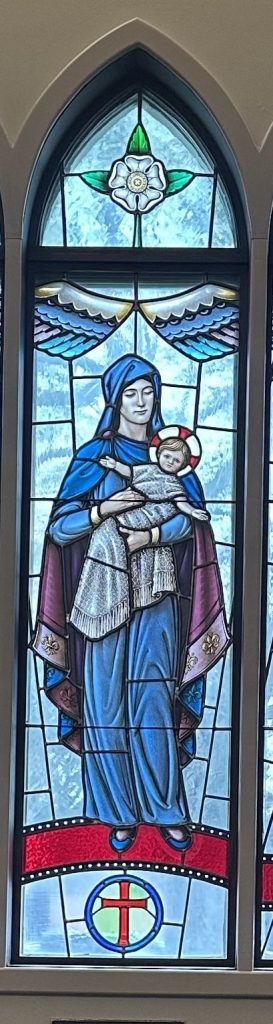
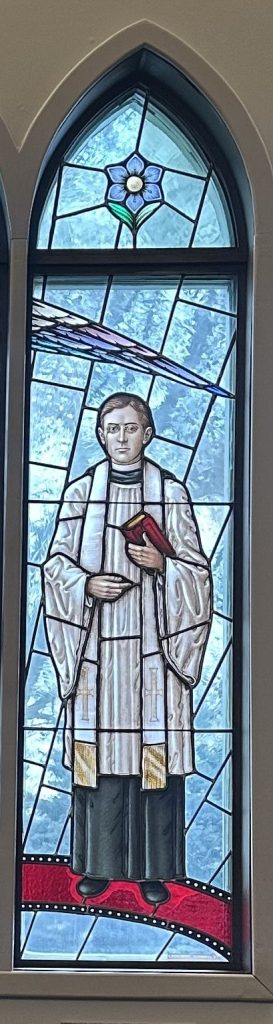
The main theme of this window is the gift of God of His son. The background of this window is clear, which allows for the view of the outside to come inside the church chapel. The three figures depicted on this window are David, the Virgin Mary and Jesus, and Jacob Anderson. Above all three figures is a pair of angel wings that are meant to represent divine presence that had manifested in all three figures’ lives.
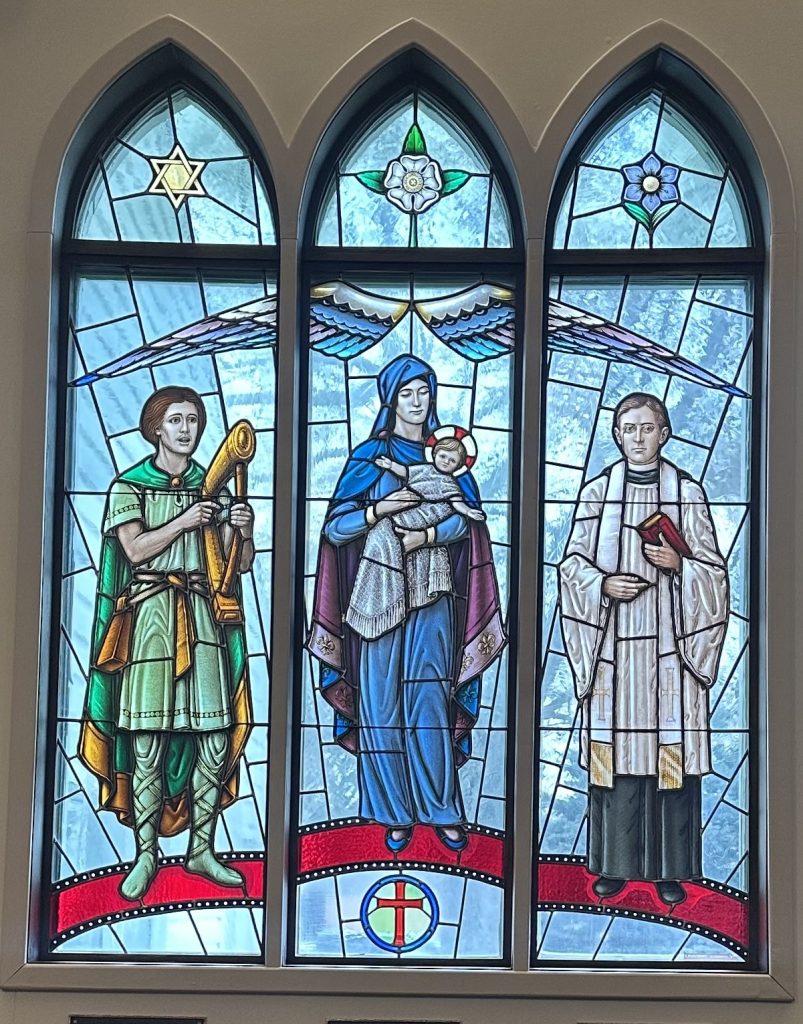
David is depicted on the first panel; he was remembered to be a skillful harpist who had been called to soothe King Saul. He is depicted in an outfit of different greens. His hands hold his harp to his chest. Above him is the Star of David which is also known as the Star of Bethlehem.
The middle panel depicts the Virgin Mary holding her infant son Jesus. She is depicted in her robes of blue holding an infant Jesus who is dressed in white swaddling cloth. On the edges of Mary’s robes are fleur de lis which are meant to represent and symbolize her purity and Jesus’s humanity. Above Mary is a white Christmas rose, which is the symbol of Mary. Below her is a cross. This is the cross of redemption with the circle of eternity around it to highlight the timelessness of the holy birth of Jesus.
The final panel hold the depiction of Jacob Anderson (1875-1962) who had been born in St. Andrews, Manitoba and served as the Archdeacon of Selkirk from 1932-1942. He is depicted wearing his vestments. In one hand he holds the bible. Above him is pictured the Prairie Crocus, which is the provincial flower of Manitoba.
The Epiphany Window
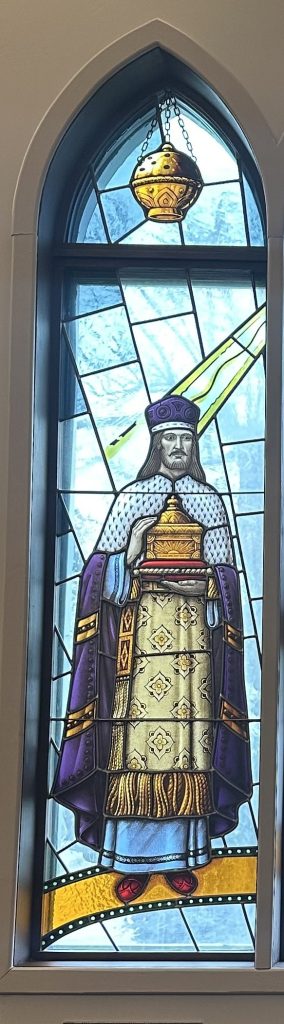
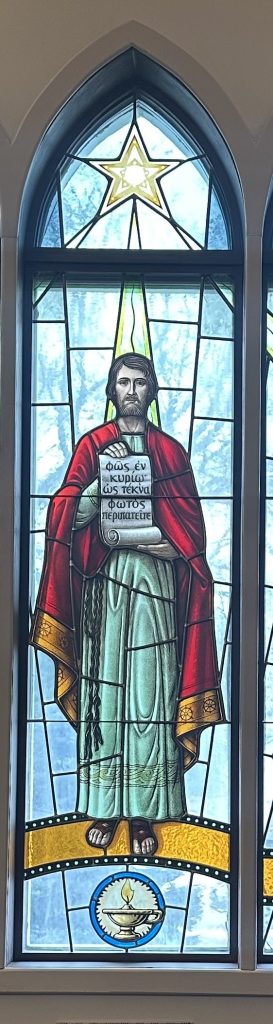
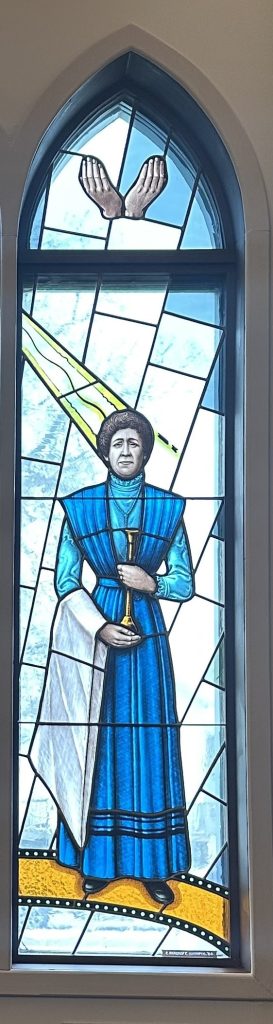
The main theme of the Epiphany Window is to represent all those who saw the light of God and acted upon their experiences. The three figures depicted in this window are one of the Three Wise Men who had brought gifts to the newborn Jesus, Paul, who was one of the apostles, and Catherine Jane Roberts. The background of this window is also see through which allows the outside views to come inside as well. Above all three figures is a ray of light that is cast from the star in the middle, which reinforces the theme of those who found the light of God.
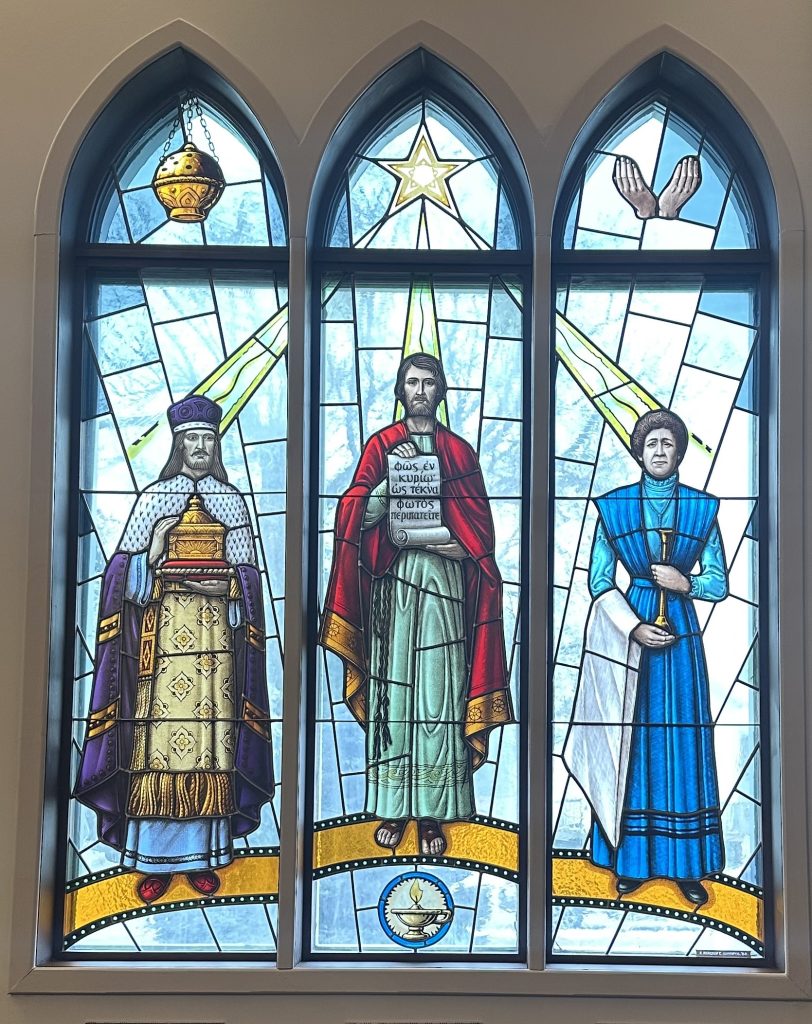
The first panel shows one of the three wise men who had traveled to Bethlehem to give gifts to the newborn baby Jesus. The three wise men had been guided by a star, the three wise men traveled from the east and carried with them the gifts of gold, frankincense, and myrrh. The wise man is wearing lavish robes of purple, blue and gold. Pictured above the wise man is an incense burner, which is representative of incense being a gift for purification, atonement and is symbolic of prayer.
Paul is depicted in the middle window, he wears robes of green, red and gold. Paul had been a part of the persecution of Christians and assisted in the martyrdom of Stephen. Paul, while traveling to Damascus, has a life-changing experience and he became a Christian. In his hands he holds a scroll that reads “You are light in the Lord: was as children of the light” which is another quote from the bible. Above him is the Epiphany star which spreads its radiance across the ages, drawing people to Jesus. Pictured below, Paul is an oil lamp with a flame.
Catherine Jane Roberts (1875-1952), who is the image meant to represent all the members of Christ church who have served God. She is wearing a blue dress; in her hands she is holding linen and a candlestick demonstrating that she is preparing the altar for service. Pictured above her is a pair of uplifted hands which are meant to represent the offerings of work and prayer.
The Easter Window
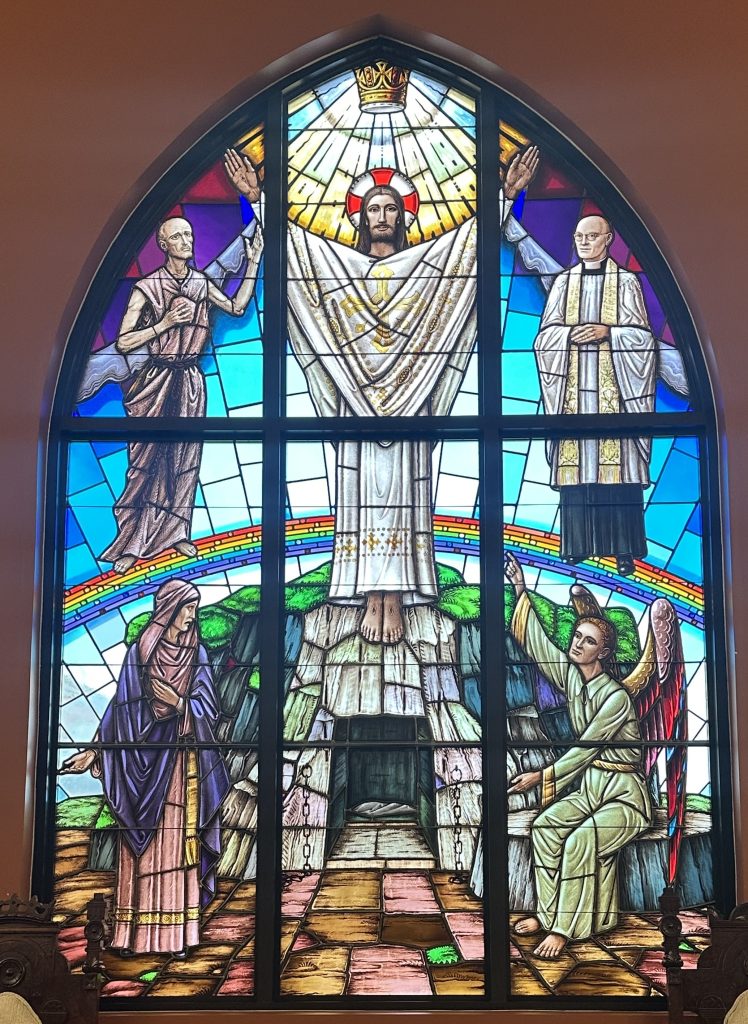
The final window in the church is the Easter Window. It sits in the middle of the chapel and is the largest window in the church. This window is incredibly detailed and colourful. There are five figures located on this window with the main three figures being Mary Magdalene, an angel and Jesus. The other two figures are Job (an Old Testament figure) who remained faithful to God despite all the trials he faced. The other is The Reverend Roy Spalding Montgomery (1885-1973) who was the rector for the Parishes of Christ Church and St. Clement’s from 1930-1950.
This window shows Jesus ascending to Heaven, while an angel comforts a distraught Mary Magdalene, showing her Christ’s ascension. The figures of Job and The Reverend Roy Spalding Montgomery are also seen as ascending with Jesus in this window.
The background of a scene depicting the heavens with the bright yellow rays, the sky, and a rainbow. The lower half of the window shows Christ’s tomb which is now empty. At the very top is a crown which represents God’s heavenly kingdom. The rainbow is meant to represent God’s eternal Covenant with his people.
Sources
The Stained Glass Windows of Christ Church Brochures
Christ Church Stained Glass Windows