
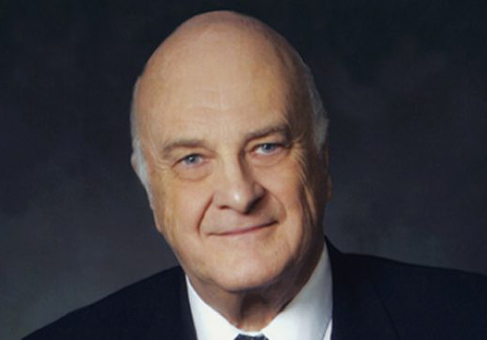
Howard Pawley built a career in law, education, and ultimately politics, becoming MLA for Selkirk from 1969–1988 and Premier of Manitoba from 1981–1988. He is known for initiatives like public auto insurance, senior housing, and bilingual legislation. He later transitioned to academia, teaching at universities as well as publishing a memoir reflecting his public life and values.
Education and Law
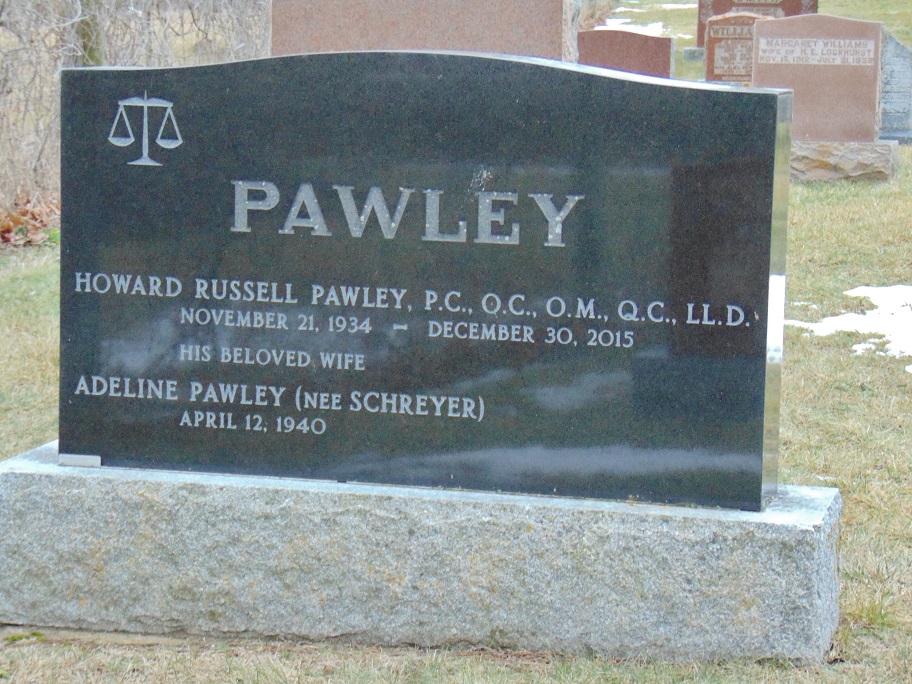
Howard Pawley was born in Brampton, Ontario on November 21, 1934. He grew up on a farm and attended Brampton High School. After his father sold the farm, the family moved to Winnipeg. Pawley attended the Manitoba Teachers College where he earned a teaching certificate. His first job was at South Plympton School in Springfield.
After a year of teaching, Pawley returned to post-secondary education to study law at United College. From there, he continued his studies at the Manitoba Law School at the University of Manitoba. While studying at United College, Pawley joined the Manitoba Co-operative Commonwealth Federation (CCF), which later became the NDP, where he worked for both the provincial and federal wings of the party. He was elected president at the age of 22, marking him as the youngest president in the party’s history.
After completing his studies, Pawley moved to Selkirk and opened a law office in Stonewall. He worked as a lawyer and an educator.
Launching a Political Career
Pawley launched his political career in the 1957 and 1965 federal elections, as well as the 1958 and 1965 provincial elections. He was unsuccessful in these pursuits but continued to work as an organizer for the Manitoba CCF and NDP.
In 1960, Pawley married Adele Schreyer, cousin to Ed Schreyer, who was Premier from 1969-1977. They had two children, Christopher and Charysse. Christopher later became a city councillor from 1995 to 2006.
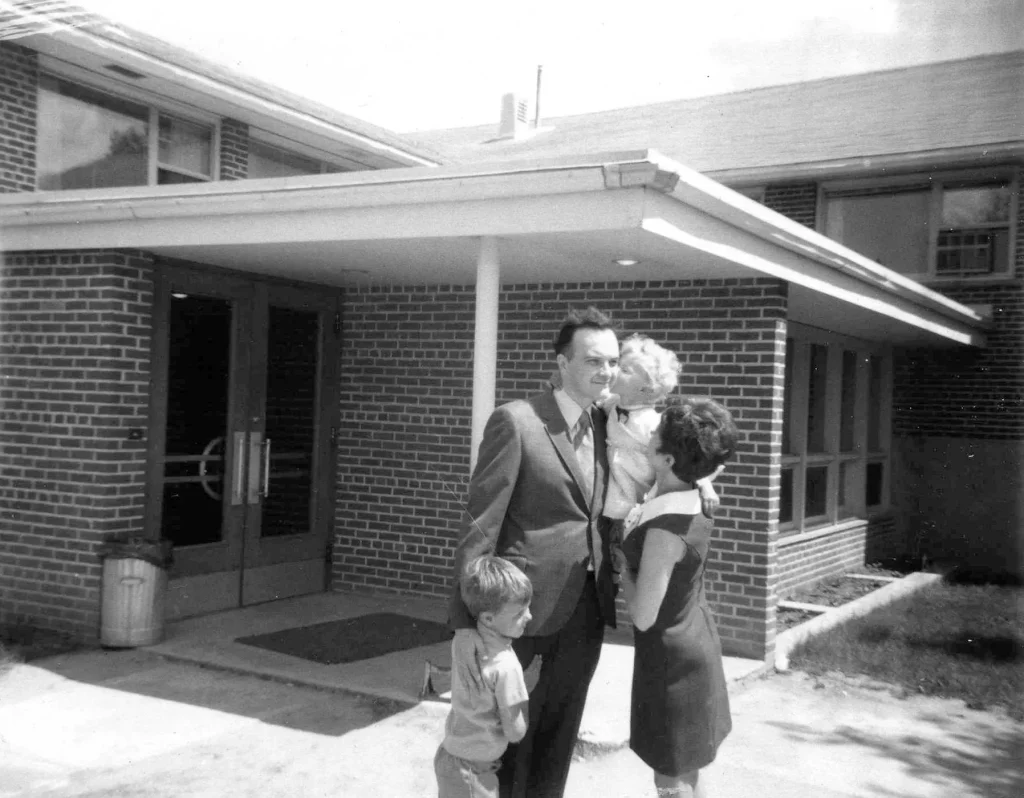
Running Before He Could Walk
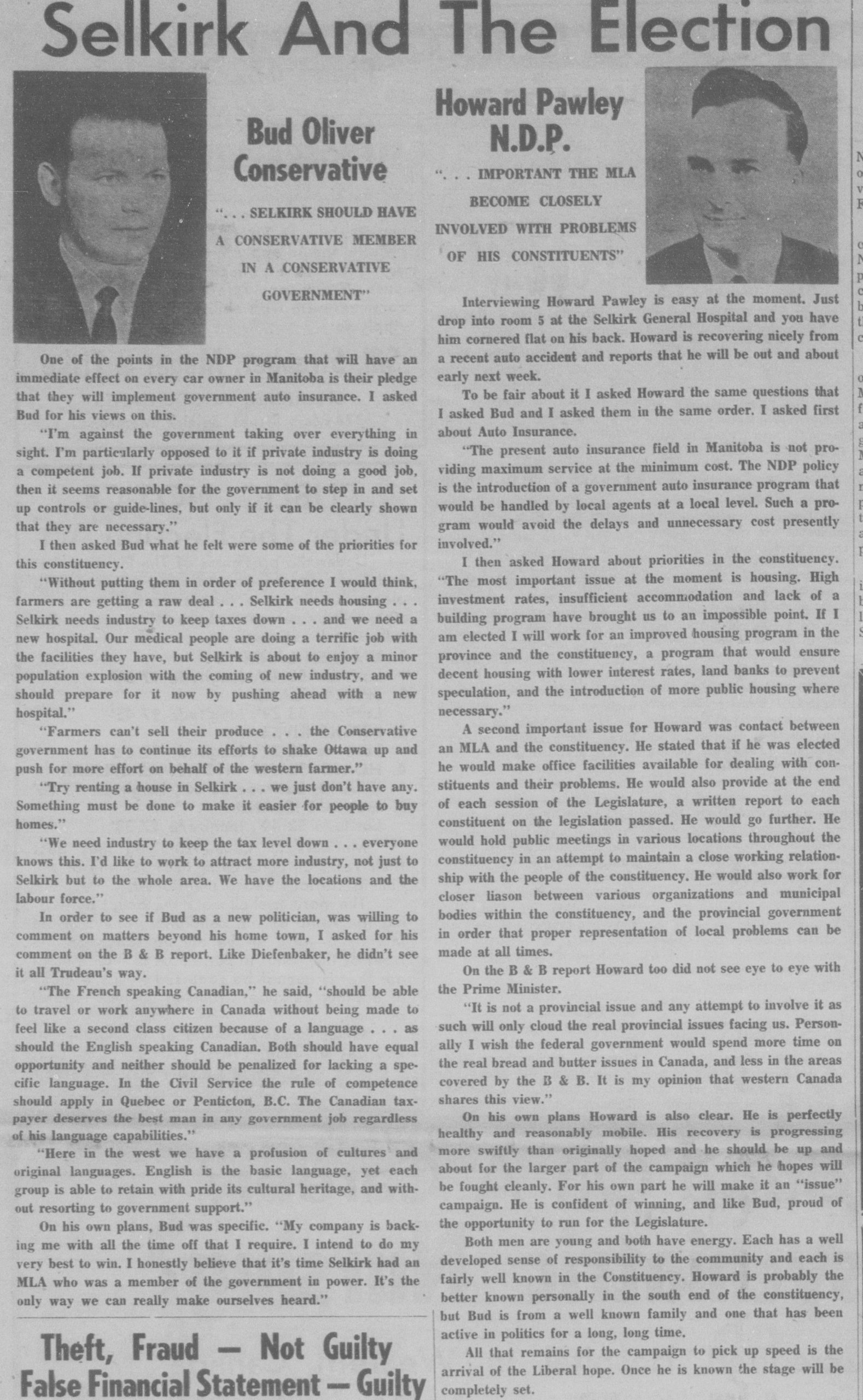
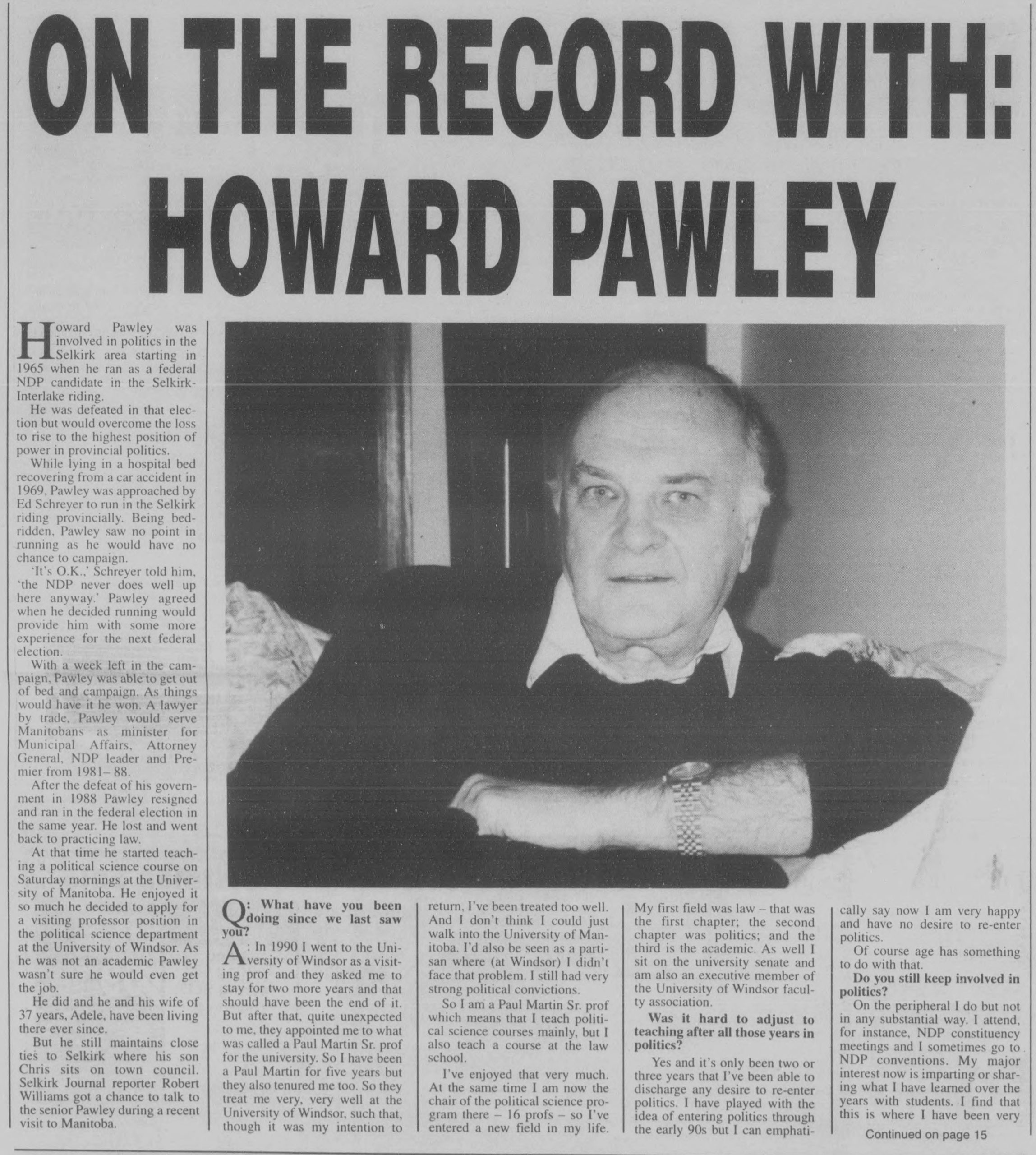
Nearly a decade later, Pawley was in a car accident which left him bedridden for several months. While in the hospital, Ed Schreyer encouraged him to run in the next provincial election in the Selkirk riding. Pawley felt that this effort would be futile, as he was unable to get out of bed to campaign. Schreyer humorously responded, “that’s okay, the NDP never does well up here anyways.” (Selkirk Journal, 1997).
Despite the challenges, Pawley agreed to run because it would provide him with experience for the next federal election. With only one week left, he was able to get out of bed and campaign, and then he had his first win. This win occurred in the historic 1969 election which saw Manitoba’s first NDP government.
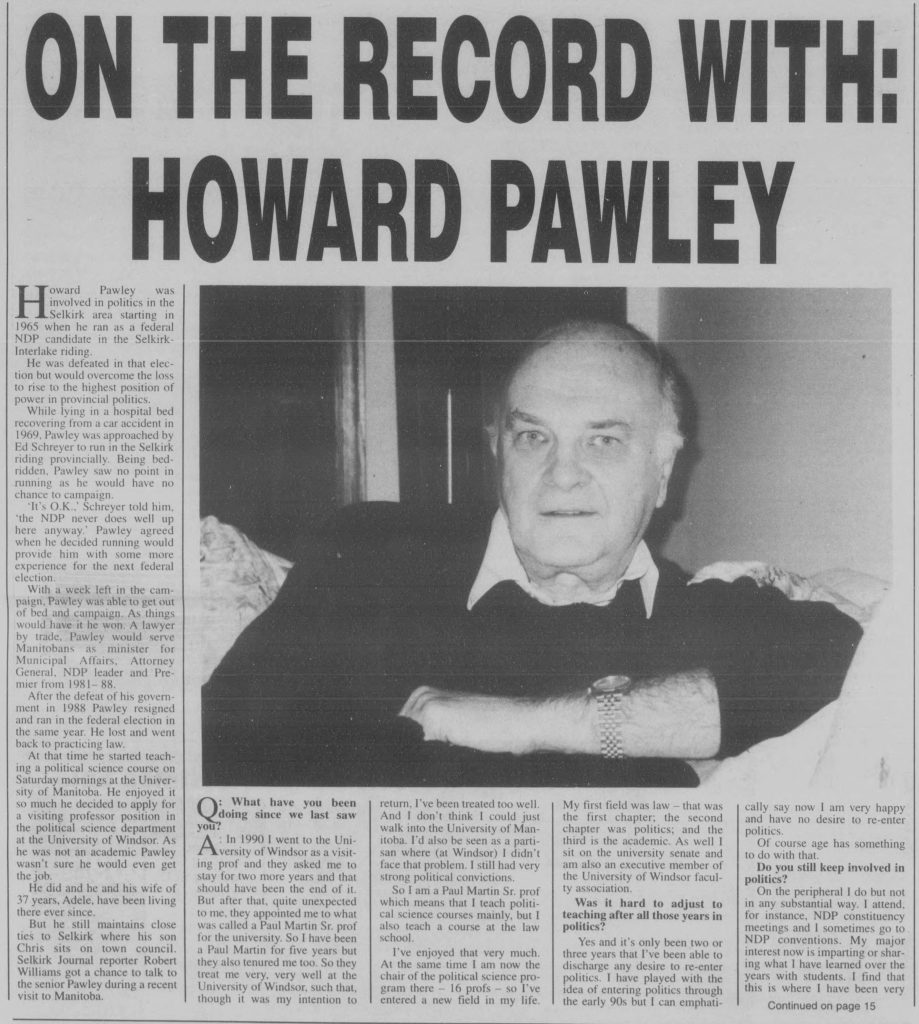
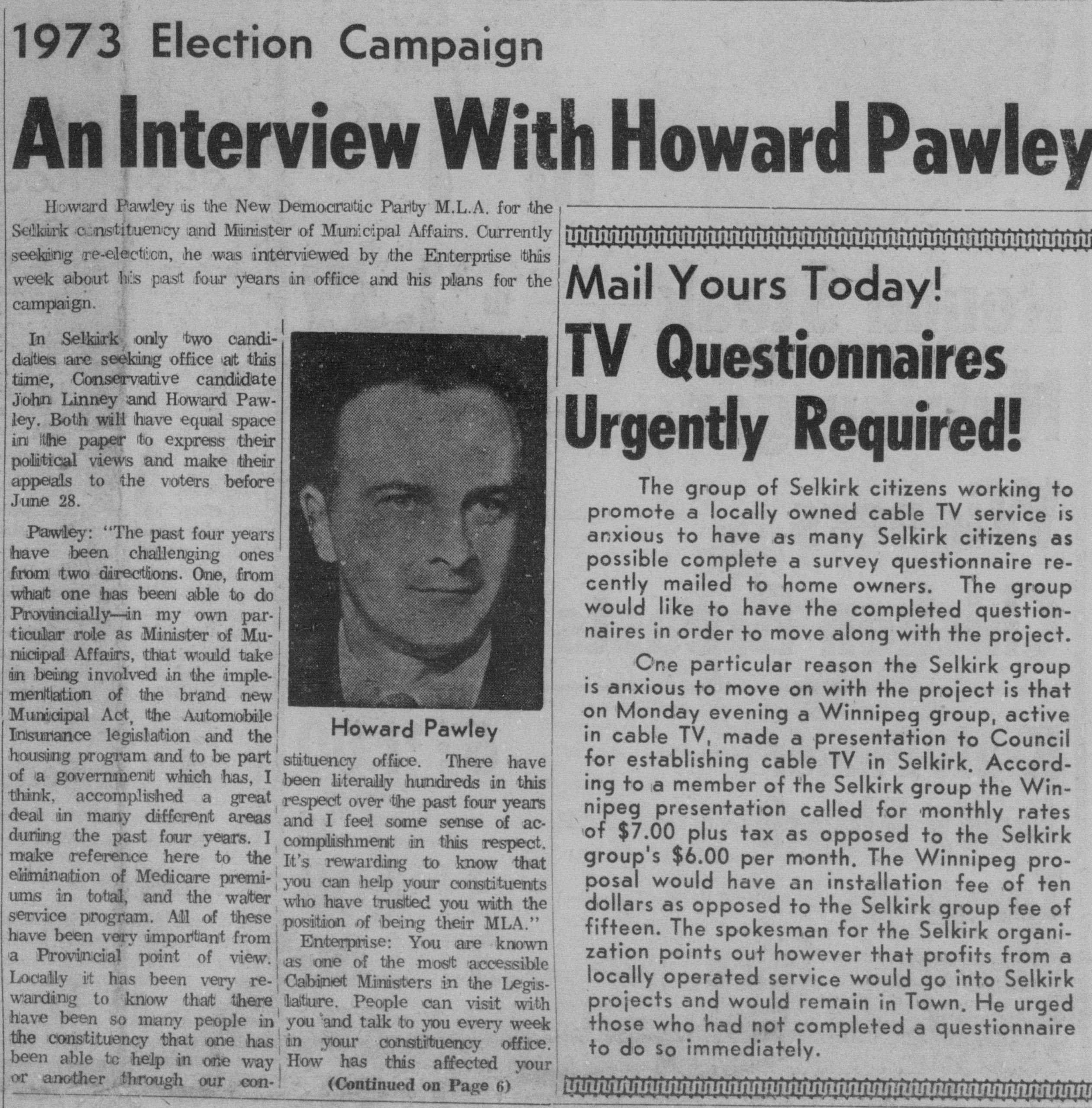
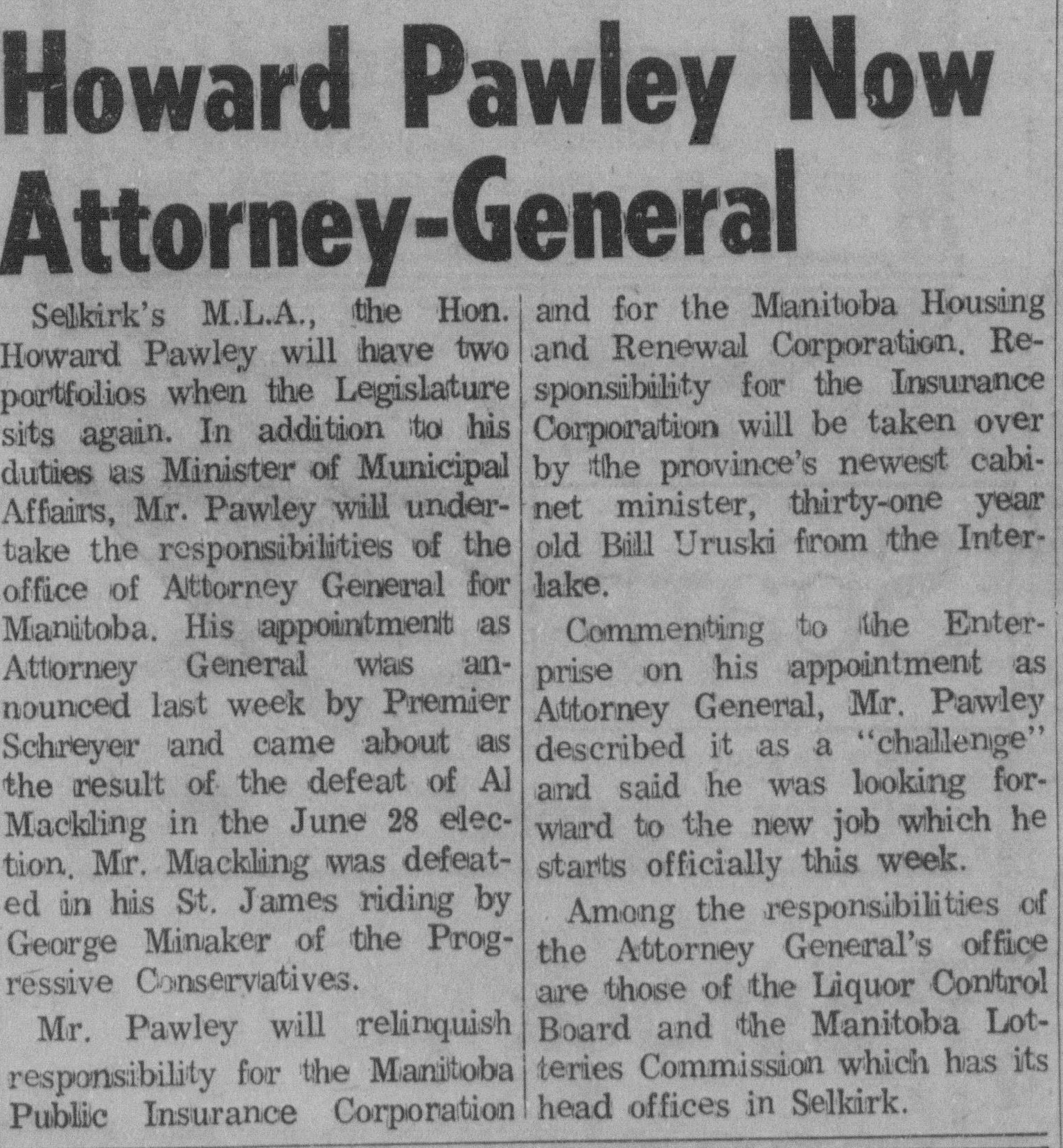
Pawley served as the MLA for Selkirk from 1969-1988. Under Premier Ed Schreyer’s administration, Pawley held the portfolios of Minister of Municipal Affairs from 1969-1976, Minister responsible for administering the Liquor Control Act from 1976-1977, and Attorney General from 1973-1977.
Making Changes
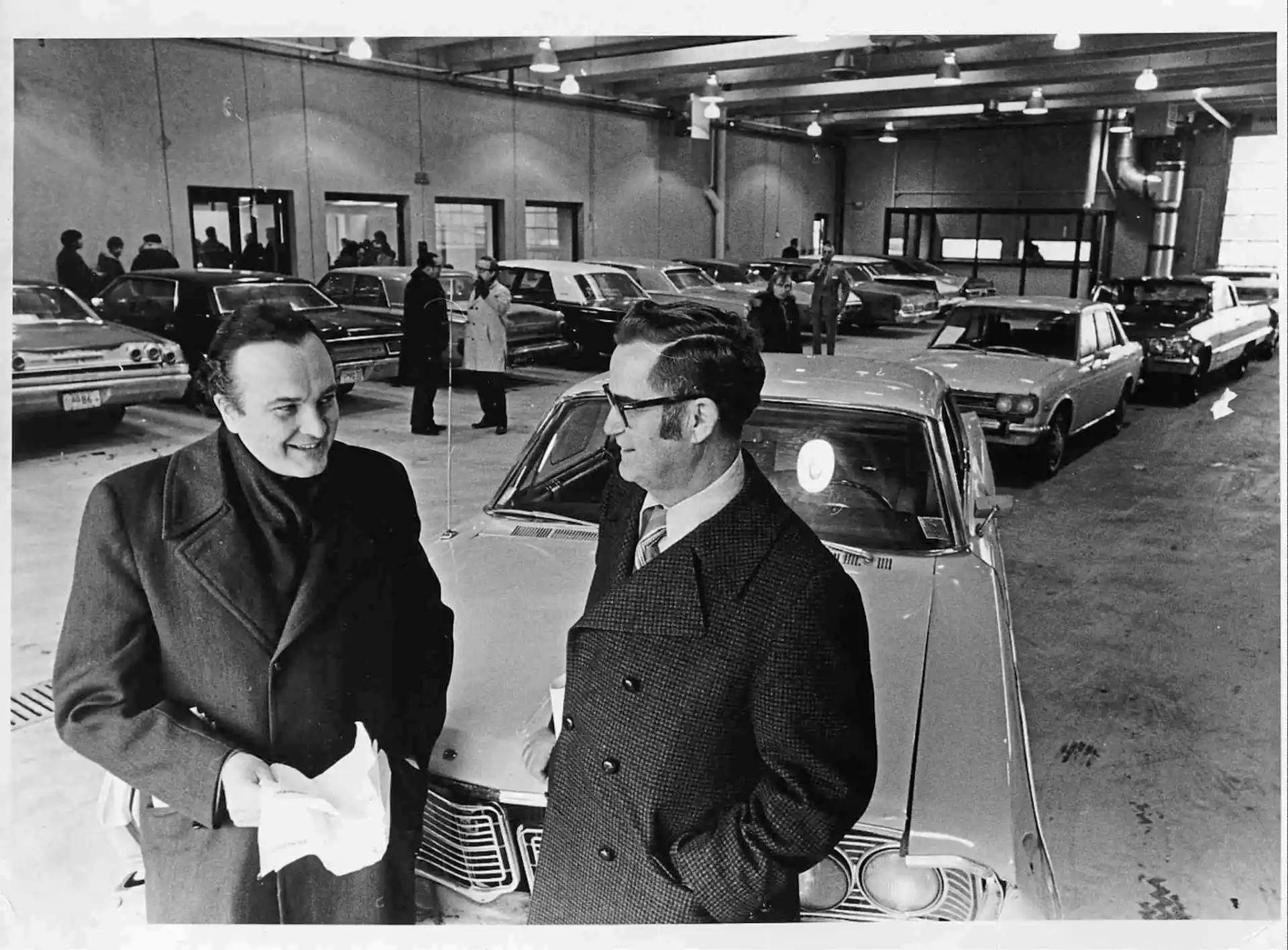
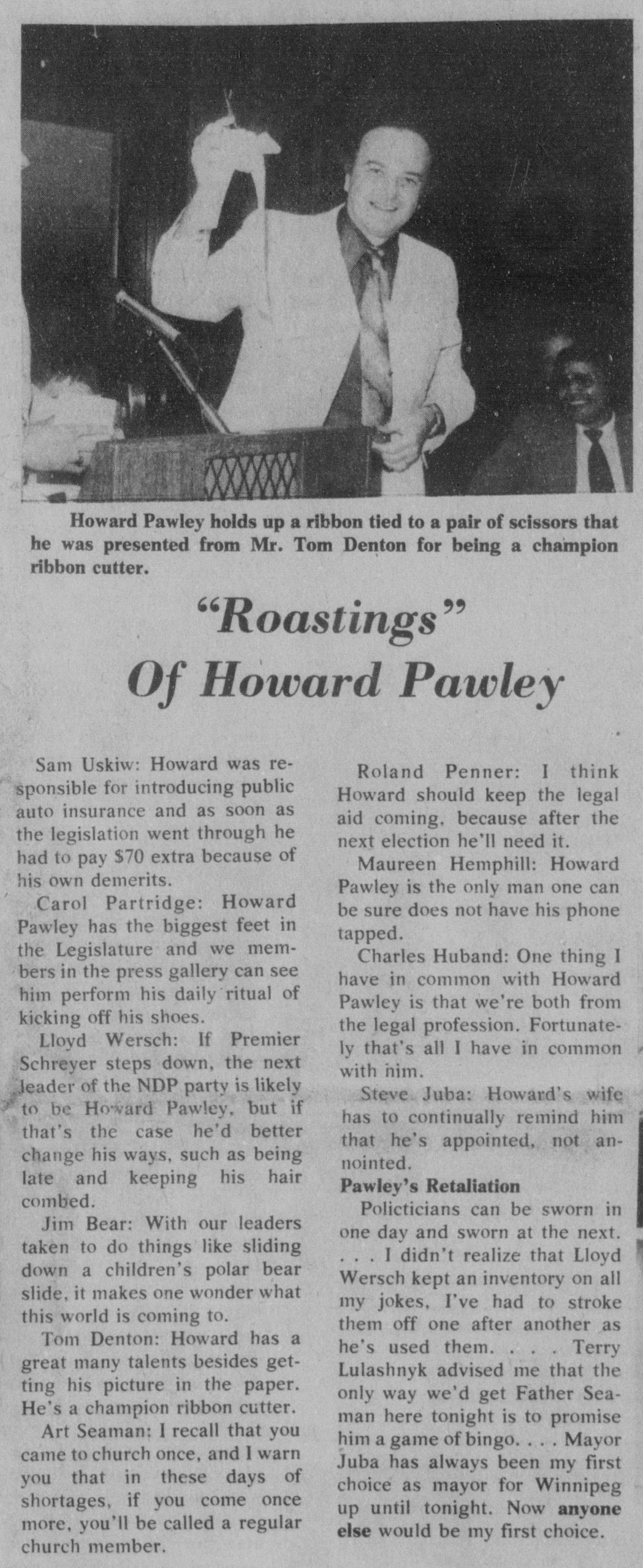
During this time, he was passionate about creating a public car insurance program and affordable housing. In 1971, Ed Schreyer formed a three-person committee chaired by Pawley who was responsible for provincial auto insurance, now known as Manitoba Public Insurance. Ironically, as soon as the legislation was passed, Pawley owed $70 due to his own demerits.
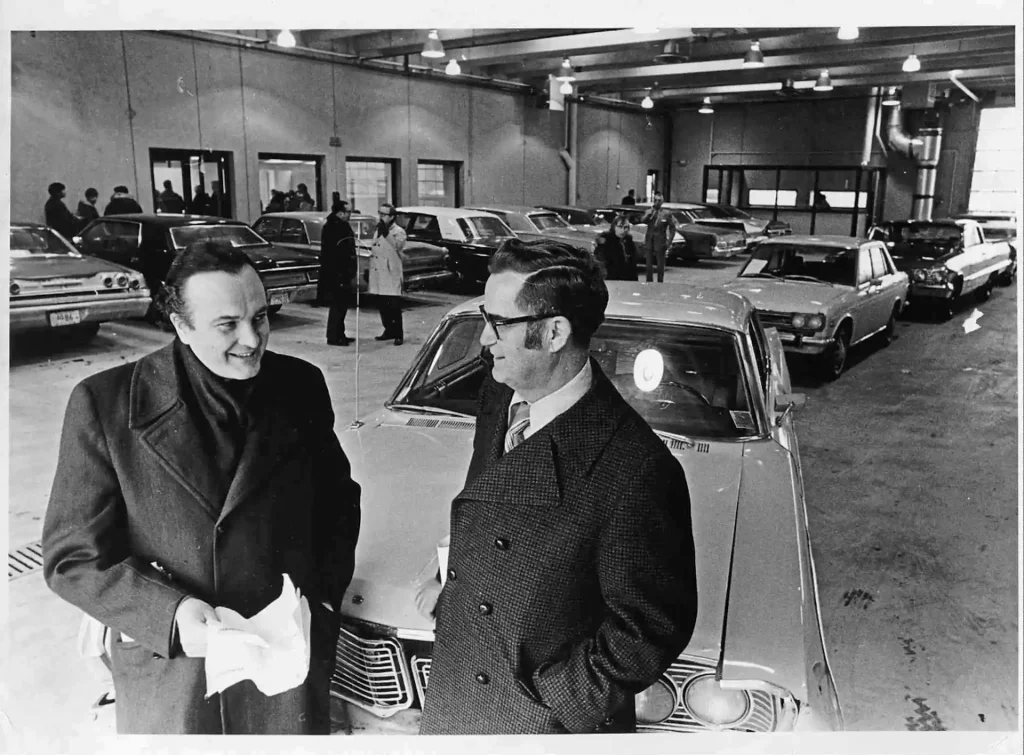
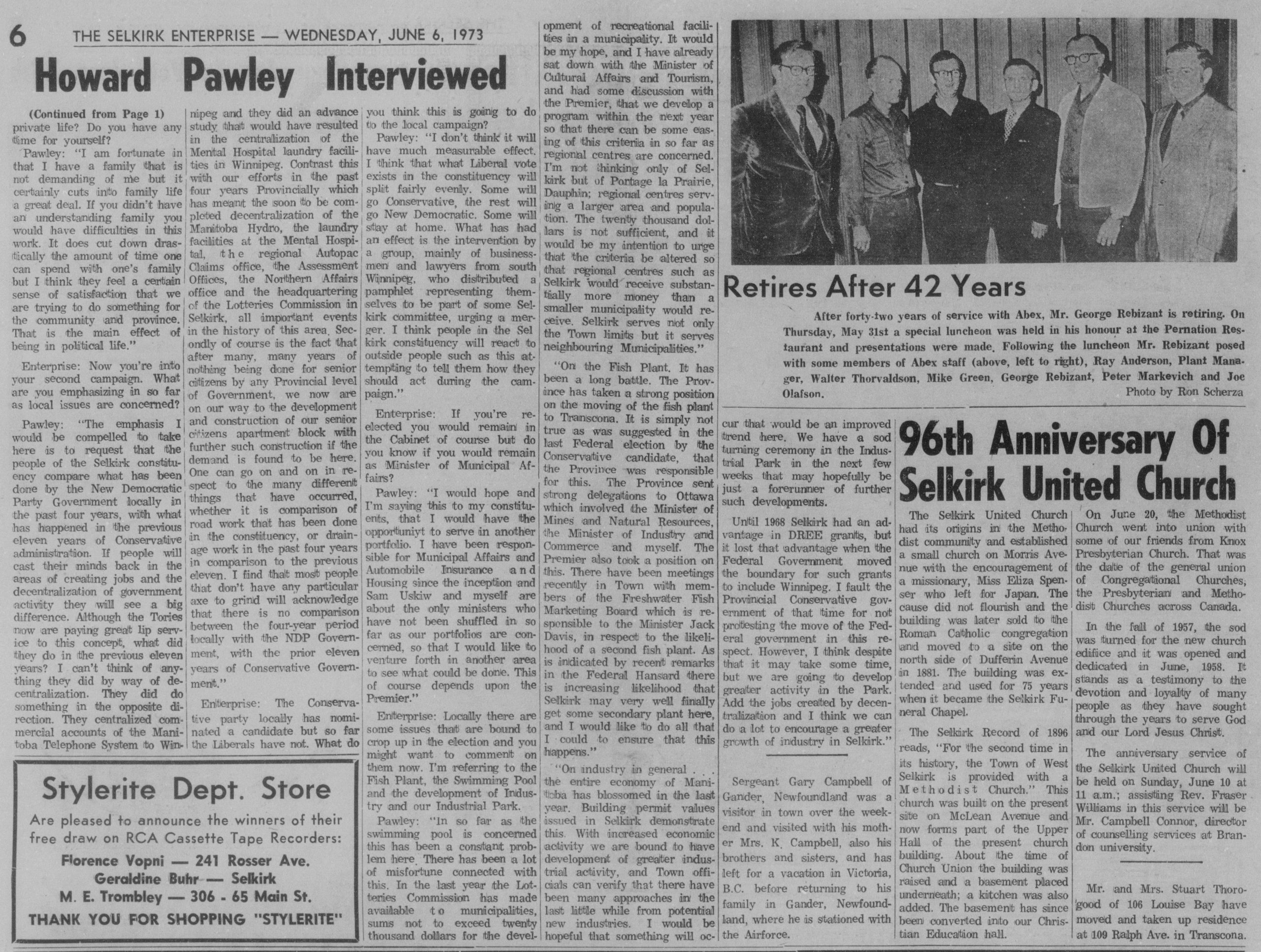
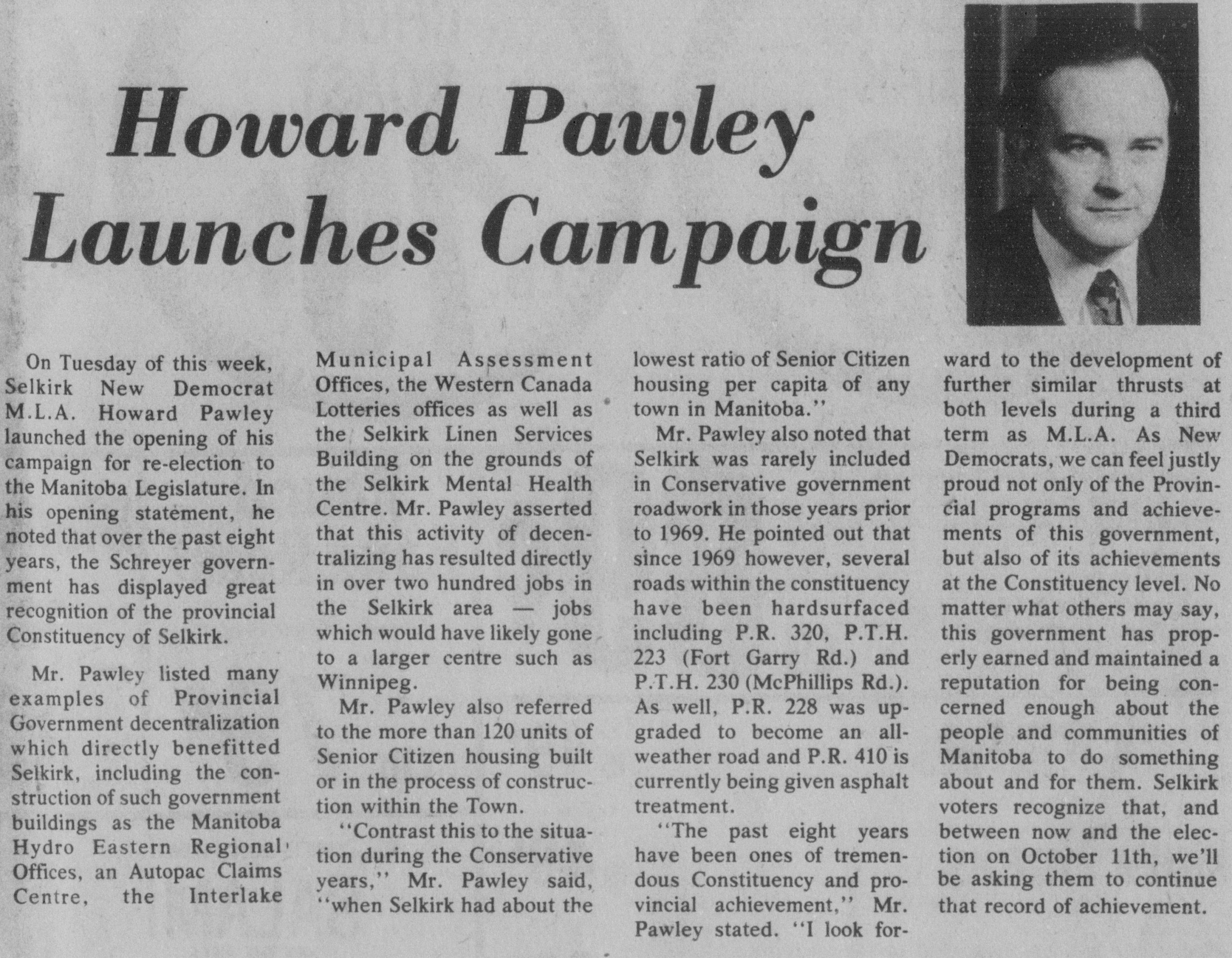
Pawley promoted downtown housing developments for seniors and families. He felt that high interest rates and insufficient accommodation didn’t provide people with enough options. His proposed program would ensure decent housing with lower interest rates. In the years prior to Pawley’s election, “Selkirk had the lowest ratio of senior citizen housing per capita of any town in Manitoba.” During his time in office, 120 senior citizen housing units were built. Pawley also believed in decentralization to create local jobs in the Selkirk area. He claimed the construction of several government buildings contributed to this goal, as it created over two hundred jobs which would have otherwise gone to larger centres, such as Winnipeg.
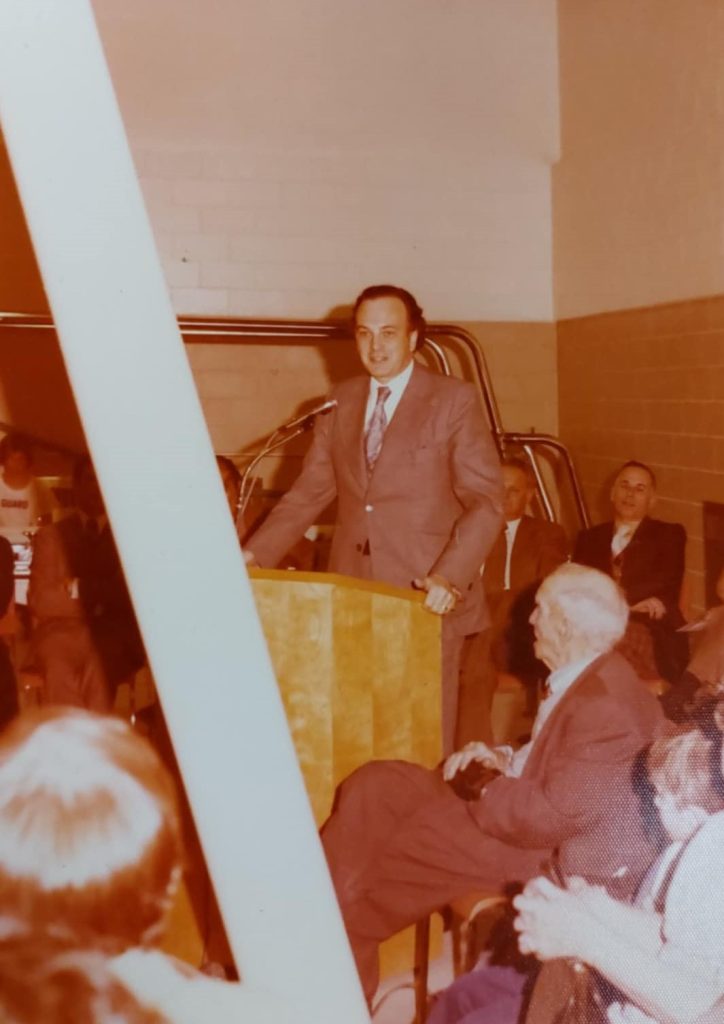
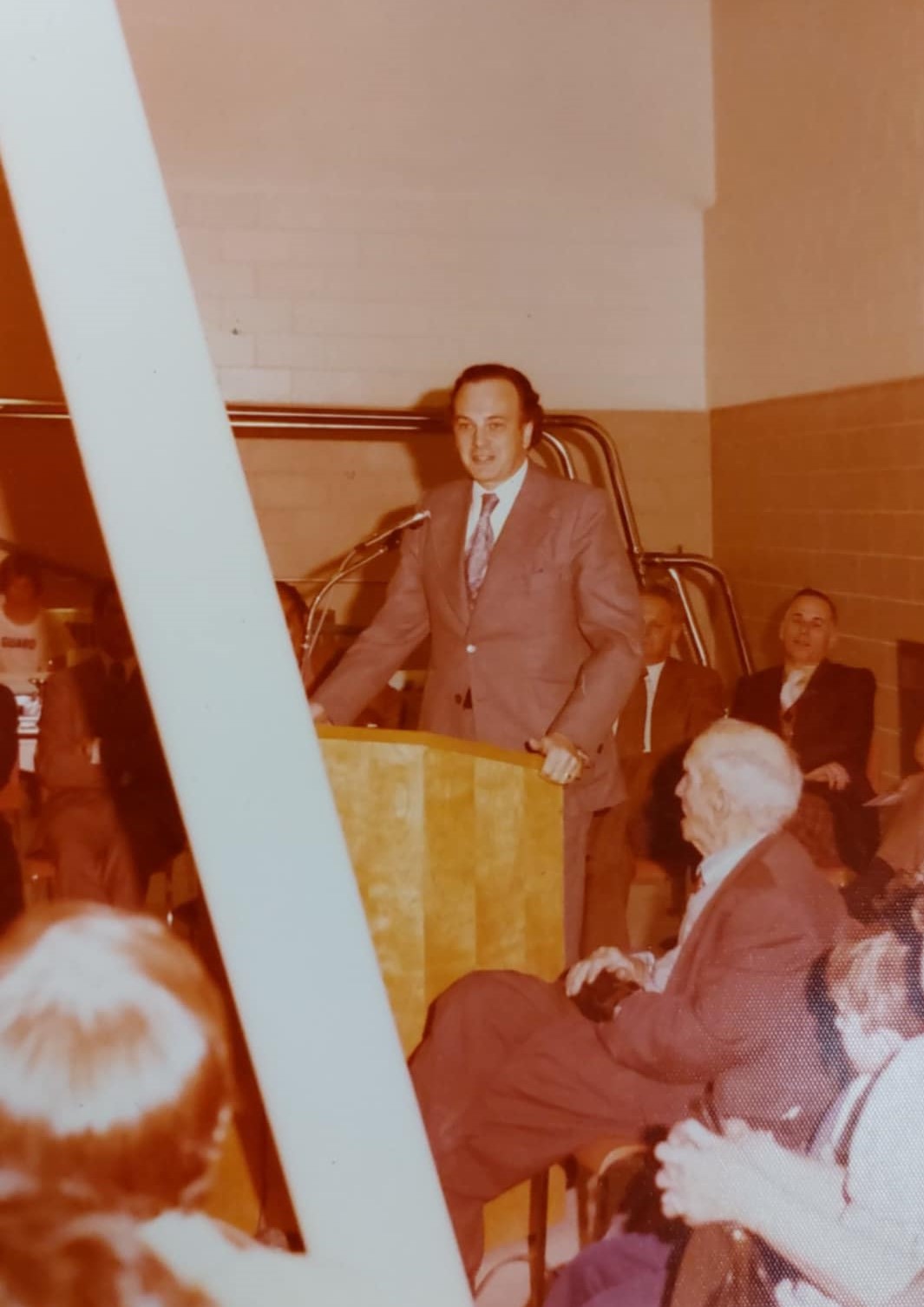
Pawley was one of several speakers at the opening of the Selkirk Community Pool, signifying a momentous occasion for the Town of Selkirk.
Community-minded
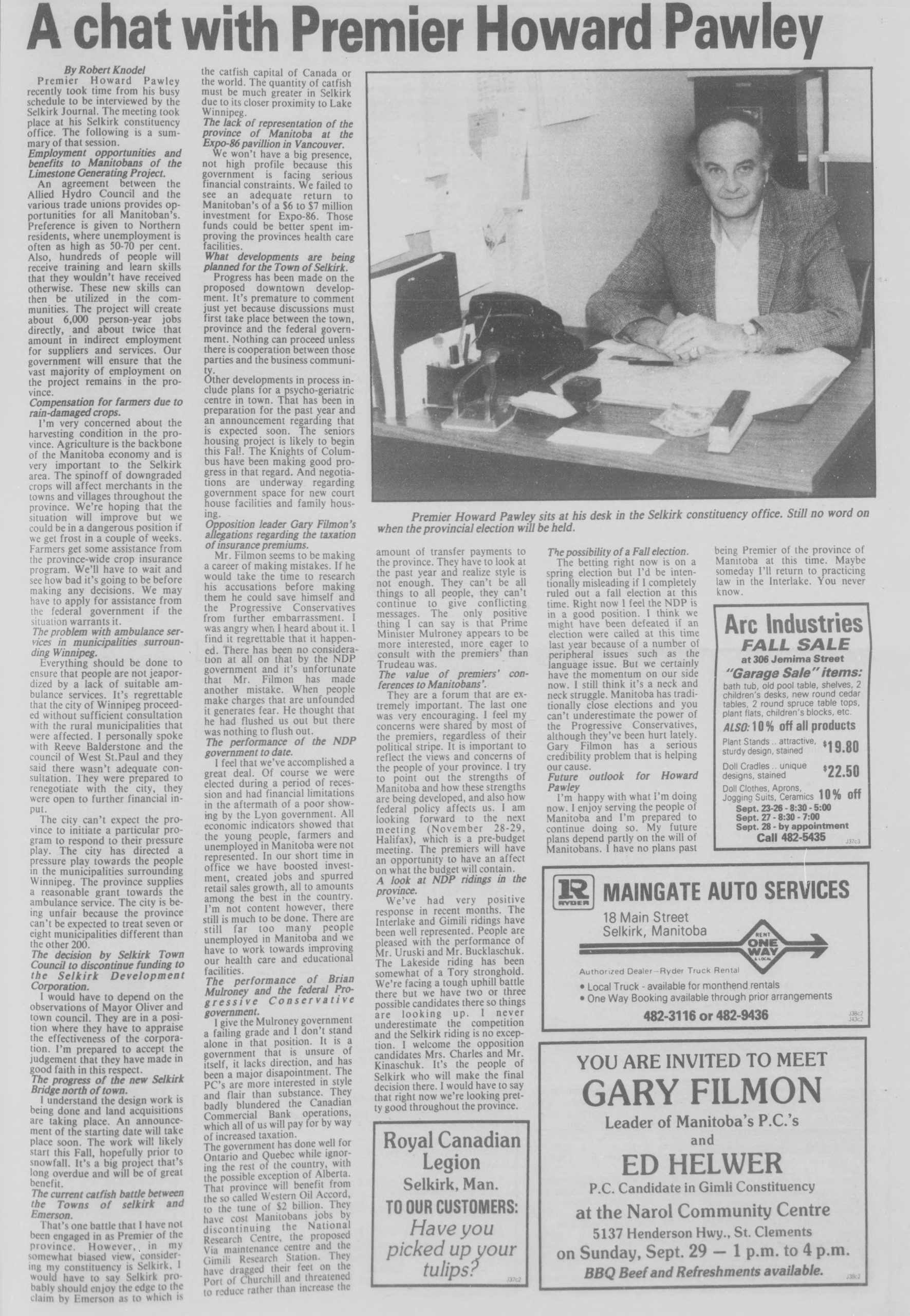
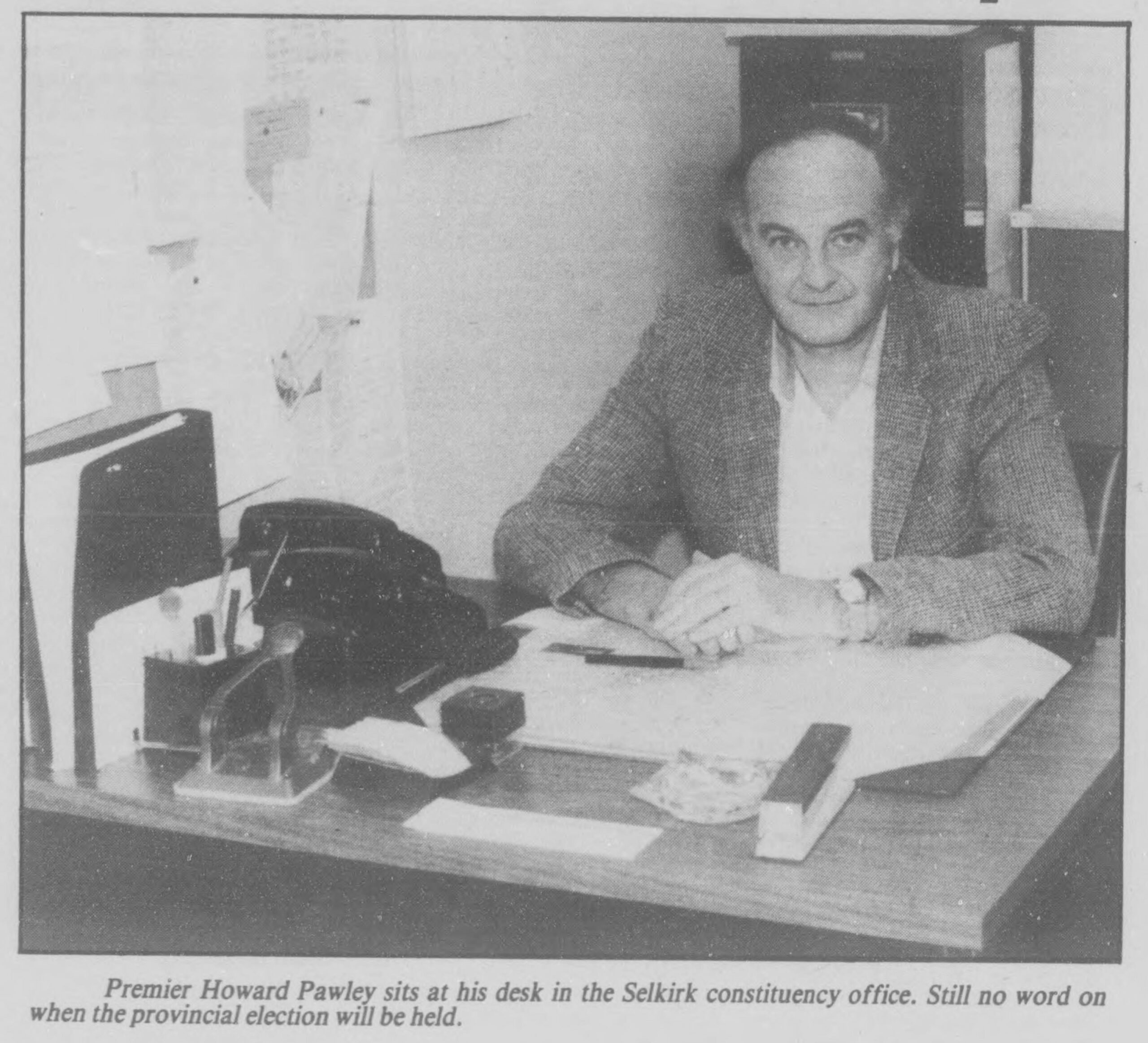
Pawley often interceded on behalf of individuals navigating the system, particularly with housing and social services concerns. He worked to build a strong presence in the Selkirk riding, often meeting with residents personally and maintaining an accessible office. He was approachable, compassionate and “gave his undivided attention to whoever he was speaking with” (Andrew Swan), qualities which earned him great community trust and respect.
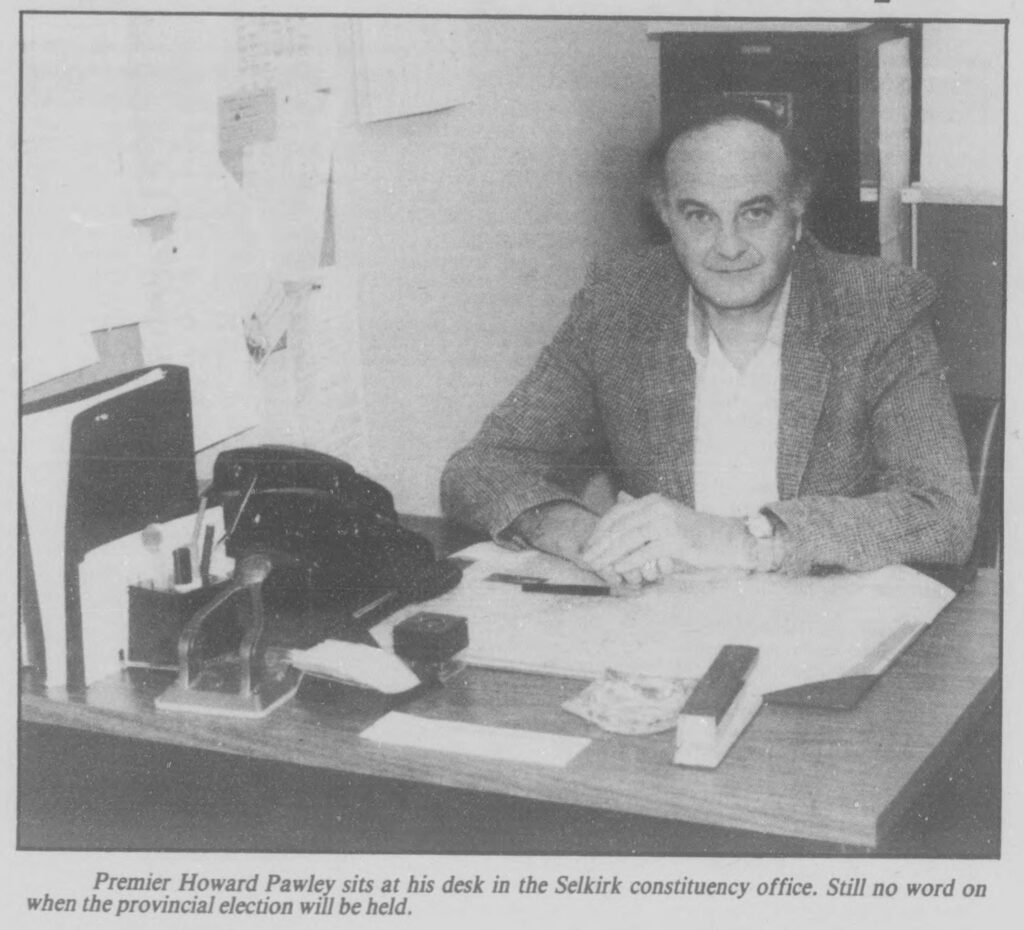
One of these important connections that Pawley made, was with the Selkirk Friendship Centre in the early 1970s. At the time Murray Sinclair (later Honourable Murray Sinclair) was working at the Centre. He frequently reached out to Pawley regarding social service concerns and housing support for local families. Pawley responded by holding regular meetings at the Centre to hear resident’s concerns. The two quickly became good friends, with Pawley acting as a mentor to the younger, up-and-coming Sinclair.
In 1973, after becoming Attorney General, Pawley offered Sinclair the position of executive assistant. He encouraged Sinclair to pursue a career in law, support which set him on the path to becoming a lawyer, a judge, and later the Chief Commissioner of the Truth and Reconciliation Commission. Sinclair worked for Pawley until 1976 when he was accepted into the Faculty of Law at the University of Manitoba.
Moving Up
In 1977, the NDP lost the provincial election to the Progressive Conservatives, under Sterling Lyon. No longer Premier, Schreyer remained an MLA until he resigned to become the Governor General in 1979. After his resignation, Pawley became the leader of the NDP. In 1981, Pawley succeeded Sterling Lyon as Premier and served for seven years. His time working closely with residents in the early years helped him during his time as Premier as he had a secure foundation of community trust and support.
On Defense
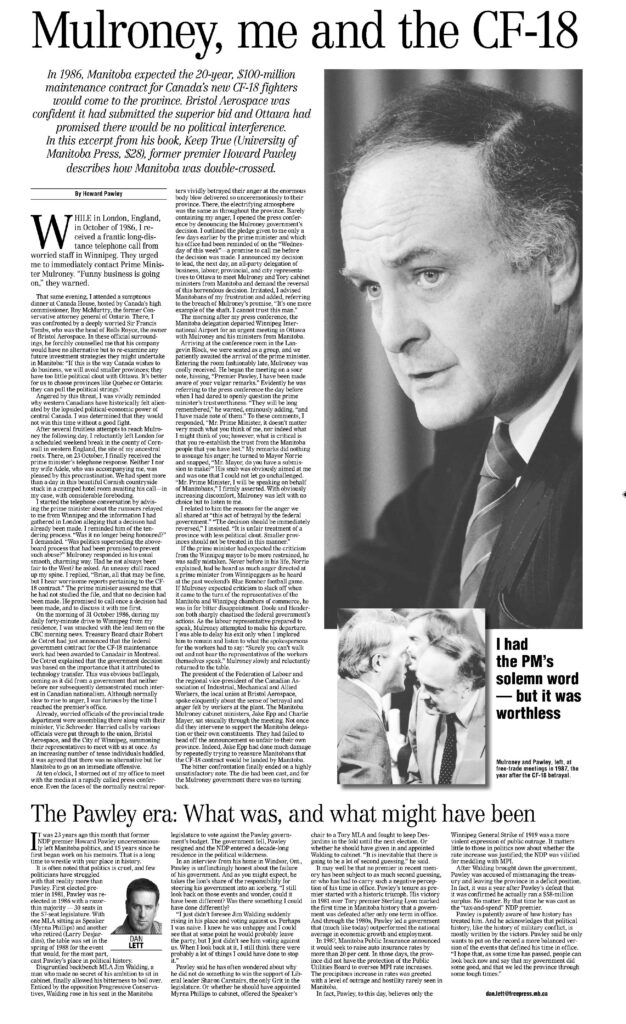
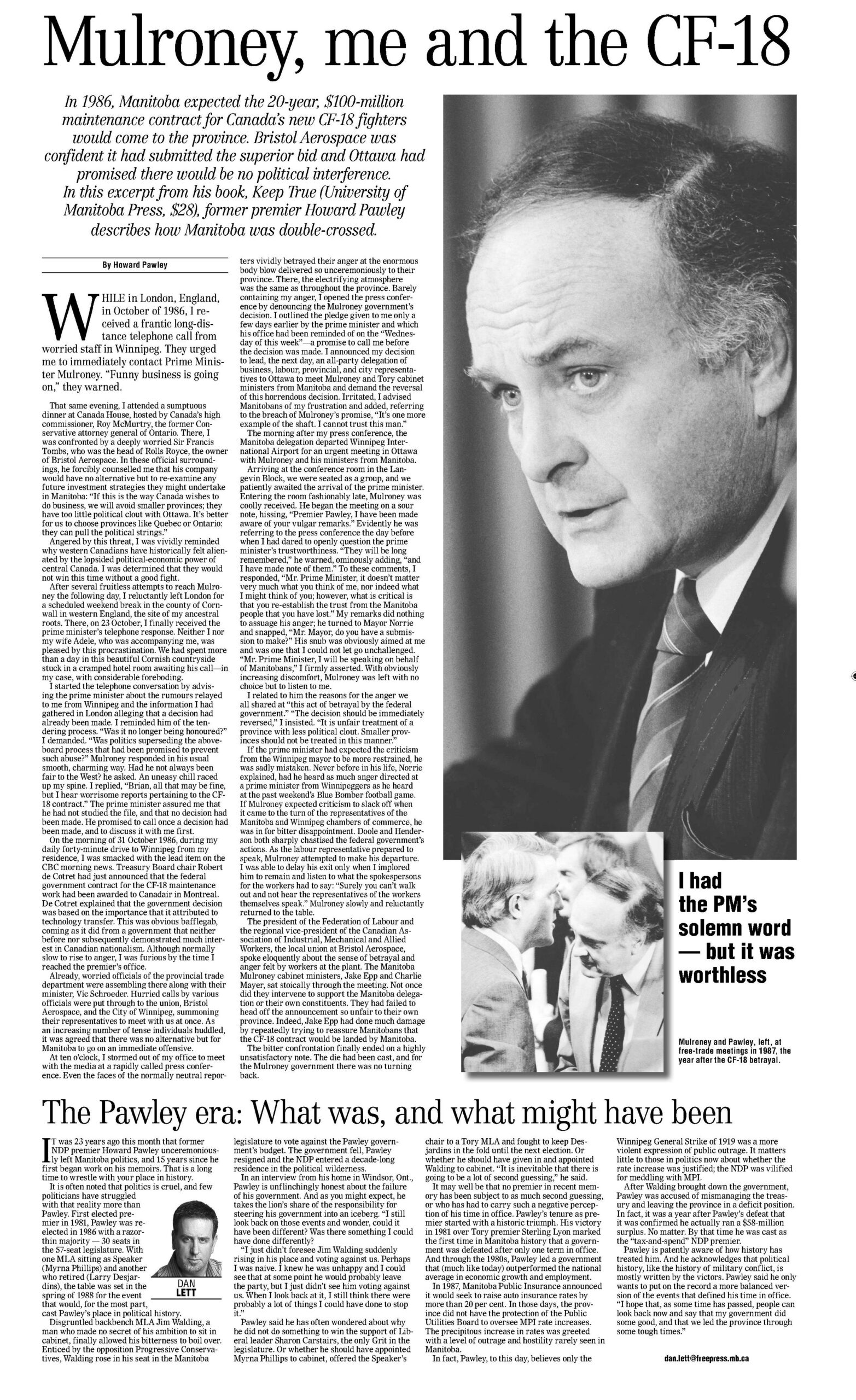
In 1982, the federal government replaced deteriorating CF-104 and CF-101 jets with McDonnell Douglas F/A-18 jets, renamed in Canada as CF-18s. The purchase of these jets came with the promise of local economic benefits in the form of manufacturing and maintenance jobs at Bristol Aerospace in Winnipeg.
However, after Brian Mulroney became Prime Minster in 1984, the CF-18 work was shifted, moving the maintenance and upgrading contract from Bristol Aerospace to a Quebec firm instead. Pawley loudly objected, stating that Mulroney had a ‘Quebec-first political strategy’ and was alienating the west.
The fiasco resulted in Manitoba losing high-value aerospace jobs and an opportunity for a long-standing arrangement which would bolster the economy. Pawley appeared unable to protect Manitoba’s interests in amongst an already grim economical landscape.
In the Wake of Meech Lake
A few years later, the these political tensions reached a breaking point with the Meech Lake Accord. The Meech Lake Accord was an attempt by Prime Minister Brian Mulroney to address the problem that Quebec had never formally agreed to the 1982 Constitution Act. The Accord was intended to bring Quebec back into the ‘family’ without reopening the constitution, however, the plan never got off the ground. Negotiations happened behind closed doors with only specific people involved. Neither the public nor Indigenous leaders were consulted, which resulted, ultimately, in its downfall.
Unanimity was required by each province in order for Meech Lake to pass. In Manitoba, in the wake of the CF-18 deal, further perceived favouritism of Quebec and alienation of the west, caused Meech Lake to fall flat.
While Pawley had resigned before the Meech Lake Accord was negotiated, he did have a hand in setting the political stage for apprehension and distrust towards the larger, eastern provinces.
Right of Bilingualism
Another controversial action during the Pawley government was the introduction of a resolution to designate both French and English as official languages in Manitoba. This resolution came as a reaction to the Bilodeau case which challenged the fairness of Manitoba’s laws because they were only in English. A ruling in favour of Bilodeau could have invalidated hundreds of provincial laws passed since 1890. Because of this, the matter faced significant political pushback and was referred to the Supreme Court. In 1985, The Supreme Court ruled in favour of the resolution, designating both languages as official and declaring that past and future laws must be translated into French as well as English. To achieve re-election, the Pawley government avoided controversial initiatives for the remainder of its first term.
Getting Nowhere?
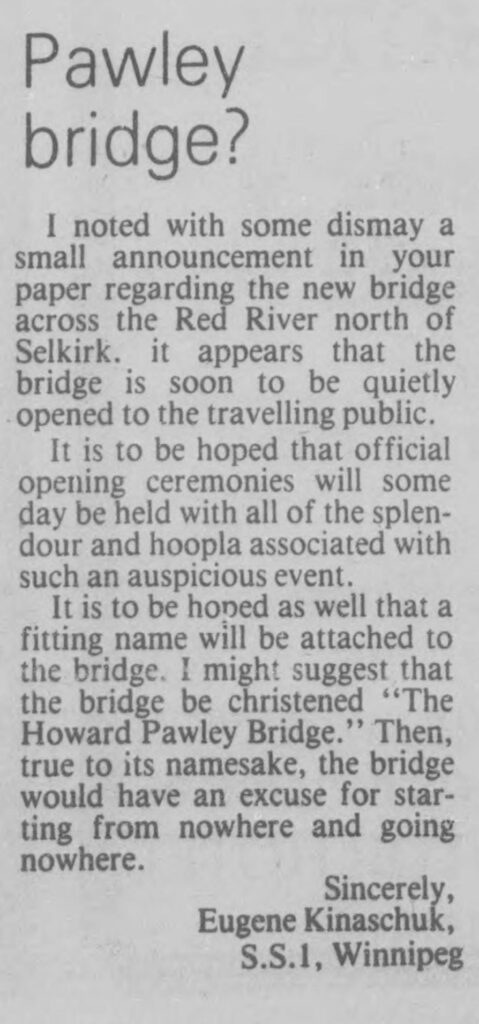
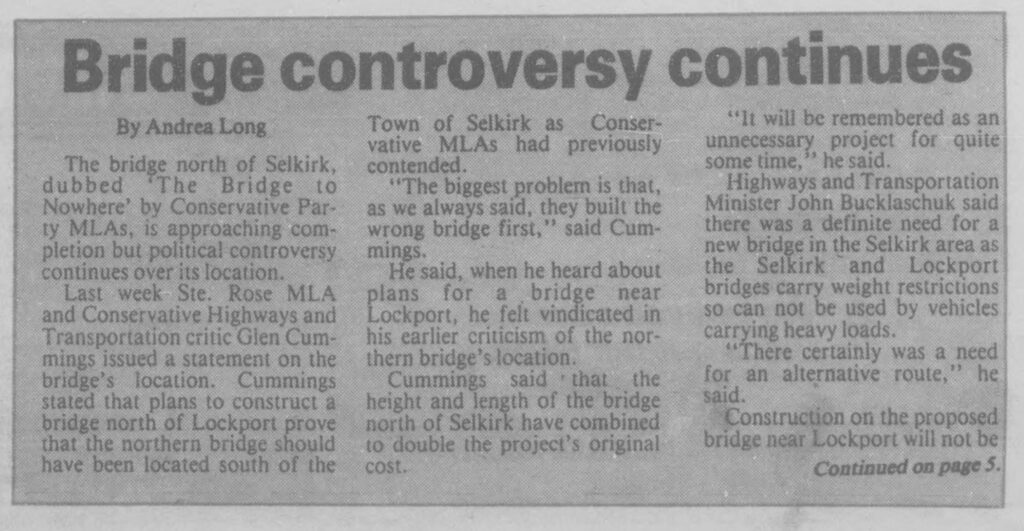
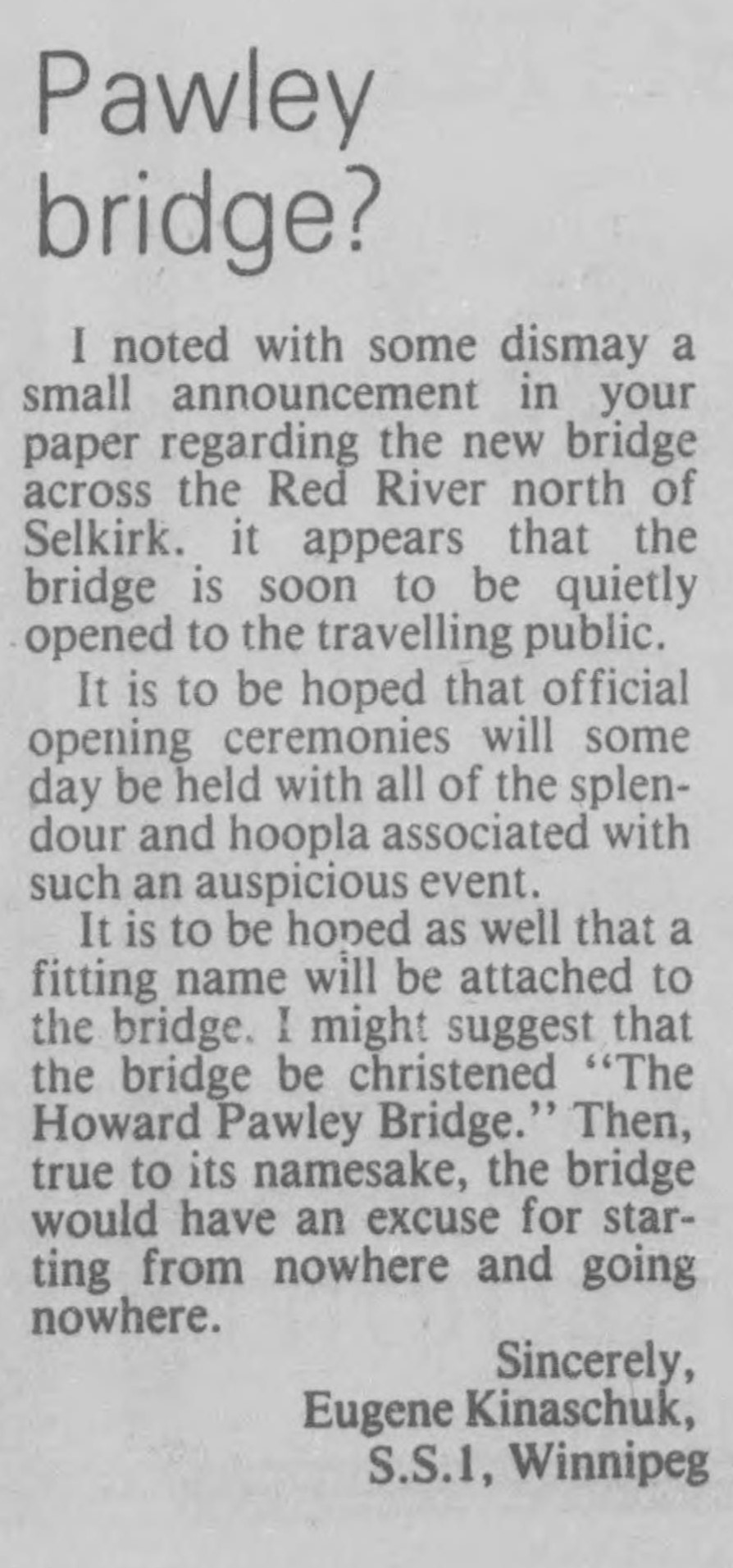
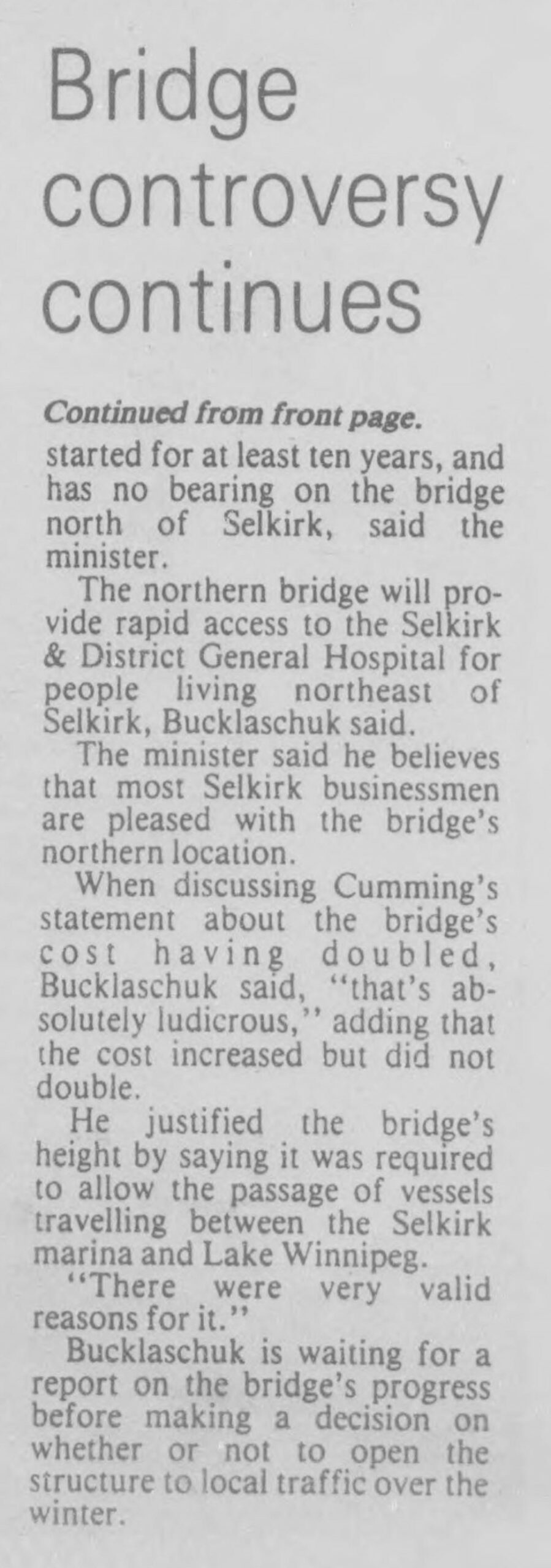
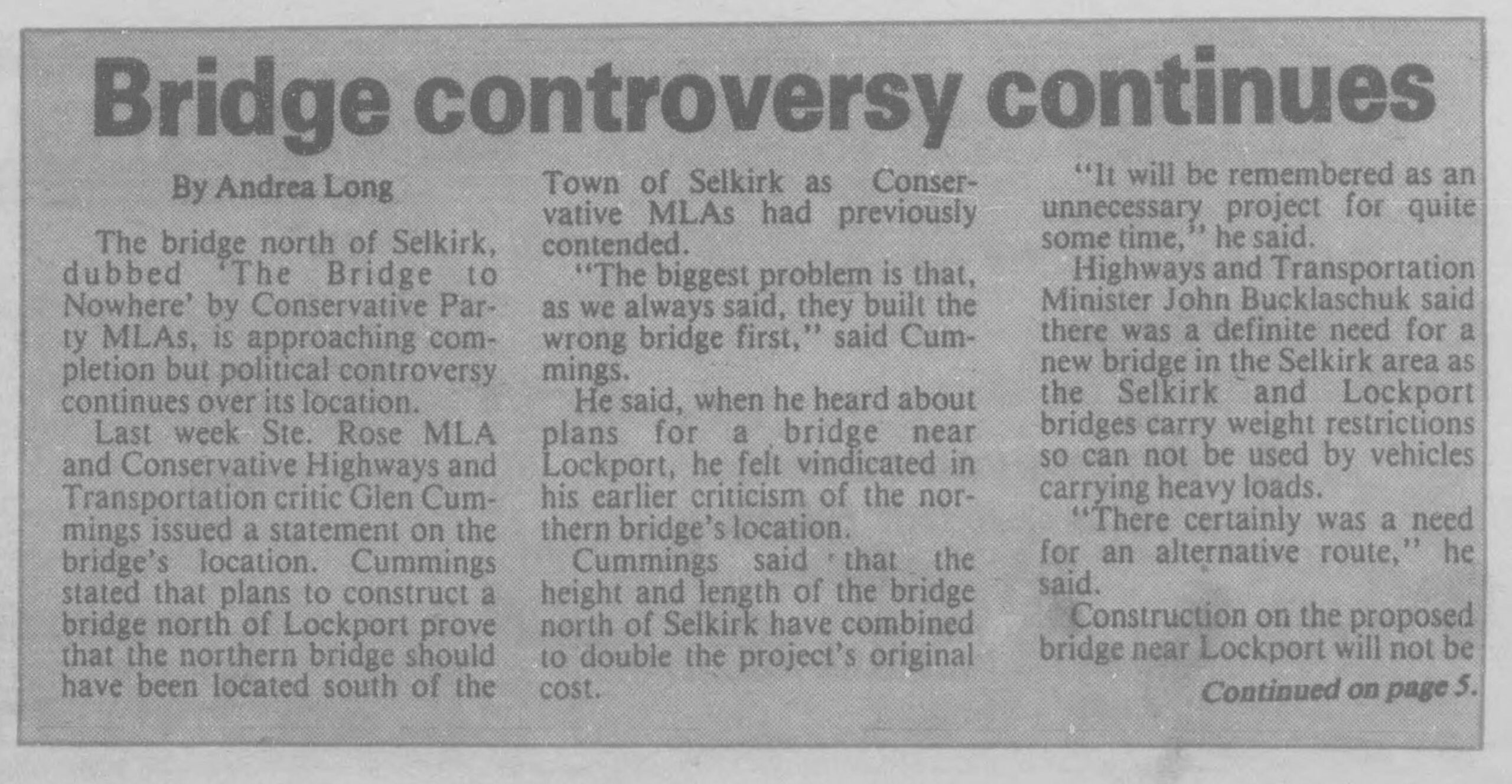
The construction of the St. Peters Bridge branded the “Bridge to Nowhere,” by Progressive Conservative critics, marked another point of controversy during Pawleys time as Premier. The bridge was designed to connect the Selkirk by-pass and Highway #59. The project was completed in phases, with the bridge portion being completed first and the roads completed and connected afterwards. This delayed construction process left the bridge isolated from the connecting roadways, resulting in criticism from the opposing PC party and the public.
Pawley came under scrutiny over the decision to construct the bridge particularly due to its location, timing of the build, and spending during a period of financial strain. For some, the bridge became a symbol of poor planning development and an ill use of tax dollars.
“In the six years that Howard Pawley was Premier, he borrowed an unprecedented amount of money, and he borrowed this money during a period of high interest rates and he left it for future governments to repay.” – Meeting of the Legislative Assembly of Manitoba, April 7, 1993.
However, the bridge brought undeniable benefits that have only grown over time. Not only was the bridge vital in connecting communities north and east of Selkirk, but it provided an alternate route over the Red River, a route which never floods or closes during the spring ice breakup.
The bridge improved access from Winnipeg and surrounding communities to the amenities found in Selkirk, such as the hospital. “The northern bridge will provide rapid access to the Selkirk & District General Hospital for people living northeast of Selkirk,” Minister Bucklaschuk, Selkirk Journal 1987. Alternatively, the bridge provided an additional throughway, reducing potential congestion by those heading to destinations beyond Selkirk.
Larger, heavier commercial traffic also benefitted from an additional crossing point over the river. As part of Manitoba’s highway system, the bridge was engineered to support standard legal truck loads without the need to implement weight restrictions. The bridge is subject to less repairs and maintenance than the older Selkirk Lift Bridge, offering a predictable and reliable route.
Rights for All
In 1987, the Pawley government amended the Manitoba Human Rights Code to strengthen equality, specifically sexual orientation protection, and labour rights. He famously “argued that the new Human Rights Code was drafted to entrench the rights of all Manitobans saying that there are no A class citizens or Class B citizens.” – The Manitoba Human Rights Commission, December 2012.
New Pursuits and a Great Fall
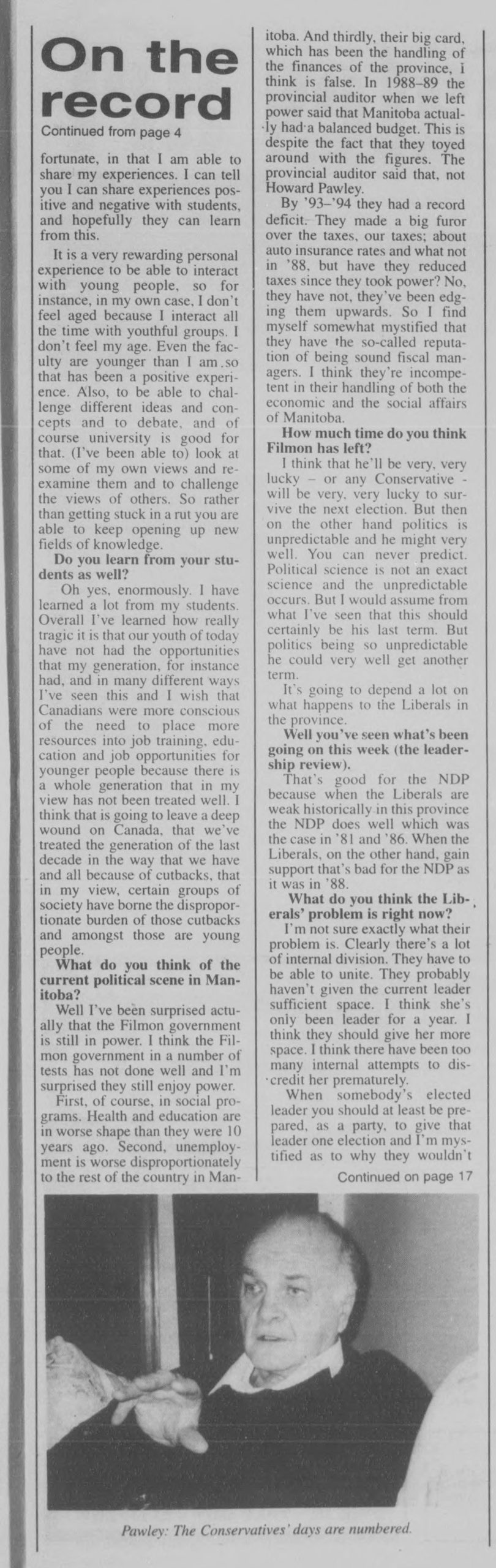
Pawley’s preoccupation with national politics, financial strain from an untimely economic downturn, and growing discontent amongst his own caucus created significant tension. In 1988, the Pawley government introduced a budget that increased taxes and spending restraint. Morale inside the caucus plummeted and when put to a vote, Jim Walding voted against the government’s budget defeating it 31-30. The vote completely upturned the government and Pawley resigned as Premier the same night.
Pawley was replaced by Gary Filmon and turned his focus to the House of Commons in the 1988 general election but was defeated there also.
Professorship
After Pawley’s career in politics ended, he began teaching a political science course at the University of Manitoba. During this time, he applied for a visiting professor position in the political science department at the University of Windsor. He was accepted and offered the position.
In 1990, Pawley and Adele moved to Windsor, where he worked for a few years before the University of Windsor offered him tenure. The university appointed him as a Paul Martin Senior Professor for the University of Waterloo and as a visiting professor in Canadian Studies at the University of Washington in Seattle. In 2008, he received a Distinguished Alumni Award from the University of Winnipeg Alumni Association, and University of Manitoba Alumni Association in 2011.
In 2000, Howard was inducted into the Order of Manitoba and a year later, he was made an Officer of the Order of Canada. These awards not only complemented the alumni awards, but also the Queen Elizabeth II Silver Jubilee Medal he received in 1977, the Queen Elizabeth II Gold Jubilee Medal in 2002, and the Queen Elizabeth II Diamond Medal in 2012.
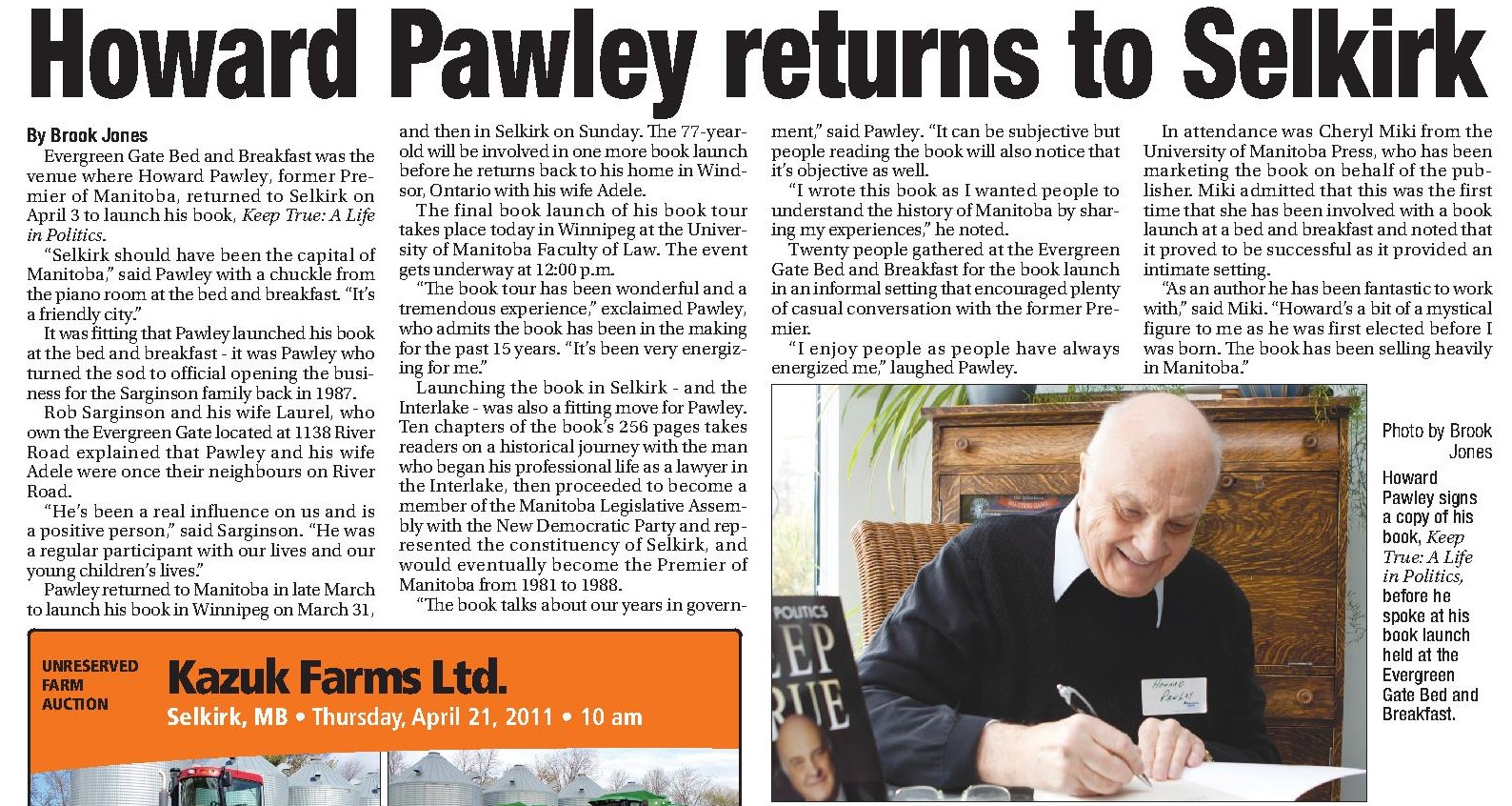
In 2011, Pawley published his memoir, A Life in Politics, where he details his experiences in politics, academia, and his beliefs towards human rights, social justice, and economic development.
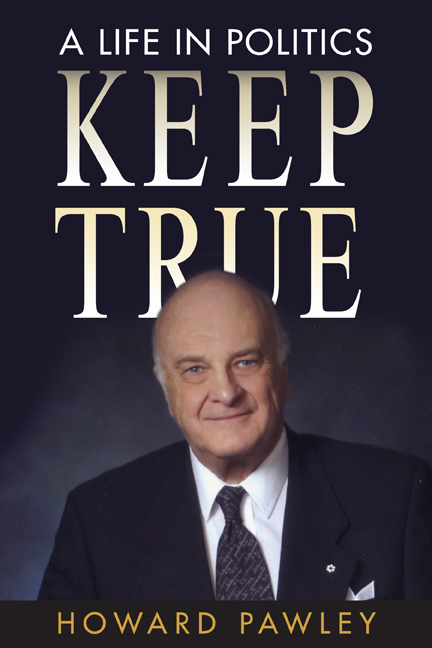
Howard Pawley passed away in Windsor, Ontario on December 30, 2015.
Howard Pawley Collection
Click on images to enlarge
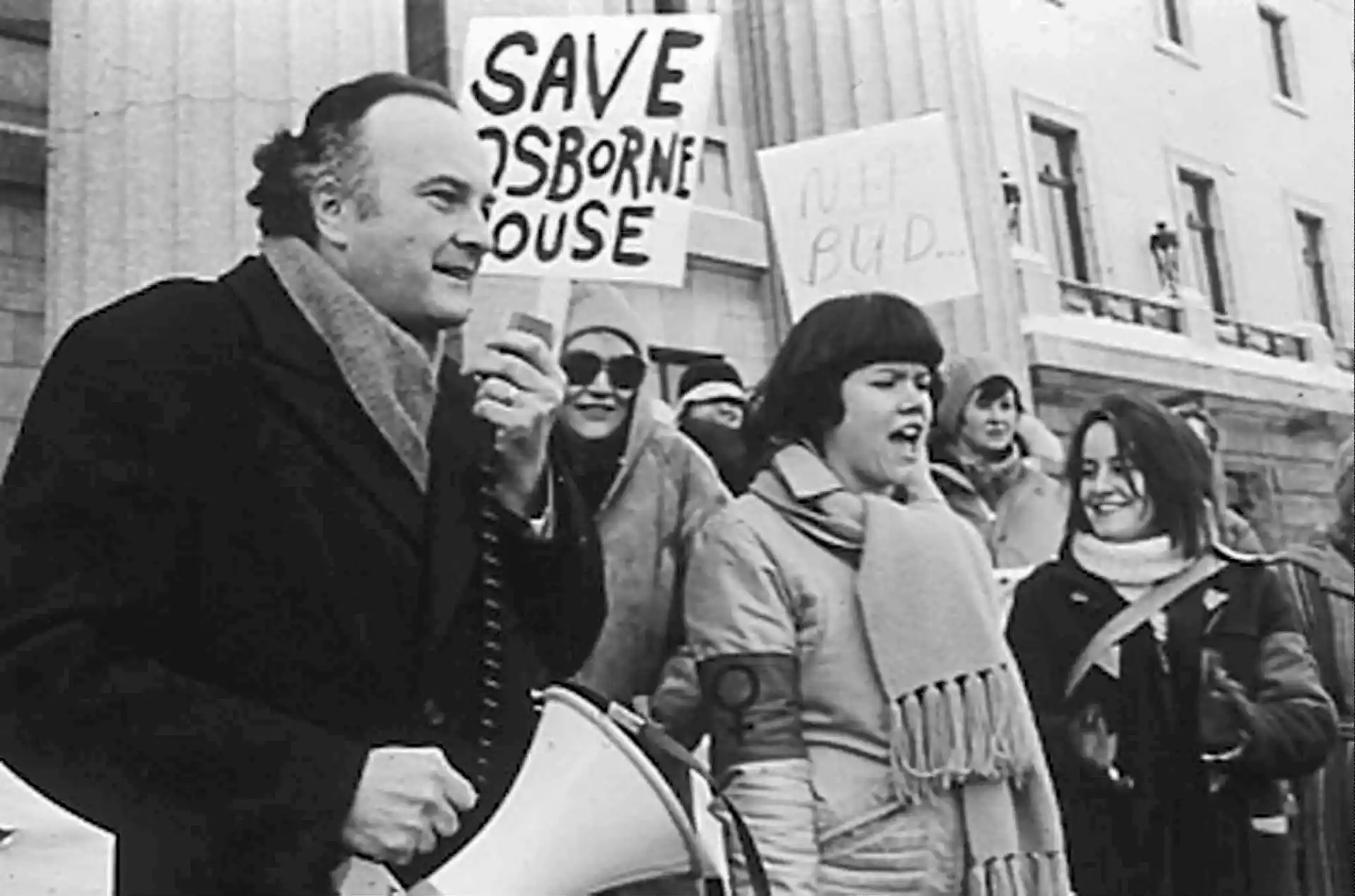
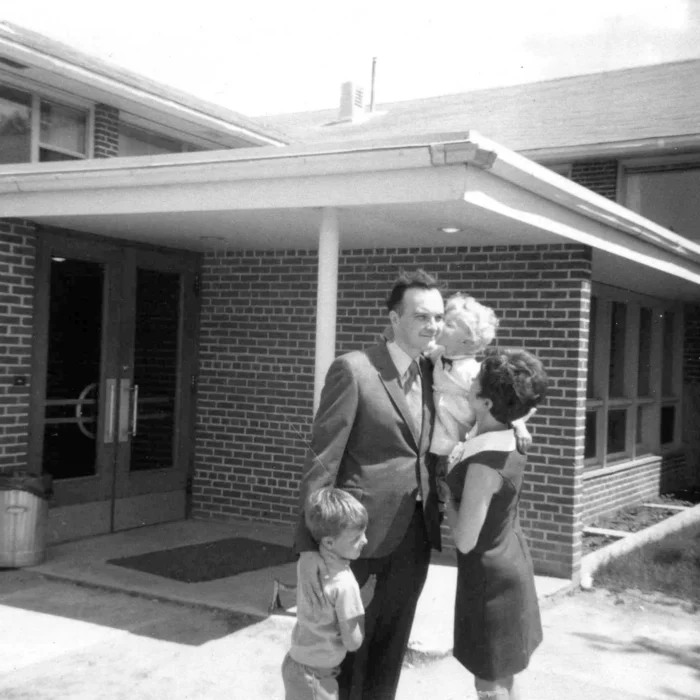 Howard Pawley and Family, 1969, Winnipeg Free Press
Sources
Keep True, Howard Pawley
Howard Pawley, Alumnus and Former Premier Dies at 81, UM Today Alumni
Howard Pawley, University of Winnipeg
Pawley, Howard, Archives of Manitoba
Howard Pawley, The Canadian Encyclopedia
Memorable Manitobans: Howard Russell Pawley (1934-2015), The Manitoba Historical Society
Meech Lake Accord, The Canadian Encyclopedia
Meeting of the Legislative Assembly of Manitoba, March 8, 1988, page 560-591, Hansard Archive
Meeting of the Legislative Assembly of Manitoba, April 7, 1993
Meeting of the Legislative Assembly of Manitoba, Oct 24, 2018
Manitoba Human Rights Code
The Manitoba Human Rights Commission
Heading off Bilodeau: Attempting Constitutional Amendment, Gordon H. A. Mackintosh
Selkirk Journal, 1985, 1987, 1997
Selkirk Enterprise, 1969, 1976, 1977
Brian Really Was Lyin’, Winnipeg Free Press, 2010
Mulroney, me and the CF-18, Winnipeg Free Press, 2011
Howard Pawley and CF-18 Fiasco, Real Estate News, 2011
A champion of Indigenous rights: Murray Sinclair awarded 2022 Loyola Medal, Concordia University