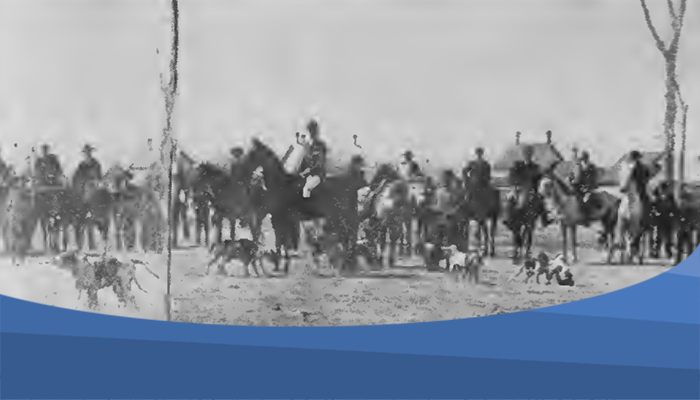
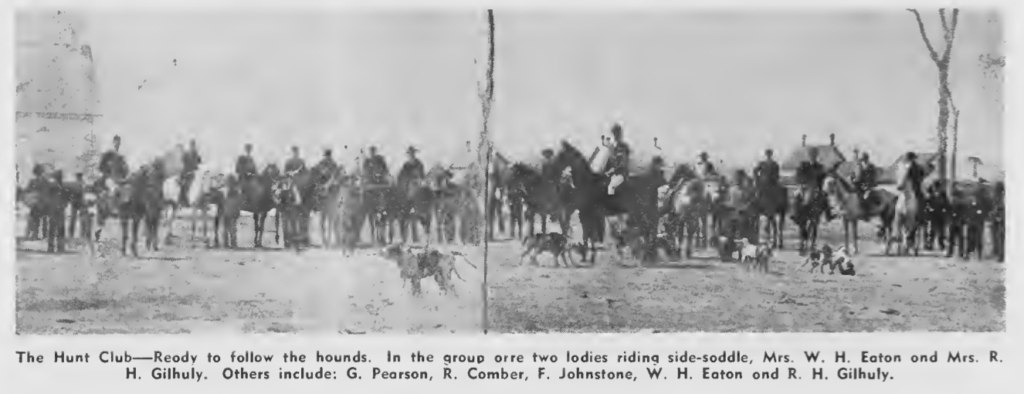
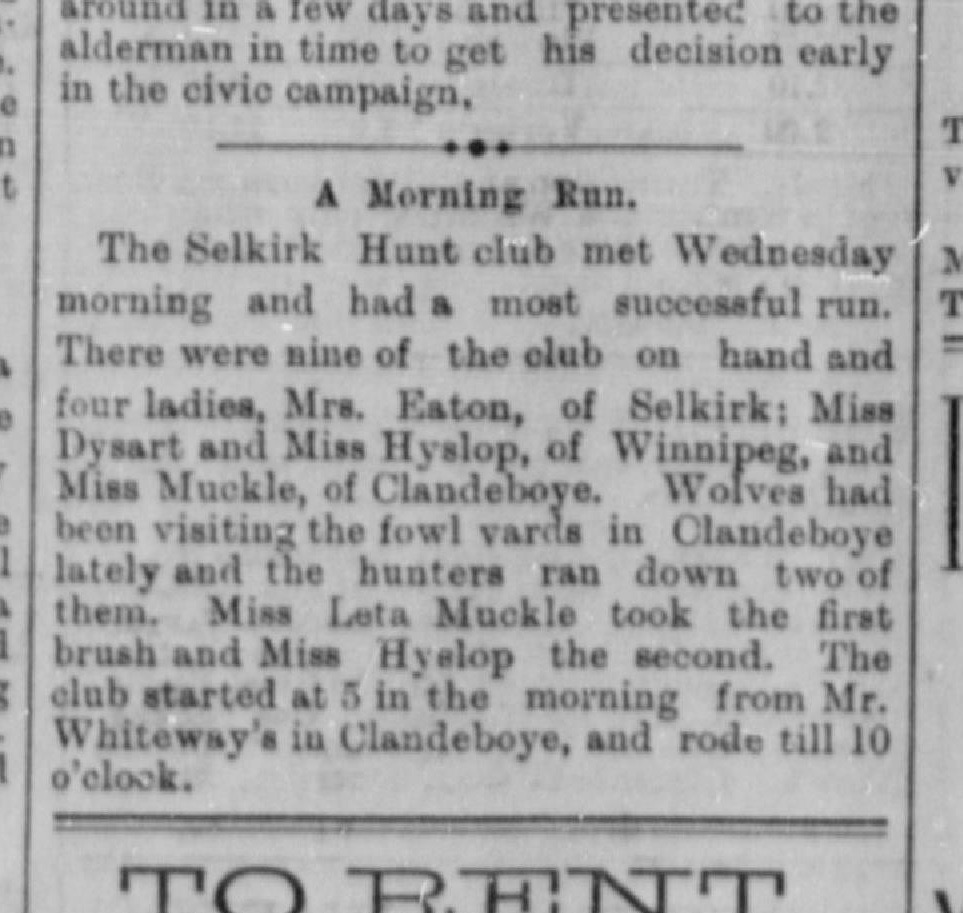
Community organizations and clubs have been at the heart of Selkirk for much of its history, and that includes one of Selkirk’s earliest community groups — the Selkirk Hunt Club.
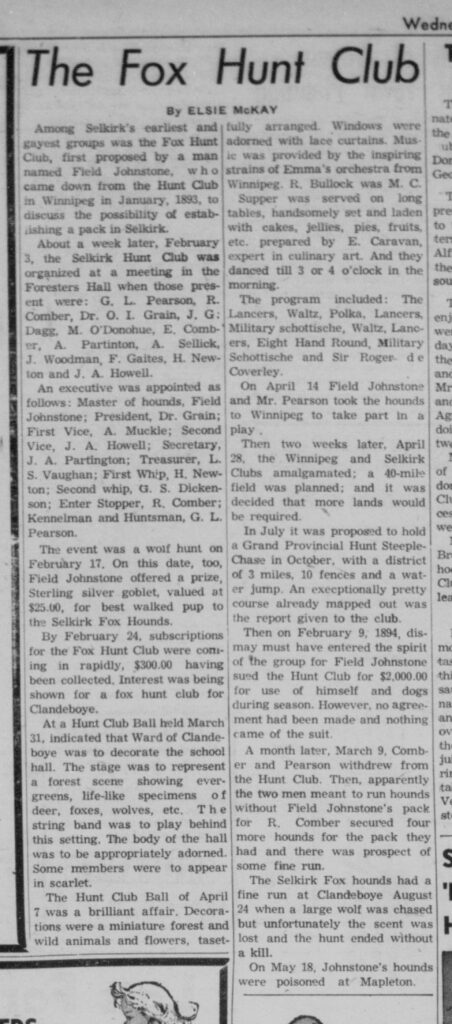
Formed on Feb. 3, 1893, by Field Johnstone, the Selkirk Hunt Club — also known as the Fox Hunt Club — quickly boomed in popularity upon its conception.
The club came to be after Johnstone attended Winnipeg Hunt Club programming, and Selkirk’s new club was described as “among Selkirk’s earliest and gayest groups.” Several notable Selkirk men made up the founding board members of the club, including Johnstone as the Master of Hounds, Dr. Grain as President, A. Muckle as First Vice, J. A. Howell as Second Vice, J.A. Partington as Secretary, L.S. Vaughan as Treasurer, H. Newton as First Whip, G.S. Dickenson as Second Whip, R. Comber as Enter Stopper, and G. L. Pearson as Kennelman and Huntsman.
The Club Quickly Gains Popularity
The club organized several group hunts, the inaugural being held on Feb. 17, 1893. It was on this date that Johnstone was also offered a sterling silver goblet worth $25 for having the best walked pup of all of Selkirk’s fox hounds.
As a subscription-based club, membership fees already brought in $300 by Feb. 24, proving the success and popularity of the club.
The Grand Hunt Club Ball: An Evening of Music, Dancing, and Elegance
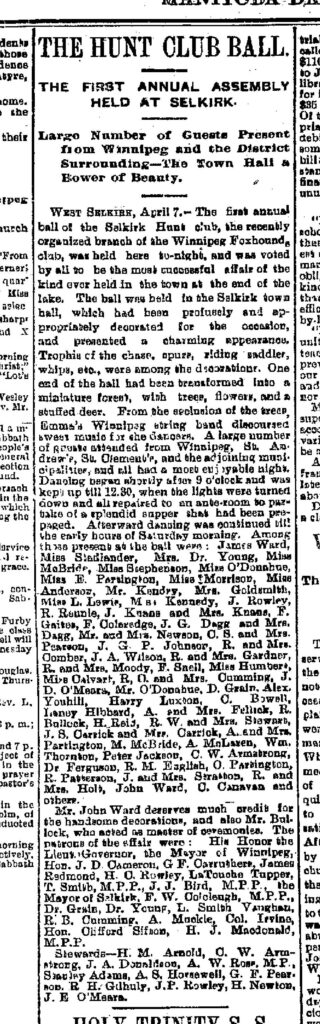
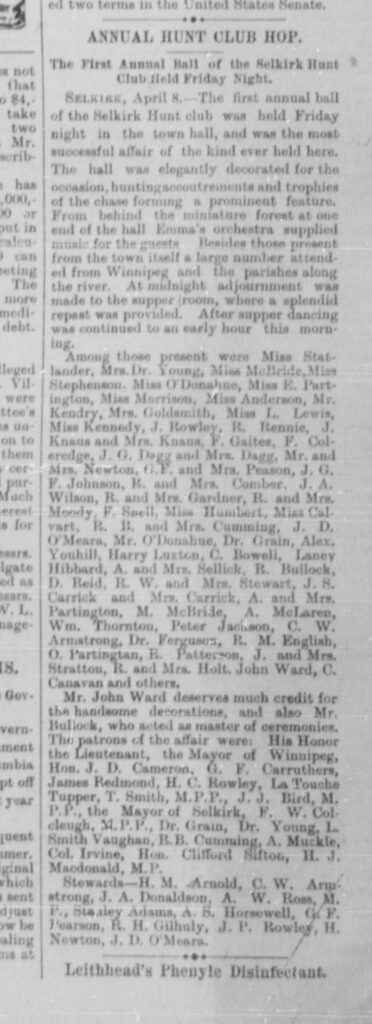
On April 7, an extremely well-attended Selkirk Hunt Club ball was hosted in the Town Hall, inviting guests from Selkirk, Winnipeg, and other communities along the Red River. As described by several newspapers, the hall was “elegantly decorated” and had a “charming appearance.” It was Mr. John Ward who took head of the decorations, adorning the hall from head to toe with flags, bucking, trophies, flowers, lace curtains, and more.
There were several honourable guests, including Mr. Butlock as the Master of Ceremonies, His Honor the Lieutenant, the Mayor of Winnipeg, Hon. J. D. Cameron, the Mayor of Selkirk F. W. Colcleugh, M.P.P. Dr. Grain, Hon. Clifford Sifton, M.P. H. J. Macdonald, and several stewards and other community members.
Guests were entertained by Emma’s Winnipeg String Band throughout the night. Other activities included a “splendid repast” prepared by culinary expert E. Caravan, who served foods on a long table with cakes, jellies, fruits, pies, and more.
An extravagant dance program was another main feature of the night, including: the Lancers, Waltz, Polka, Lancers, Military Schottische, Waltz, Lancers, Eight Hand Round, Military Schottische, and Sir Roger de Coverley. Guests were kept entertained until 3 or 4 a.m., when the ball finally wrapped up for the day.
A Lasting Social Legacy
The impact of the club’s ball was still remembered years later during a Selkirk fashion parade in 1962, where two of the apparels featured included a man’s riding costume symbolic of the Hunt Club, along with a ballgown similar to those worn at the original ball.
Expansion and Ambition
Following the ball, the success of the club continued. The hounds of the club took part in a play in Winnipeg. The Selkirk and Winnipeg clubs eventually amalgamated, expanding the hunting fields, and many hunt proposals took place, including a “Grand Provincial Hunt Sleepless Chase,” intended to take place in October 1893, with an “exceptionally pretty course” planned within a 3-mile district, 10 fences, and a water jump.
Conflict and Controversy
Chaos would soon break loose, as on Feb. 9, 1894, Johnstone sued the club for $2,000 for the use of himself and his dogs during hunting season. Fortunately for the club, nothing further came of the suit and no agreement was made.
Comber and Pearson eventually withdrew from the club a month later and tried to run a pack of hounds without Johnstone’s pack. Finally securing four more hounds of their own, their newly formed pack was described as a “prospect of a fine run.”
On May 18, Johnstone’s hounds were poisoned at Mapleton, sparking an investigation conducted by Chief Clark of Winnipeg, the outcome which remains undocumented in available records.
The End of an Era
In 1895, the club’s reign came to an end following the death of George Pear, who was thrown from a horse while going out on a hunt with Comber, leaving behind only memories of Selkirk’s once-loved Hunt Club.
Sources
Selkirk’s 75th Anniversary, 1957
Harold Newton, Selkirk Museum
Winnipeg Daily Tribune, March 1893, April 1893, September 1893, August 1984,
Winnipeg Free Press, June 1962
Selkirk Enterprise, June 1957