
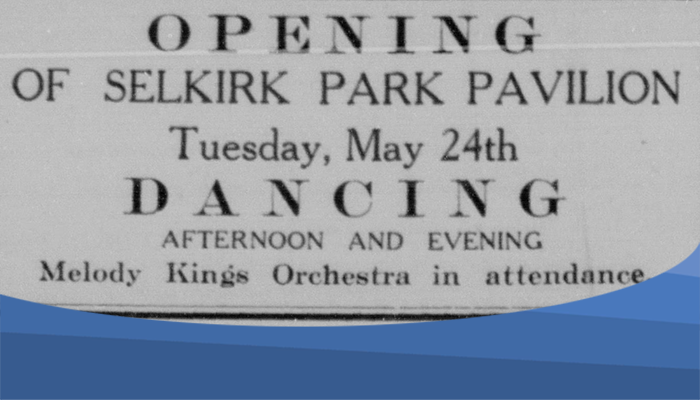
Selkirk Park was once more than a place to enjoy the beauty of nature. During the 1920s, 1930s and 1940s, the park served as one of Selkirk’s most vibrant social gathering places. At the centre of this activity stood the Selkirk Park dance pavilion, a destination that drew residents together for music, movement and celebration.
Building the Lively Environment
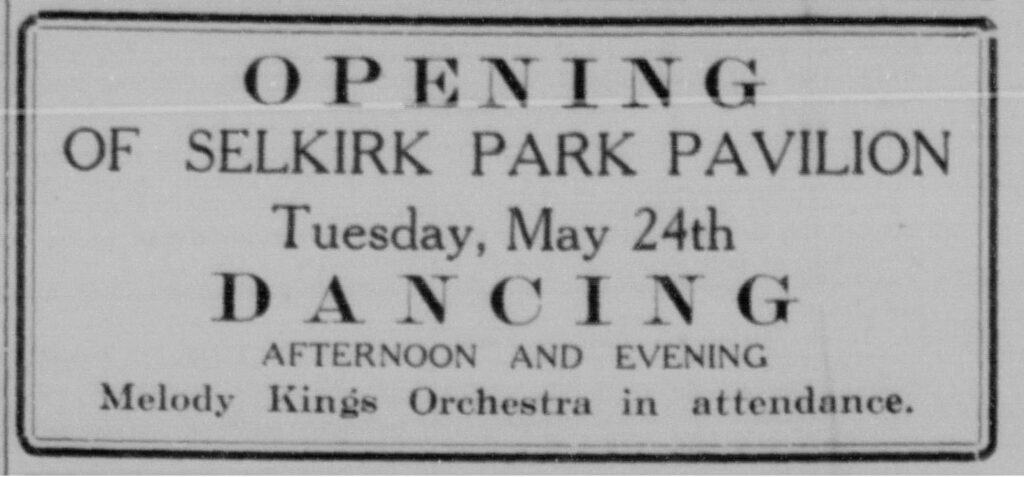
The pavilion was built in 1927 by the Winnipeg Selkirk and Lake Winnipeg Railway. Its construction was closely tied to the railway’s presence in Selkirk Park, where a loop track allowed trains to turn around. Designed for dining and dancing, the pavilion became a popular stop for passengers and locals alike. Ownership of the pavilion belonged to the Town of Selkirk, while operations were managed by Max Finkleman, who oversaw its busy schedule of events.
Originally, the pavilion was a large open-air space that welcomed people of all ages. Frequent socials, picnics, dances and celebrations were held on its expansive dance floor, making it a cornerstone of community life. Food and refreshments were sold from booths set up around the pavilion, allowing visitors to enjoy long evenings without leaving the park. Each spring, ballroom dance lessons were offered for both young people and adults interested in learning or improving their skills.
Music played a central role in the pavilion’s popularity. Live bands and orchestras regularly performed, filling the park with sound. According to several articles published in former newspapers, the music could be heard all the way down Eveline Street, a testament to both the volume and excitement surrounding the events. On warm summer nights, Selkirk Park came alive as couples danced and spectators gathered to take in the atmosphere.
Fire on the Dance Floor
That sense of liveliness came to a sudden halt on May 27, 1936, when disaster struck. A gasoline tank exploded near the pavilion, destroying the booths and dance floor. The incident brought park activities to an abrupt stop. As a Selkirk Enterprise reporter stated, the fire caused, “a complete standstill of the park activities.”
Just two months later, a new pavilion was constructed on the site. Unlike its predecessor, this version featured a roof designed to shield patrons from rain, falling leaves and mosquitoes. While the change offered practical benefits, many residents felt the new pavilion lacked the charm of the original open-air structure.
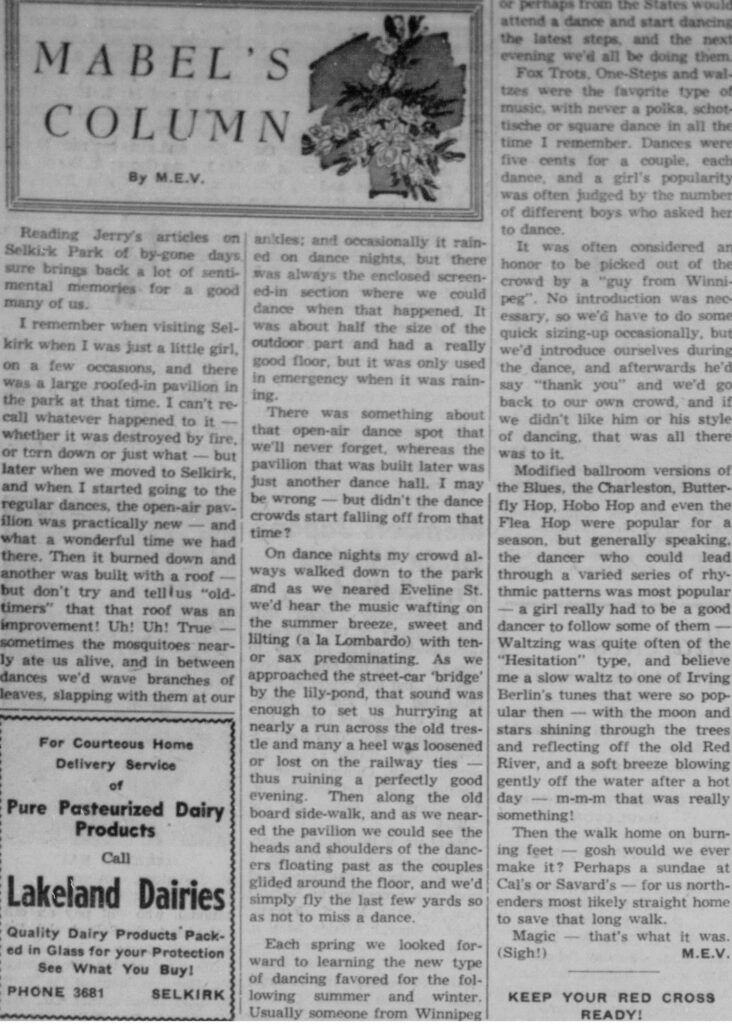
“There was something about that open-air dance spot that we’ll never forget,” Mabel Vogen wrote in one of her Mabel’s Column pieces in the Selkirk Enterprise. “Whereas the pavilion that was built later was just another dance hall.”
Vogen fondly recalled attending dance lessons at the pavilion, including fox trots, one-steps and waltzes. She noted that dances cost five cents per couple and remembered how boys would walk around choosing which girl they wanted to dance with. Being selected was a source of pride and excitement.
“Magic–– that’s what it was,” she wrote.
Fred Linklater also shared his memories of the pavilion in a 1990 issue of the Selkirk Journal.
“At night, the dance pavilion came to life with live bands.” He described young men wearing boaters and spats who bought five-cent dance tickets and let them dangle from their jacket pockets to entice partners onto the dance floor. The music ranged from two-steps to more energetic tunes, including “the brassy tune of Jotta-Jotta, Jotta-Jotta Jing Jing Jing, or maybe the livelier and bolder Charleston,” he noted.
Selkirk Park Pavilion Becomes a Past Phenomena
Despite these lively memories, Selkirk Park’s popularity declined by the 1950s. The park was described as “reaching its lowest ebb,” and attendance at dances dwindled. At the start of the decade, Selkirk council members passed an order to have the pavilion torn down, leaving only memories behind.
In 1955, a Special Parks Planning Committee was formed at the civic offices in an attempt to revive Selkirk Park and its former vibrancy. Although efforts were made to improve the space, the dance pavilion was never rebuilt, and the dances that once defined Selkirk Park never returned.
Sources
Potyondi, B., Selkirk The First 100 Years
Selkirk and Lake Winnipeg Railway (Selkirk Park, Selkirk), Manitoba Historical Society
Selkirk Weekly Record, 1927
Selkirk Enterprise, 1955, 1962
Selkirk Journal, 1990