
In early 1977, the Government of Canada proposed a new prison be built in Selkirk. The project was called the, Manitoba Maximum Security Penitentiary, and it was intended to be an additional maximum-security prison to open alongside the Stony Mountain Penitentiary, increasing inmate populations for the province.
Manitoba minister of Corrections and Rehabilitations, Joseph Russel “Bud” Boyce, also played a prominent role in the decision acting as the voice between the public and government officials.
A Prison Proposal
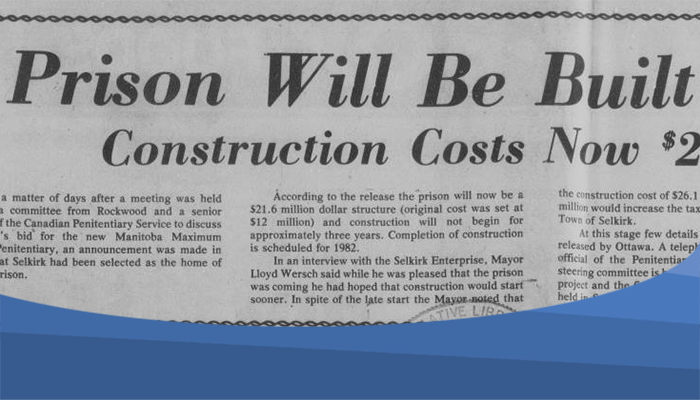
As initially proposed to Selkirk council members, the 100-acre and $12 million two-storey build would house 200 prisoners and be surrounded by a chain link fence. It would begin construction within two years and according to a government spokesperson, the Selkirk prison was supposed to be, “a model for future prisons.”
While the site of the prison was never fully determined, it was proposed to be built north-east of the Selkirk Mental Health Centre near the junction of Highway 9 and 9a. It was later announced that the prison would now sit on 190-acres of land and would cost approximately $21.6 million with the addition of a required protective custody unit. From a federal meeting in Saskatoon, it was determined one institution per province is required to have a protective custody unit, a unit for prisoners who need additional protection from other inmates. Each unit would have their own facilities –– like dining hall, laundry, and recreation rooms –– and would essentially become their own secluded prison. The new unit would pushback to construction timeline, now expected to start by 1980.
Pros and Cons of a Local Penitentiary
Residents voiced their concerns about having a penitentiary in town, and what it could bring to the community.
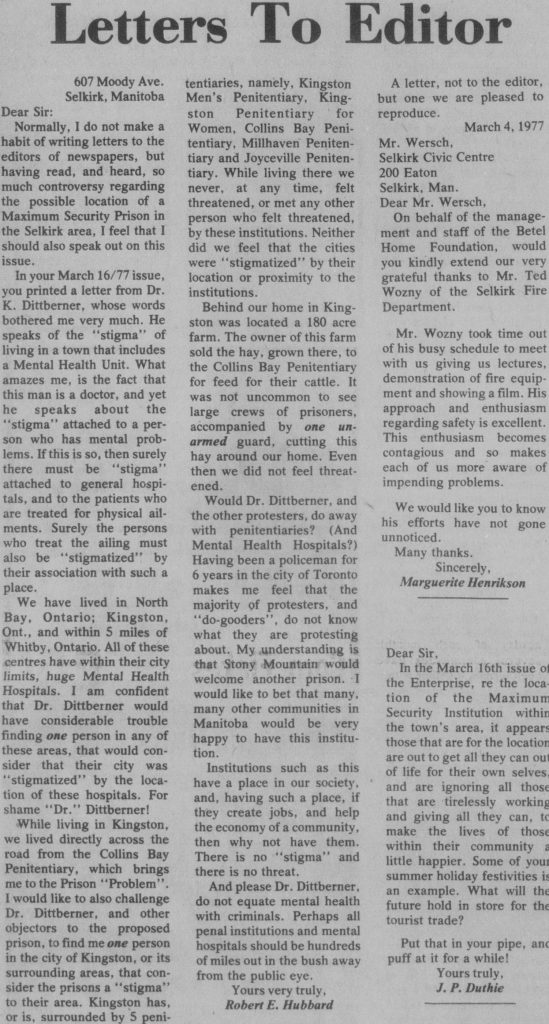
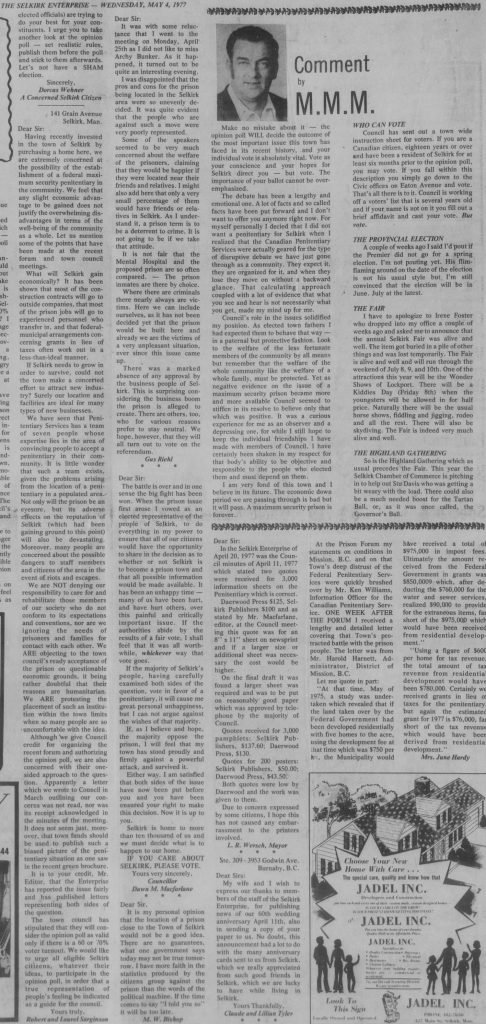
With several discussions and debates taking place in the Manitoba Legislative Assembly, the most vocal consequences were the safety risks associated with prisoners in the area and the need for increased police presence. Strong opinions about the prison circulated around town–– one petition opposing the build even received 1,200 signatures in two weeks. These petitions ultimately led to a referendum being hosted May 11, 1977. The results of the referendum, meanwhile, brought in wavering answers. More than 2,600 had their say and a majority of residents –– two to one –– voted in favour of the prison.
A prison in Selkirk would pose several benefits for the town. The Government of Canada would supply an annual grant worth $340,000 in lieu of tax payments and expenditures for water and sewer payments were also being negotiated. The prison would create 190 jobs to be filled by local residents, with the remainder being filled by transferred professionals–– potentially increasing the population and economy for the town.
Budget Cuts Put a Stop to the Prison
Selkirk’s prison had a positive outlook. Even council members voted in favour –– five to one –– for the building. But come the 1978 federal budget–– Selkirk’s prison quickly became an abandoned project.
With the newly implemented budget restraint program, extreme efforts to control inflation and reduce government spending were made, including scrapping the proposed prison. Since the cut, no additional proposals to build a prison in Selkirk have been made, leaving the 1977 project a moment in history.
Sources
Historic Sites of Manitoba: Memorable Manitobans: Joseph Russell “Bud” Boyce (1924-1984), Manitoba Historical Society
Staudohar, Paul, Effectsof Wage and Price controls in Canada: 1975-1978
Legislative Assembly of Manitoba meeting, March 31, 1977
Legislative Assembly of Manitoba meeting, April 20, 1977
Selkirk Enterprise, 1977