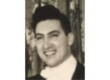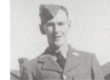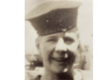

William “Bill” Dalton Little was born in Selkirk in 1920. He served the nearly the entirety of the Second World War. After the war, Bill continued a long career in military intelligence and later became a key figure in Canadian equestrian sport before his death in 2019.
Early Life
William (Bill) Dalton Little was born in Selkirk to Frederick and Helen Little on June 15th, 1920. Bill’s brothers and fellow Dufferin Gang members, Harold Little, Charles Tetroe, and Frank Tetroe also served in the Second World War.
Military Career
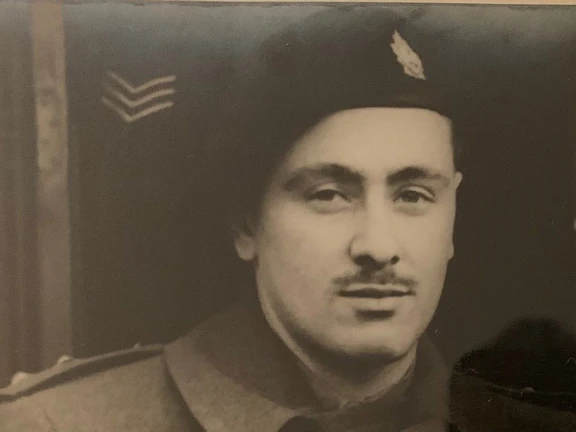
Throughout the 1930s, the Fort Garry Horse in Selkirk ran summer training camps to teach boys and young men how to care for and saddle horses perform drills. Bill, having grown up with horses joined the camp at the age of 15. Like many others did, Bill later lied about his age so that he could enlist as a trooper with the Fort Garry Horse.
In 1937, Bill attended the Royal School of Cavalry in Winnipeg and by 1939, he had achieved the rank of Sargeant. At the outbreak of the war, the Fort Garry Horse changed gears from an armoured cavalry unit to a tank regiment. Training the new ‘mechanical horse’ quickly began in Camp Warden, Ontario. However, the troops had no equipment to train on, so the scrap tanks from the United States were purchased for a few cents per pound. Troops used the tanks for driving and maintenance courses. Bill quickly qualified as ‘Driver, Internal Combustion’ in 1940 and by early 1941, he was qualified to drive tracked vehicles as well.
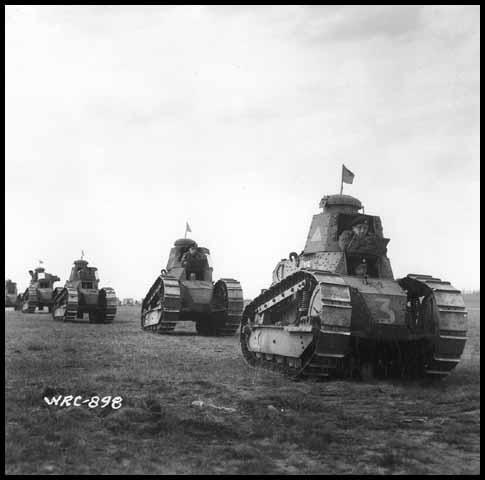
In August 1941, Bill was selected for Officer training in Brockville, Ontario, where he became a Lieutenant. Shortly afterward, the regiment moved to Debert Camp, Nova Scotia in preparation for the transition to Europe. The troops left Halifax aboard the S.S. Oronsay and arrived in Liverpool, England on November 22nd, 1942. While in England, Bill received special training in camouflage, anti-aircraft defense, aircraft recognition, combined tank operations, and amphibious landings.
Bill met Patricia Samson, an army pay clerk at the Metropole Hotel in Brighton. She was there with her parents, who Bill asked if he could take their daughter to dinner. Shortly after Bill and Patricia were married at the Registrar’s Office in Brighton in 1943.
Military Career – D-Day
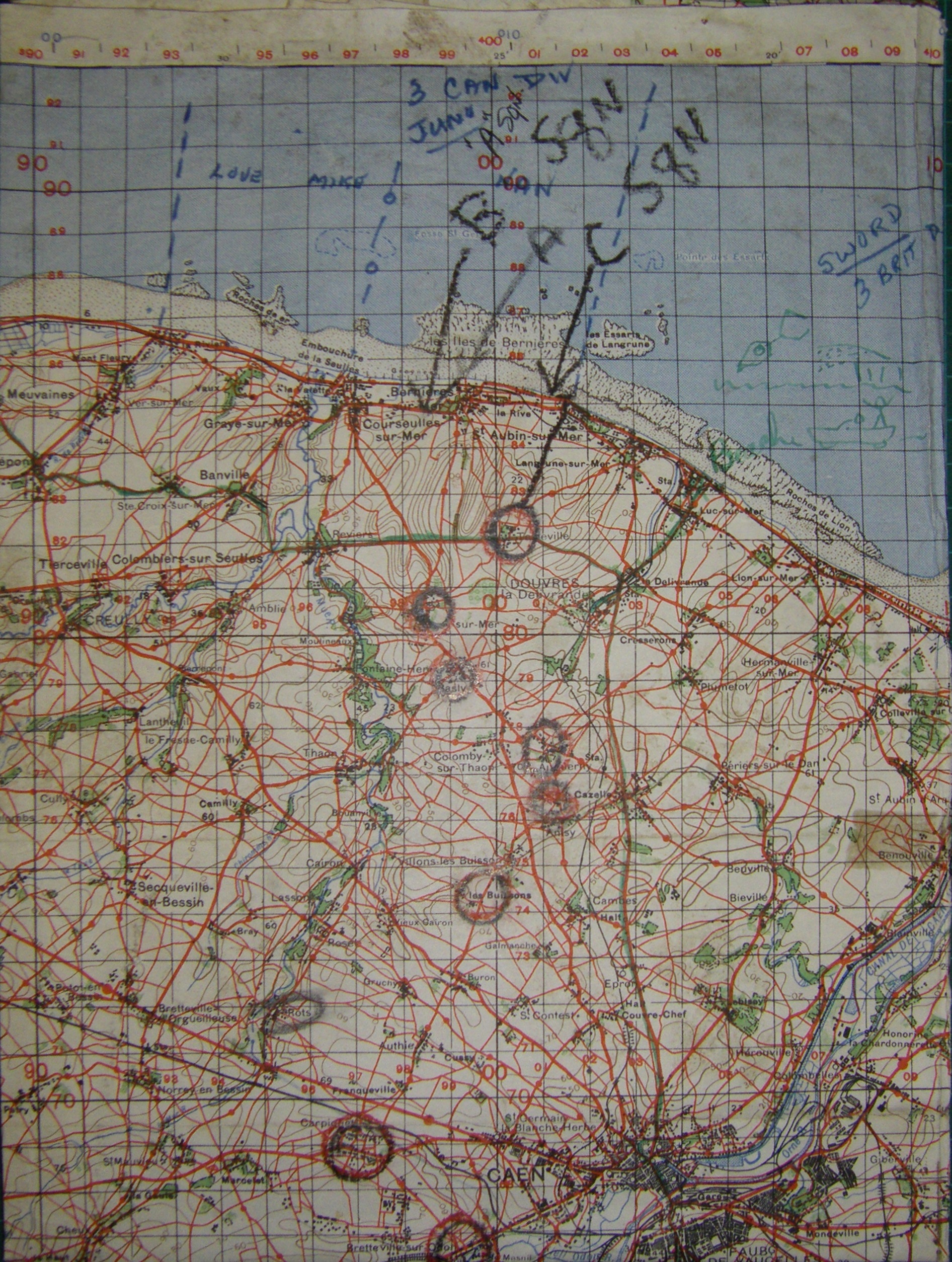
The Fort Gary Horse organized Squadrons A, B, and C for the D-Day Assault. Squadron A remained in reserve until needed most, while Squadron B and C crossed the English Channel to arrive at Bernieres-sur-Mer and St. Aubin-sur-Mer, respectively.
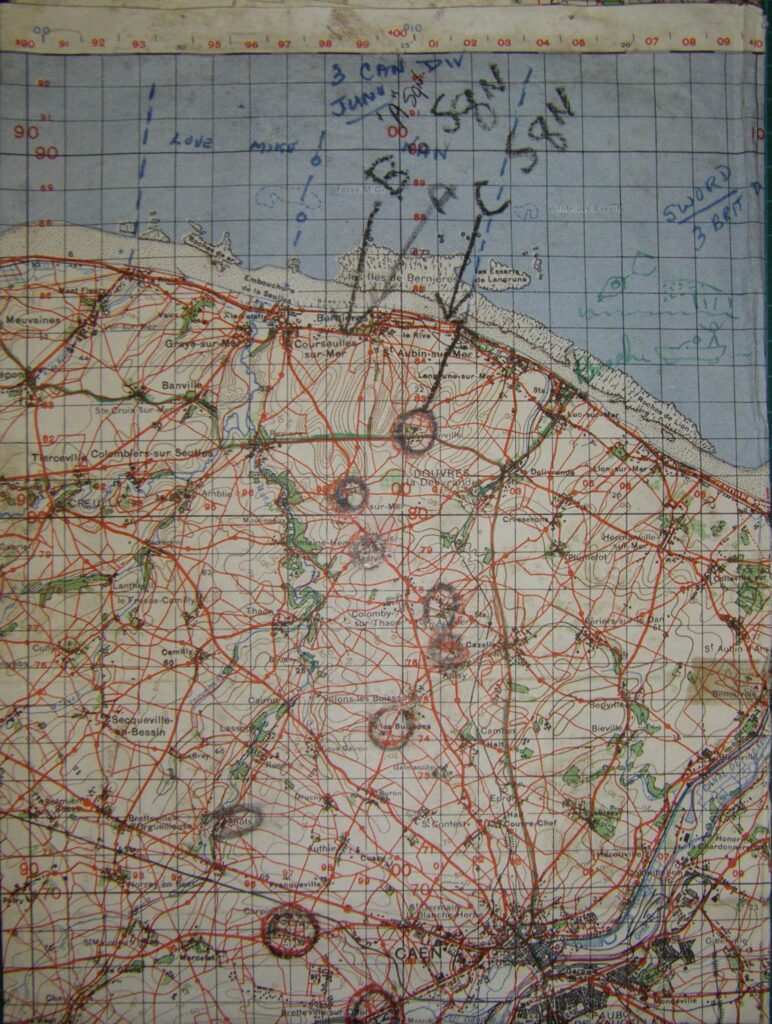
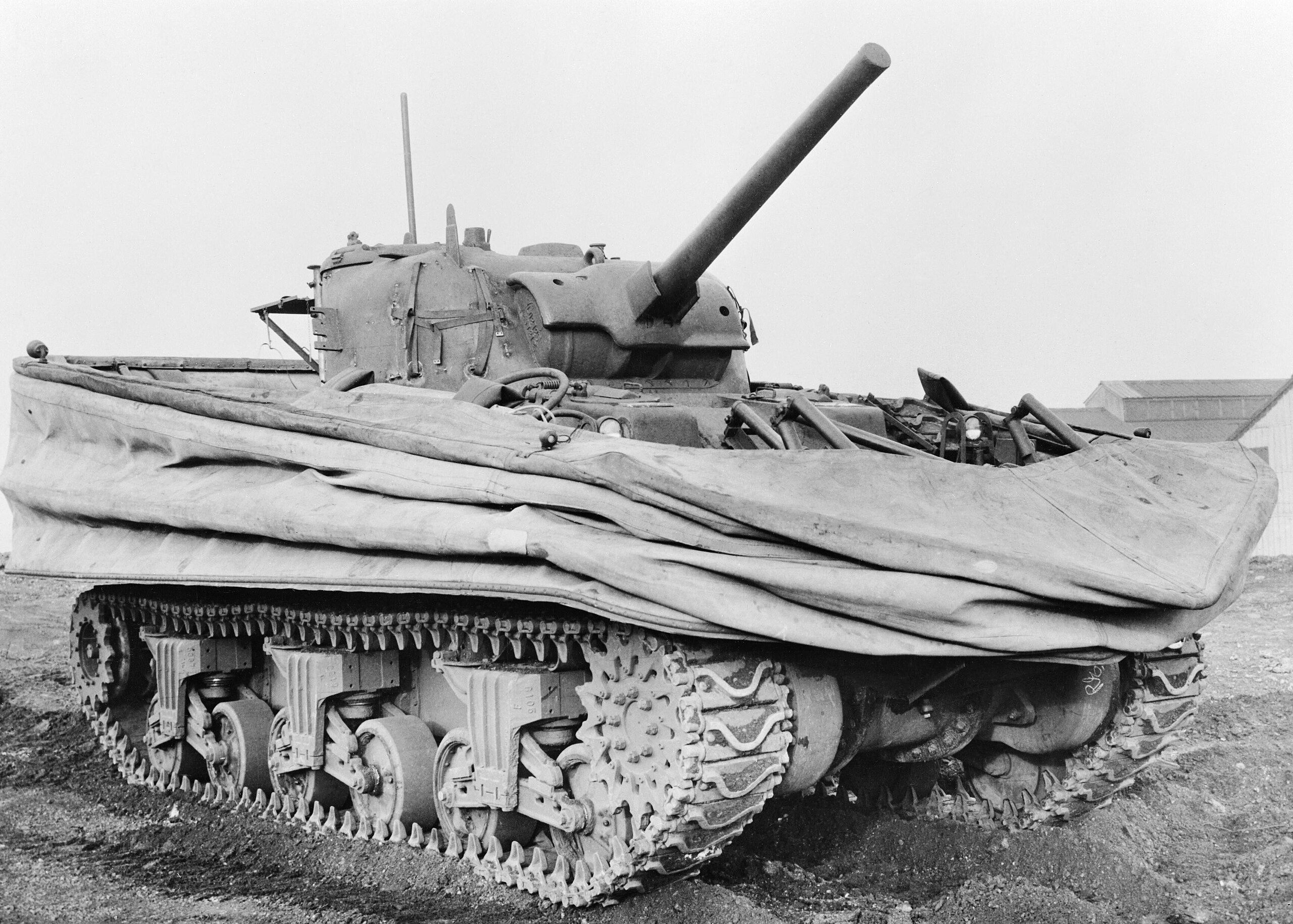
Bill oversaw a troop of C Squadron tanks which included fifteen men – five per tank. Fellow Dufferin Gang members, Blair Gunter, Gerald Gunter, and Jack Gunter were part of C Squadron.
Landing on the beach, C Squadron was immediately met with an 8ft seawall and enemy fire. Four tanks were lost in the landing, and another three were lost crossing a minefield – an alternate route into Tailleville. Once the wall was destroyed, the tanks were able to pass through. Bill’s troop is credited with the successful attack on the German positions in Tailleville.
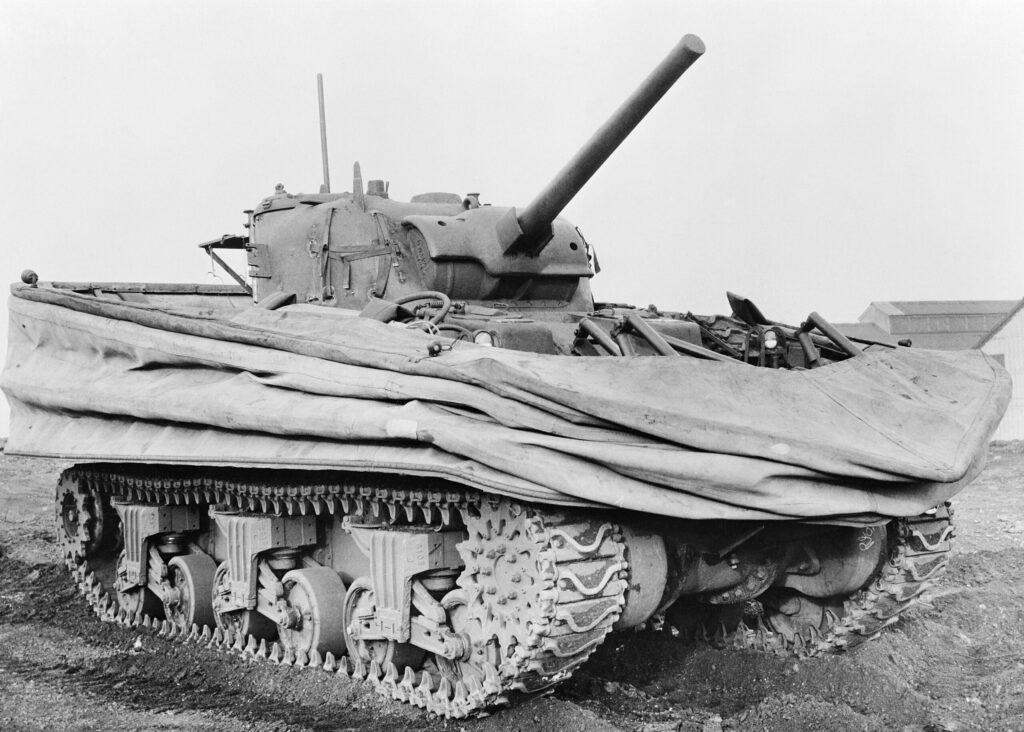
“We lost a lot of men. I was wounded once. I had a body full of shrapnel, which I still carry, from a grenade. We were attacking a town and out on the ground with the infantry chatting about the next move. It was a walled town, and a German threw a grenade over the wall and missed everyone but me.” (Winnipeg Free Press, 2013).
Military Career – Evacuation
Bill was evacuated to a British hospital and then the Canadian Red Cross Memorial Hospital in Taplow. While in hospital, Bill learned that his daughter, Sandra had been born on May 25th.
Her birth came as a shock as “he had completely forgotten that she was pregnant. Completely forgotten. It was wartime,” – daughter, Sandra Tryfon.
After only 5 days in the hospital, Bill convinced the doctor that he was well enough to be discharged from his care. Bill along with three other soldiers were sent to a rest camp in London. Instead of continuing to the rest camp they deboarded the train in London and went south to Portsmouth where they talked their way onto a ship that was leaving for France.
Word made its way to their superiors that Bill and his fellow soldiers had not arrived at the rest camp, and they were charged with ‘absence without official leave.’ Once they returned to their Squadrons in France, the soldiers were instructed to report to General Crear, Commander of the Canadian Army. Expecting much worse, General Crear simply reprimanded Bill, shook his hand, and said, “now go take care of the Germans.”
Bill located the regiment and reunited with C Squadron. Shortly afterward, he was promoted to Second in Command of C Squadron and obtained command of two troops. The Squadron then participated in the Battle for Carpiquet Airfield, a fierce battle with the objective to capture the strategic location of Carpiquet and continue the advance on the Germans. The battle resulted in a partial victory, with the Canadians only securing the town of Carpiquet, but not the airfield.
Military Career – The Netherlands
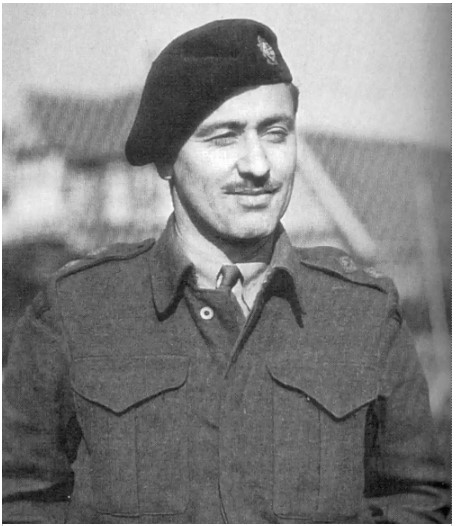
Moving into the Netherlands in October, Bill was assigned to support the infantry in an attack on Hoogerheide. The goal was to overtake the town to cut enemy communications between South Beveland and Walcheren Island. As soon as the infantry advanced, they came under heavy fire. Quickly changing plans, Bill went ahead by foot to locate a better position for the troops. After relocating, he parked his tank in line of enemy fire while the remainder of the tanks made their way to the safe location. From here the squadron was able to cover the infantry and ultimately capture Hooderheide.
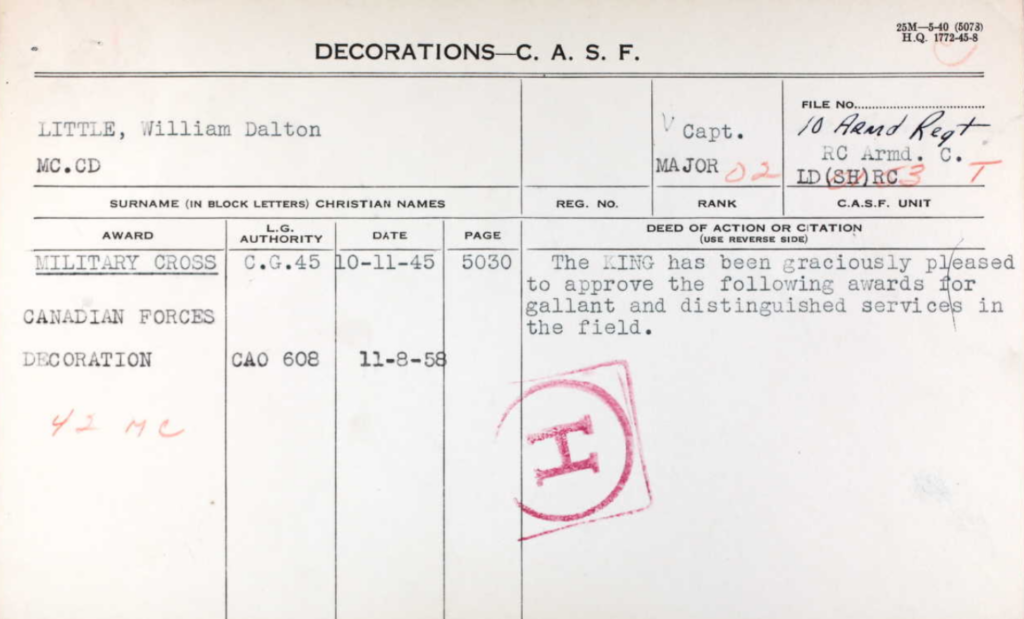
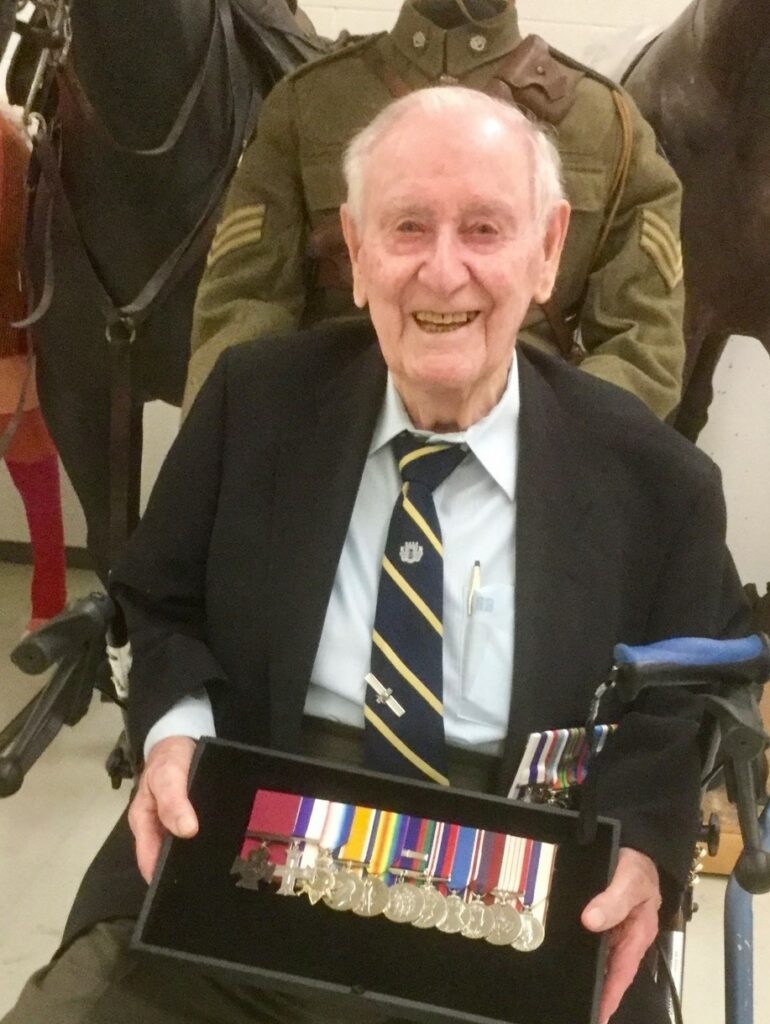
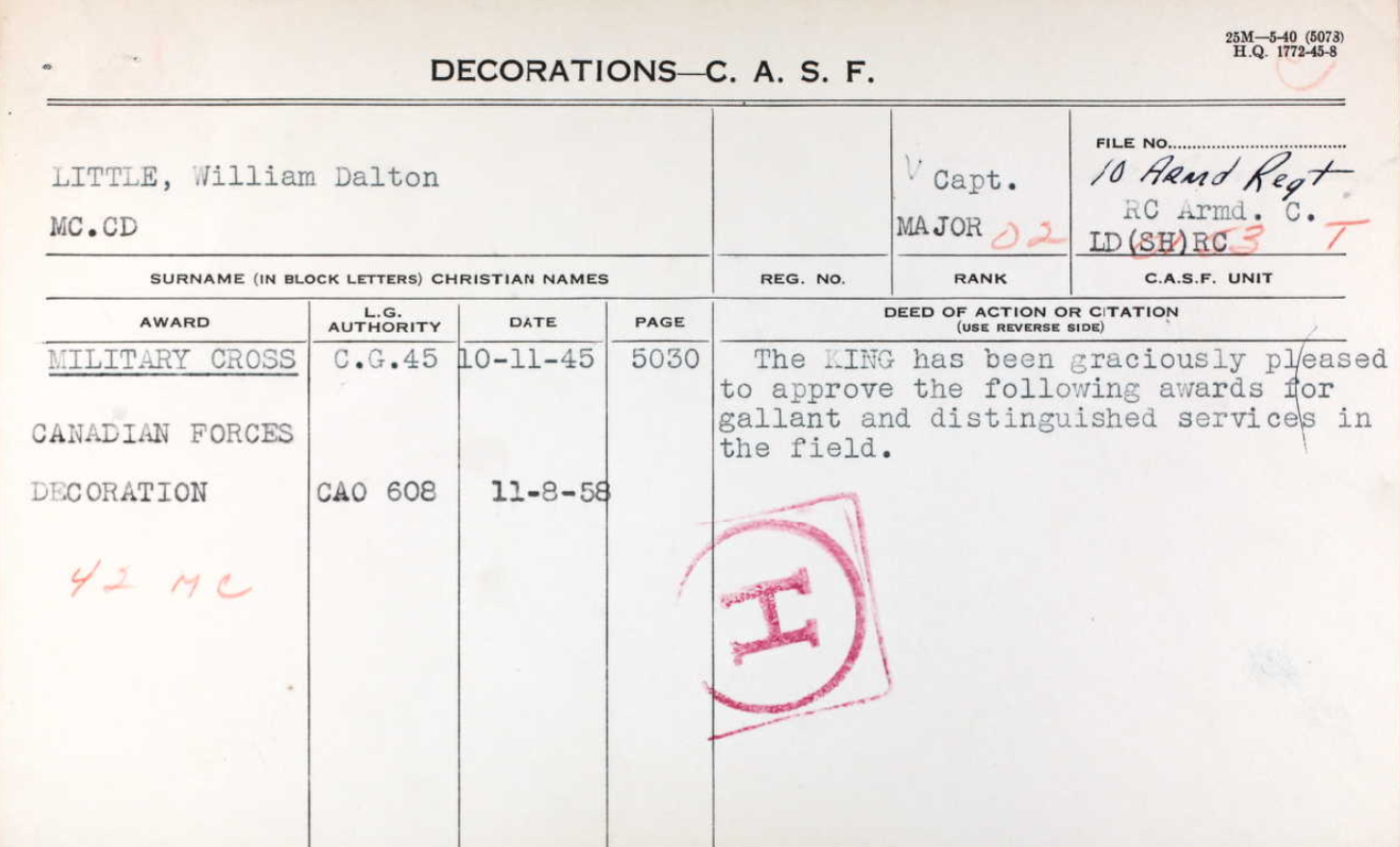
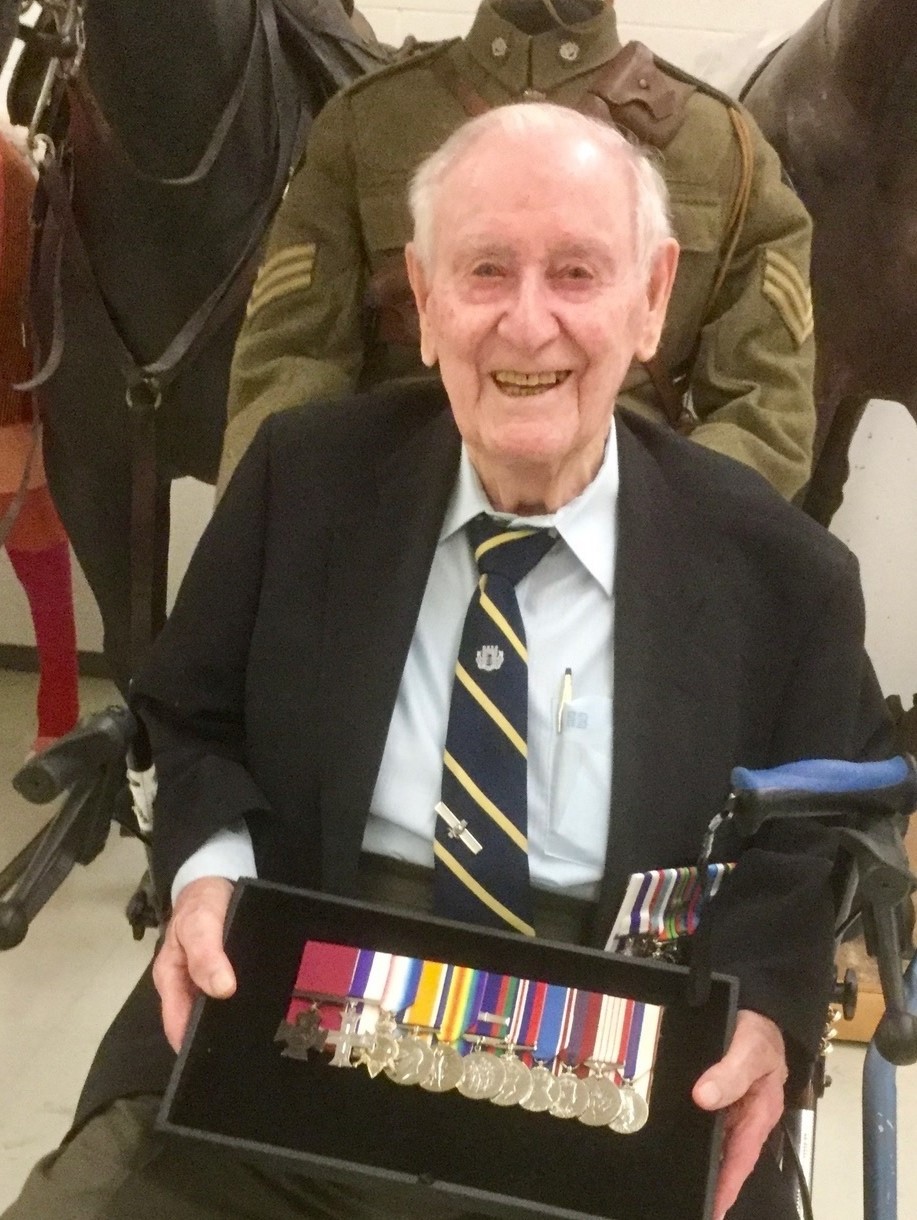
Bill’s personal courage in this battle earned him the Military Cross, an award which was given to soldiers who demonstrated “an act or acts of exemplary gallantry during active operations against the enemy on land”. He was also named to the Legion of Honour in France for his role in D-Day and the liberation of France.
Military Career – Intelligence
As one of the ‘originals’, having served the nearly the entirety of the Second World War, and having a family, Bill was discharged from active service. He returned to his wife and daughter in England before boarding the New Amsterdam to arrive in Winnipeg in June 1945. He spent a short time in Flin Flon where the Fort Garry Horse had a reserve regiment before moving to Camp Warden for a few years where the Royal Canadian Armoured Corps School was formed. He remained there until 1948 when he was assigned to his first job working in intelligence as a military attaché in Ottawa.
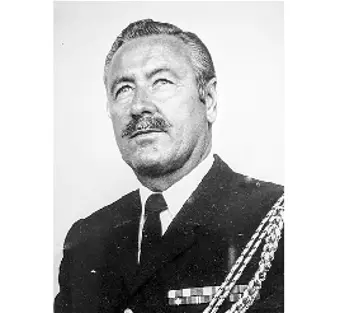
Bill held the Balkan desk from 1946-1950 where he gathered intelligence from countries such as Yugoslavia, Bulgaria, Cyprus, and Turkey. In 1950, Bill attended the Canadian Army Command and Staff College in Kingston, Ontario to study the art of war. He was then posted to Newfoundland for intelligence work from 1952-1955. In 1956, he was posted to the Canadian Military Headquarters in London, England also working in intelligence.
Moving once again, Bill returned to Canada in 1959, where he became Second in Command of the Reformation of the Fort Garry Horse. He was there until 1962 when he was posted to the Canadian Army Command and Staff College. In 1966, he was posted to Cyprus as a military attaché to the Canadian High Commission, advising on Greek and Turkish armies.
Post Military Career
After retiring from 35 years of military service in 1970, Bill entertained his love of horses. He became the Executive Director of the Canadian Horse Council where he was then appointed Competition Director for equestrian events at the 1976 Montral Olympic Games. Everything had to be built from scratch, including planning the cross-country course and building the show rings.
After a successful Games, Bill was selected as the first Executive Director of the Canadian Equestrian Federation in 1977. In 1986, partnered with past colleagues, he brought the World Dressage Championships out of Europe for the first time in history to Cedar Valley, Ontario.
William Little passed away on April 21, 2019, only 55 days from his 100th birthday.
Bill Little Collection
Click on images to enlarge
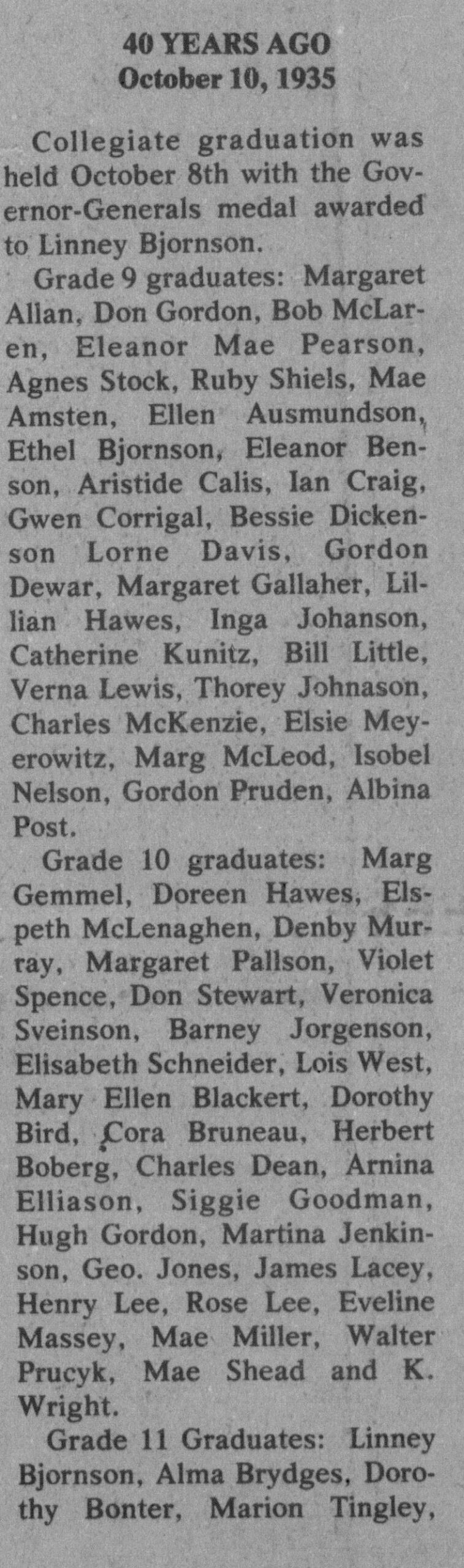
 40 Years Ago, October 10, 1935, 1975, Selkirk Enterprise
Sources
The Fort Garry Horse Museum and Archives
1939-1945, 1939 Mobilization, The Fort Garry Horse An Armoured Reconnaissance Unit in the Canadian Army Reserve
Fort Garry Horse, Juno Beach
In Memoriam: William Little (1920-2019), Equestrian Canada
Interview with William Little: CWM Oral History Project, Canadian War Museum, 2009
Ottawa’s William Little drove a floating tank in D-Day assault, wounded on Juno Beach, Ottawa Citizen, 2019
Ottawa Citizen, 2019
Winnipeg Free Press, 2013
Selkirk Enterprise, 1975