The Independent Order of Odd Fellows was a fraternity founded in England in 1730. The fraternity arrived in Selkirk in 1894 and was assigned the title of Remora Lodge No. 26 and Laurel Rebekah Lodge. The lodges played an active role in Selkirk’s development through fundraising events, community projects, and social initiatives.
Origins
The Order of Odd Fellows is a fraternity, or brotherhood, founded by working class men in England in 1730. Their membership expected a lifelong commitment to each other and their goals. They aimed to care for its members who fell on hard times prior to the existence of any government welfare, health care or job security programs. Its origins were non-political and non-sectarian, but were considered by some to be the predecessor of trade unions because the fraternity levied additional funds or strike pay to their benevolent funds.
The order arrived in North America in 1819. The Independent Order of Odd Fellows (I. O. O. F.) was founded by Thomas Wildey in Baltimore, MA. With its roots buried deep in its origins, their mission statement reaffirms the fraternity’s commitment to its membership:
“We endeavor to bridge the gap of differences and services venue where acquaintances and even enemies can become true friends using the purest and practical form of fraternity. We are simply about promoting the culture of caring and sharing, of not leaving each other behind, of thinking beyond self, and of helping others in need. The Command of I. O. O. F. is to visit the sick, relieve the distressed, bury the dead and educate the orphan.”
In 1851, the Odd-Fellows was the first national fraternity to accept both men and women. Members of the female order, Daughters of Rebekah, could belong to either the Odd Fellows, the Rebekahs or both. However, membership to the Odd Fellows or Rebekahs was limited to white people only. The American Civil War was fought from 1861 to 1865 and it shattered the I. O. O. F. especially in the south. Following the Civil War came the growth of industrialization and poor working conditions, and with it, deteriorating social circumstances. The original mission statement of the I. O. O. F. was reaffirmed and it brought many members back and the lodges thrived. By 1889, there was a lodge in every US state and by 1896, it was the largest of all fraternal organizations, even exceeding the Masonic Lodges. However, it would take until 1971 before the ‘whites only clause’ was removed.
The Odd-Fellows in Selkirk
The I. O. O. F. is a Triple Link Fraternity and can be recognized by a simple symbol of three chain links titled; Friendship, Love, and Truth.
Their main object to improve and elevate the character of mankind, to help make the world a better place, to live by organizing charitable projects which benefit the youth, the elderly and less fortunate.
The I.O.O. F. was established in Winnipeg in 1873 for both men, and for women. Eventually, Our Home for the Aged in Charleswood was built and maintained solely through Odd Fellows and Rebekahs fundraising efforts.
On January 29, 1894, the Odd Fellows arrived in Selkirk. A special ceremony was held in the hall above Finkleman’s Store. Grand Lodge officers from Portage La Prairie, Turtle Mountain, Estevan, and Winnipeg were present for the installation of the next I. O. O. F. lodge. It was assigned the title of Remora No. 26. At the time, fishing was considered a main industry, but why remora, a fish common to salt water oceans was assigned as the title is unknown. The ladies’ lodge was named Laurel Rebekah Lodge No. 67.

The original charter members included three of Selkirk’s greatest early builders and promoters; Edwin Comber (town councillor, school board member, warden of Christ Church, librarian), James G. Dagg (town councillor, founder of Dynevor Hospital, president of the Liberal Association, insurance agent), Dr. O. I. Grain (physician, member of Christ Church, president of Selkirk Hunt Club, MLA for Kildonan-St. Andrew’s).
The members of Remora Lodge No. 26 first met in the Dalman Block on Manitoba Avenue. It was home to many other groups. Eventually they would own the Clandeboye Hall where they would meet, but also use as a source of income from hall rentals. In the early years they concentrated their fund-raising efforts on hosting annual dances on New Year’s Eve, Valentine’s Day and St. Patrick’s Day, They also hosted boxing matches. A whist drive was also held in support of Hong Kong P. O. W. There was also annual church parades held in conjunction with Christ Church. Following the death of Queen Victoria, a special requiem service for ‘Victoria, the Good’ was held. It included a public procession through Selkirk with the Remora Lodge No. 26 represented, as well as seven other service groups, the school board, town council and mayor.
Milestones in Community Building
On the morning of July 1, 1905, 1,200 members of the International Order of Odd Fellows left Winnipeg for Selkirk aboard steam trains operated by the Winnipeg Selkirk and Lake Winnipeg Railway (WS & LW). They were greeted by Selkirk’s Oddfellows before walking a couple of kilometres to Selkirk Park (formerly Red River Park) to participate in the opening day and enjoy picnics, sports, and dances. This event marked an important milestone in the history of the I.O.O.F. in Selkirk and remains a memorable chapter in the city’s development.
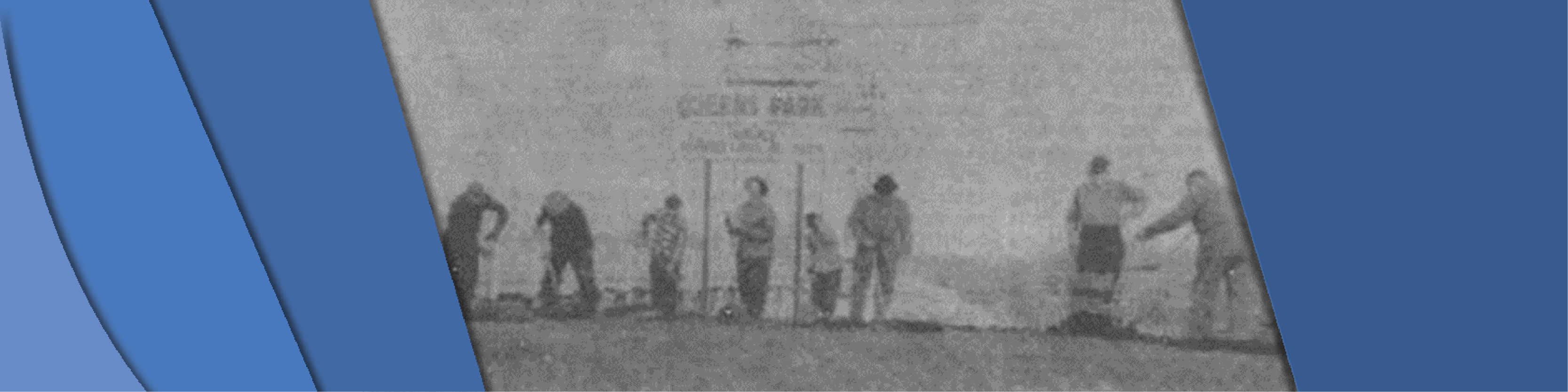
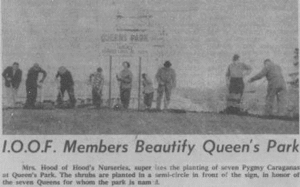
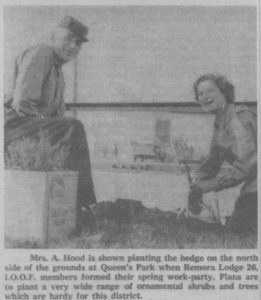
Building on this community spirit, one of the major projects undertaken by the Lodge was the development of Queen’s Park. It was a site that sat vacant since the building of the Selkirk Lift Bridge in 1935. In 1951, the Lodge leased the land from the town so that it could be beautified by its members over two summers. The new park space was named to honour Queen Elizabeth II on the day of her coronation, June 2, 1953. In 1963, R. H. Welham, representing the I. O. O. F. complained to the town council about the amount of vandalism that was occurring. The space was officially returned to the city. This didn’t deter the Lodge from continuing to make improvements over the next ten years. They engaged in Spring work parties to plant trees and ornamental shrubs.
The membership also dedicated their efforts to fully furnish a ward in the Selkirk General Hospital. They donated a special ‘sleeping chair’ to Red River Place that allowed a family member to keep vigil next to their loved one nearing the end of life. They also sponsored youth delegates to attend a yearly gathering of the United Nations in New York City. Community service through volunteerism was evident over the decades.
Prominent Members
Fraternal organizations such as the I. O. O. F. encouraged an active membership, and their rosters were often made of community builders. In addition to E. Comber, J. G. Dagg and Dr. O. Grain, other charter members included J. Cameron, T. Dobson, J. W. Joyce, W. Overton and D. F. Reid. Their names would consistently appear in various aspects of Selkirk history.

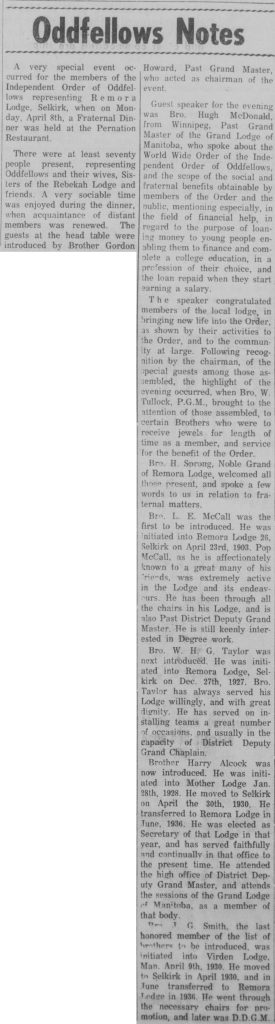
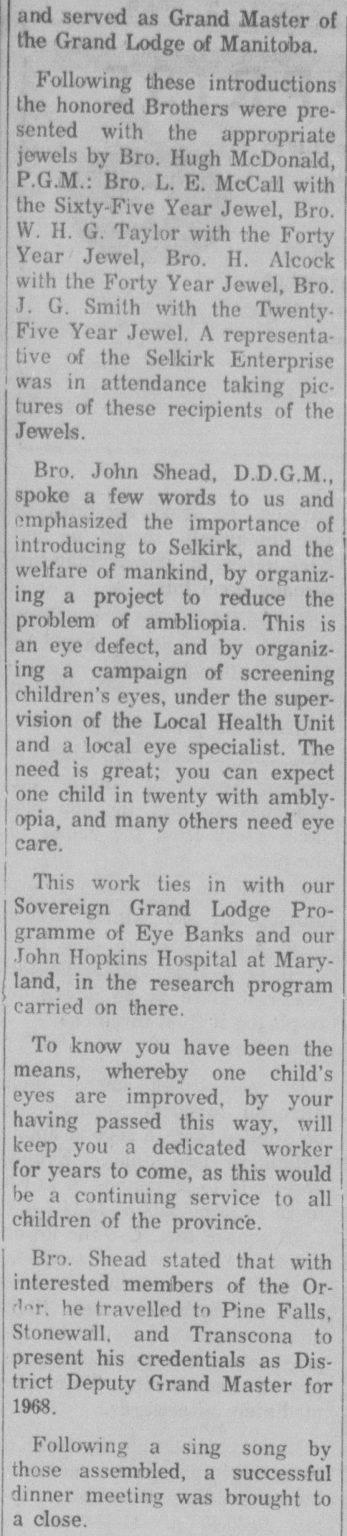
In later years, members like Gordon Howard and Benjamin Massey continued this tradition of community involvement, further strengthening the organization’s presence in Selkirk. In 1947, Mrs. Lily Gawne was elected provincial president of the Rebekah Lodge, and Mr. Jerry Smith was elected grand master of the Grand Lodge of Manitoba. Another prominent boat builder and local businessman, Roderick Smith (1850-1925) would become an active member. The last local president was John Shead (1937-2023) who was so highly involved in various community initiatives that he was recognized as Selkirk’s Citizen of the Year in 2001.

There are currently 10,000 Lodges with 600,000 members worldwide. The I. O.O. F. Remora No. 26 Branch and the Rebekah No. 67 in Selkirk are still in operation.
When Friendship, Love & Truth abound among a Band of Brothers,
The cup of joy goes gaily round each shares the bliss of others.
Then let us be social, be generous, be kind,
And let each take his glass and be mellow,
Then we’ll join heart and hand, leave dissensions behind,
And we’ll each prove a hearty Odd Fellow.
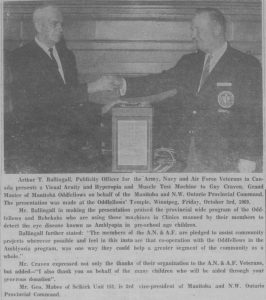
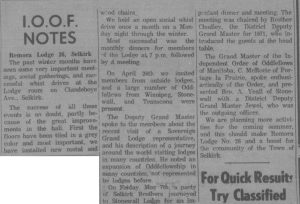
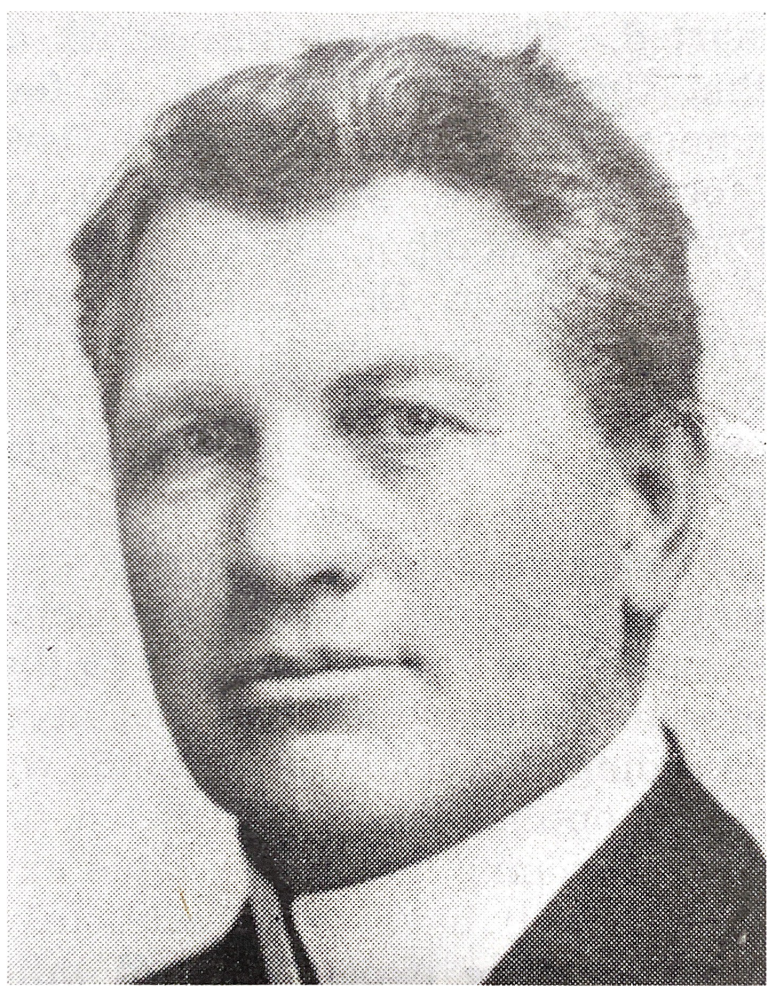
Independent Order of Odd Fellows Collection
Click on images to enlarge
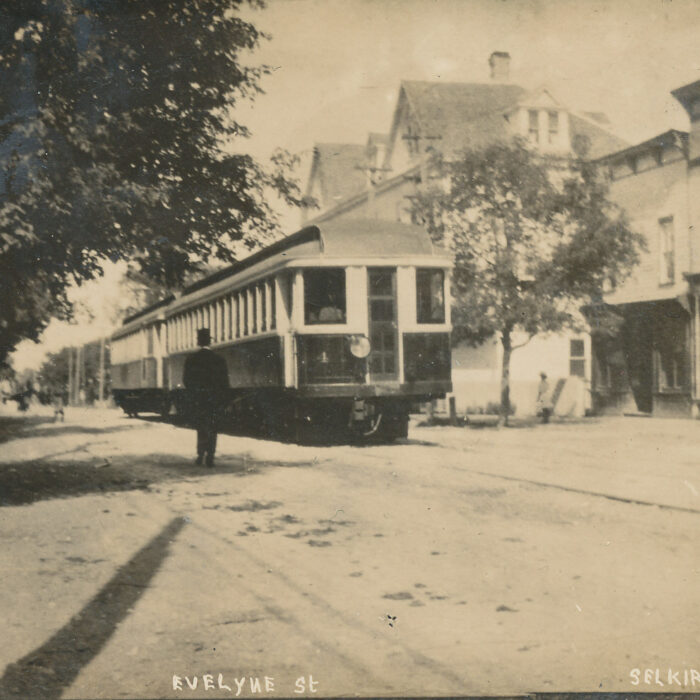 Selkirk Picnic Trail on Eveline with View of Finkelman's Store on Right, 1910, Archives of Manitoba George Harris Fonds
Sources
George, Jane & Doreen Oliver, Gathered in His Name, (www.mb1870.org)
Ingebrigtsen, Jim, www.lifestyles55.net
Selkirk 75th Anniversary, www.wordpress.com/selkirk
Thank-you to Odd Fellows brother, Tom Tullock, who provided his recollections of the Lodge in Selkirk.