
Captain Canuck was created in the 1970s by Ron Leishman and Richard Comely, who worked through significant financial and production challenges to publish a uniquely Canadian superhero comic. Captain Canuck, illustrated by Selkirk resident, George Freeman, quickly grew a following because the character reflected Canadian pride. Although the original comic ended in 1981, Captain Canuck remains an enduring symbol of Canadian identity and culture.
The Rise of a New Superhero
Captain Canuck’s origins began in 1972, when Ron Leishman and Richard Comely met through the Church of Jesus Christ of Latter-Day Saints in Winnipeg. The pair began fleshing out a character Leishman had been drawing, named Captain Canada later renamed Captain Canuck. Efforts to put this character to print were in danger of losing momentum when Leishman departed for missionary work, and attempts to secure government funding and loans proved fruitless.
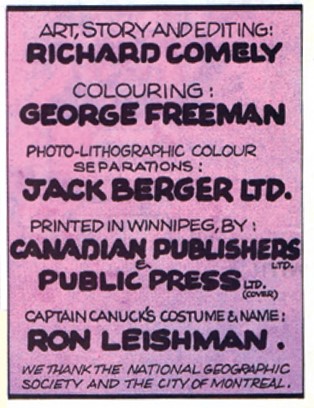
Comely was undeterred. With a herculean display of grassroots power, Comely not only took out loans, sold advertising space, secured a printer, and lined up nationwide distribution for Captain Canuck #1, he also leveraged his background in commercial art to singlehandedly co-write, draw, and colour the content inside. Where the leading American comic book publishers would have multiple staff and freelancers working to coordinate all of those tasks, Captain Canuck was realized in a small office at 1854 Portage Avenue in Winnipeg, Manitoba. “I even sweep the floor myself.”, Comely stated, perhaps apocryphally.
“Canada finally has her own honest-to-goodness comic magazine, with Canada’s own superhero – Captain Canuck!”
Printed in all-caps on the first page, these words heralded the arrival of the first issue of Captain Canuck. 199,000 copies began distribution in May of 1975, through mass-marey newsstand distribution and in border states such as New York, Michigan, and Ohio. You would be hard pressed to find a Canadian comic reader who doesn’t have a memory of encountering this book upon its release.
Making Canada Proud
Readers who picked up the first issue encountered a bold vision of Canada set in 1993 – almost two decades into the future.
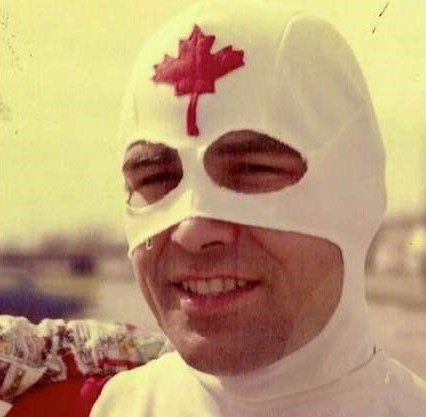
“The predictions of Canada becoming the most important country in the world became a reality in the 1980’s. This posed new threats and problems for Canada’s leaders and for the countries that depend upon Canada’s supply of natural resources.” – Richard Comely, 1975.
While comic books featuring Canadian characters experienced a Golden Age during the Second World War, the majority of entertainment consumed by post-war Canadians was created by Americans, about Americans. The near-complete absence of Canadian characters and locations in popular culture, and superhero comics in particular, implied that “Canada was a backwater bereft of heroes, bereft of guardians.” – John Bell. Encountering a comic book depicting their home country as a global superpower was seductive to comic readers – mostly young males aged 15-35.
Captain Canuck’s appeal to nationalist sentiment was intentional. “National pride and patriotism are worthy attributes”, Comely wrote in response to fan mail that was printed in Captain Canuck #3. The appearance of Captain Canuck on newsstands alongside American superheroes like Superman and Spider-Man made an undeniable statement – Canada was ready to be “a center rather than a periphery of the comic book publishing industry.” – Dittmer and Larsen.
The timing could not have been more perfect. The book and character gained momentum from a wave of Canadian nationalism that had begun with the release of the Massey Report a quarter century earlier, which made clear “the very present danger of permanent dependence” on American culture. By the late 1960’s, Canadians positioned their expressions of patriotism as a mosaic of multiculturalism, understanding, and acceptance, against the “American melting pot, tarnished by race riots and Vietnam violence.” – Ryan Edwardson.
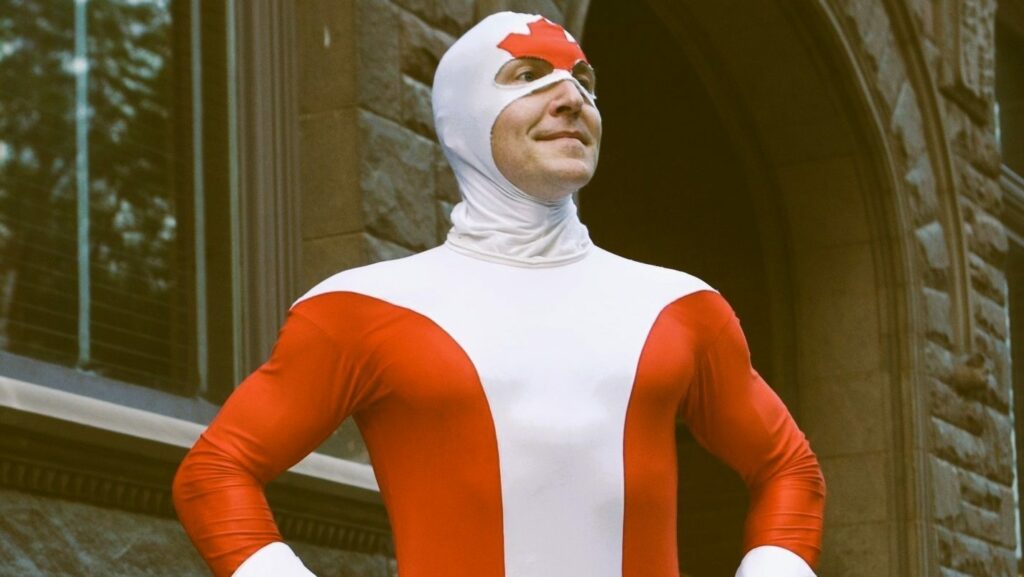
Purposefully, Richard Comely’s first three issues of Captain Canuck set out to contrast the default tropes of the American comic book. Superheroes south of the border had over-the-top fantastical powers and origins – Captain America was part of a secret government project that exponentially augmented his mind and muscles to create a Super Soldier of the American government. Playing against this, Captain Canuck’s abilities came from “a strong, clean mind,” “a good wholesome diet and lots of exercise.” – Richard Comely. The Canadian readership “felt it expressed a less aggressive and ultimately more authentic form of superhero than the American brand.” – Dittmer and Larsen.
Survey research on national pride shows that “Canadians are, statistically speaking, among the most patriotic citizens in the world,” (Gregory Millard, Sarah Riegel, and John Wright), historically favouring a ‘soft’ patriotism to distance their pride from “the boorishness or vulgarity of the American version.” – Dittmer and Larsen. ‘Loud’ patriotism is reserved for appropriate moments – reactions to threats to our sovereignty and athletic performances in Olympic competitions are two recent examples where public displays of Canadian exuberance are contagious.
Captain Canuck’s arrival was a similar moment where younger Canadians felt comfortable being ‘loud’ about their patriotism. The character “embodied the Canadian flag, clad in a red and white costume adorned with maple leaves.” – Ryan Edwardson. Ten years before Captain Canuck’s first appearance, Canada’s National Flag and its clean and modern maple leaf iconography replaced the Canadian Red Ensign as the new symbol of the country. It was a bold act towards independence from its British colonial origins. The costume “signified his Canadianness,” and for the younger demographic of readers, Captain Canuck was their first experience with national identity.
Overcoming Challenges
Canadians interested in the iconography had avenues other than comic books through which they could participate. Comely connected with merchandisers to offer “a barrage of items, including T-shirts, posters, iron-on crests, pens, pins, and doodle posters,” (Ryan Edwardson) which went on to be sold in Eaton’s department stores in western Canada.
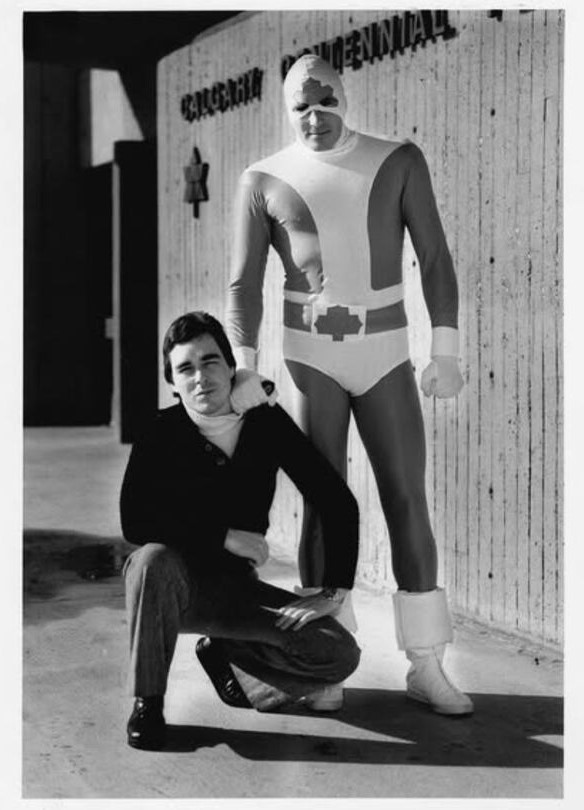
The shirts, hats, and merchandise kept Comely afloat. Despite Captain Canuck’s popularity, the high costs of publishing a book in Canada meant that every issue “cost more than twice as much to produce than the U.S. comic magazines.” Higher production costs meant higher prices for readers. The book’s cover price was 40% higher than its American contemporaries. Comely outlined his pricing plans to readers on the opening page of Captain Canuck #2: “One of the ways to (bring costs down) is to increase sales by distributing throughout the U.S as well as Canada. Once the print runs increase significantly, the cost of your copy decreases.”
While the one-man, grassroots production effort appealed to Canadian sensibilities, the art and story were identified as an obstacle preventing the book from reaching a wider audience. A July 1975 Time magazine article focused on the book’s “amateurish quality” and “often clumsy artwork and story line.”
The Selkirk Connection
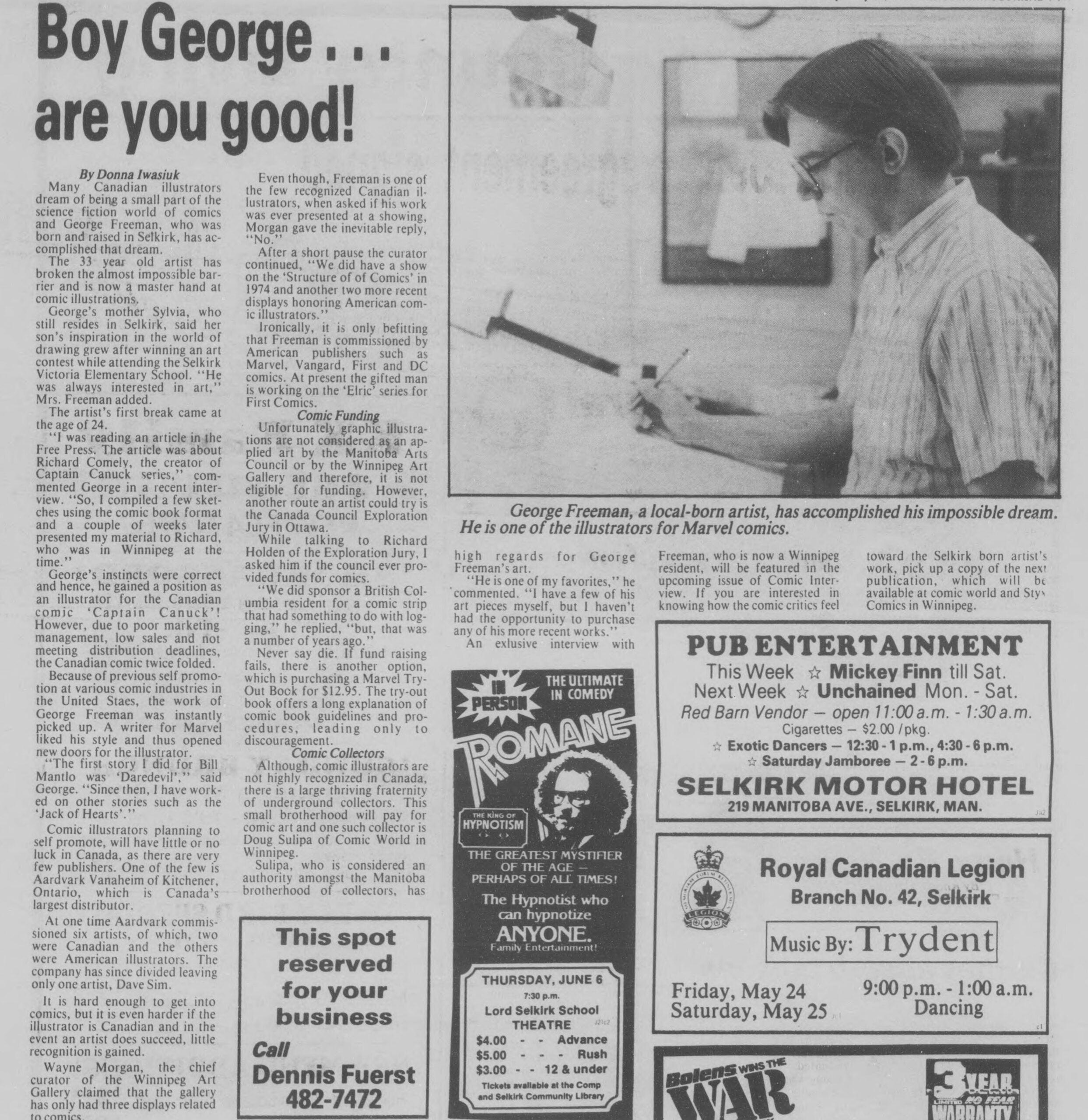
Comely was serious about expanding into the American market, and this was no longer a job for a single person. Enter George Freeman. Born in Selkirk, Manitoba in 1951, George Freeman had an early aptitude and love of drawing. As a young student at Victoria School (now known as Ruth Hooker School), Freeman possessed the aptitude to win an art contest, which spawned a love for drawing that set him on a course to become a lifelong professional artist.
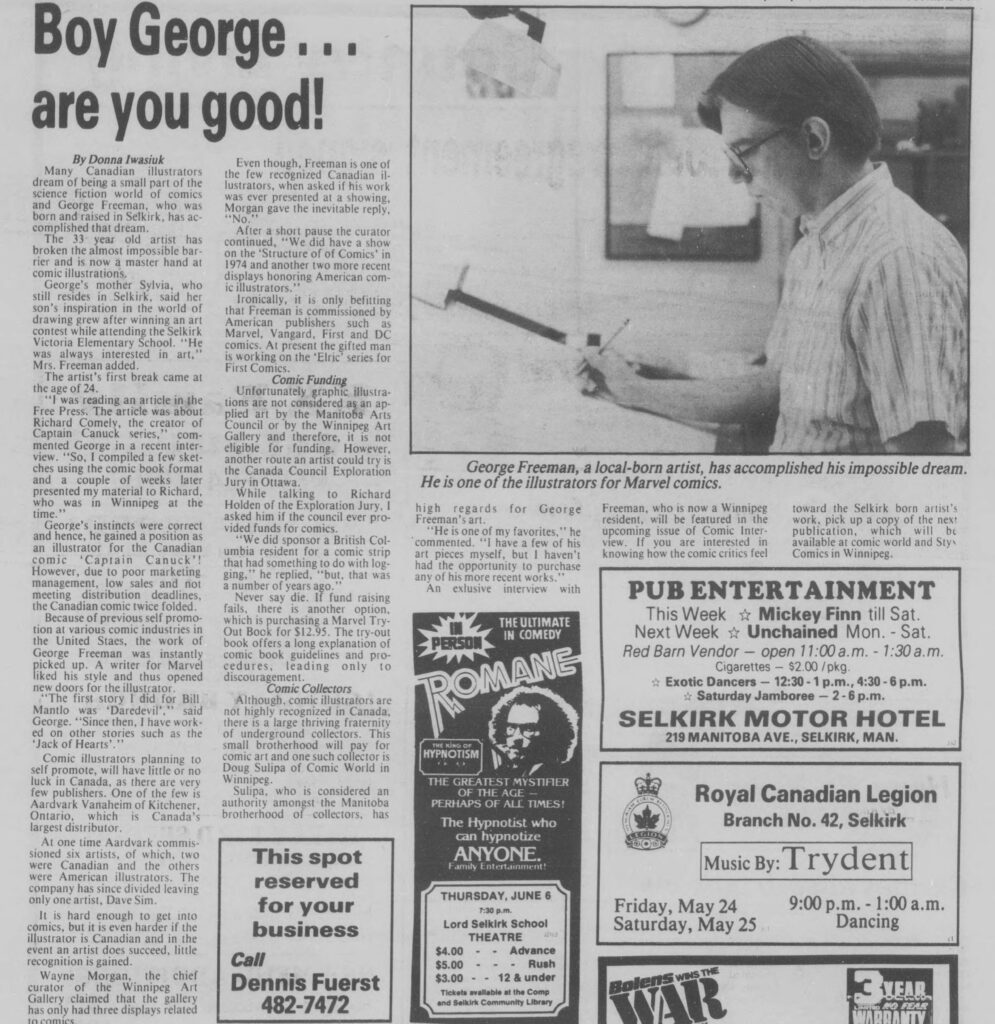
In 1985, Freeman told the Selkirk Journal that he “was reading an article in the Free Press… about Richard Comely, the creator of Captain Canuck.” Breaking into the American comics industry from Canada is a daunting task. Seeing a massive opportunity in his own backyard, he put together a portfolio of comic art and presented it to Comely in Winnipeg.
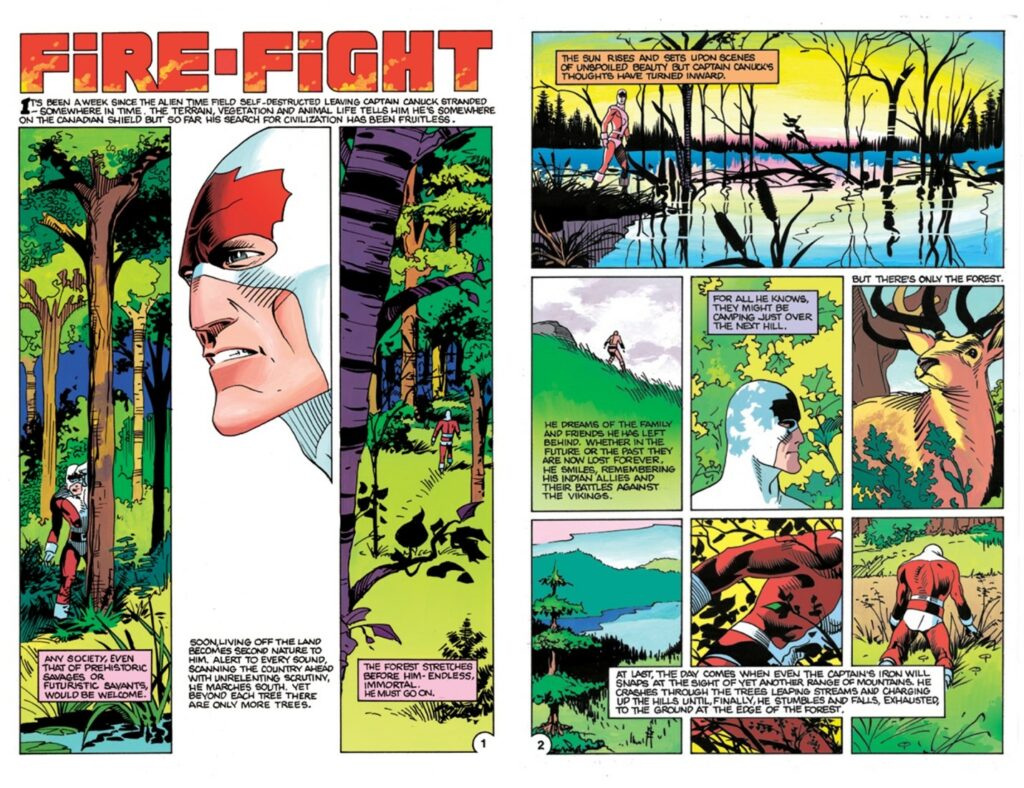
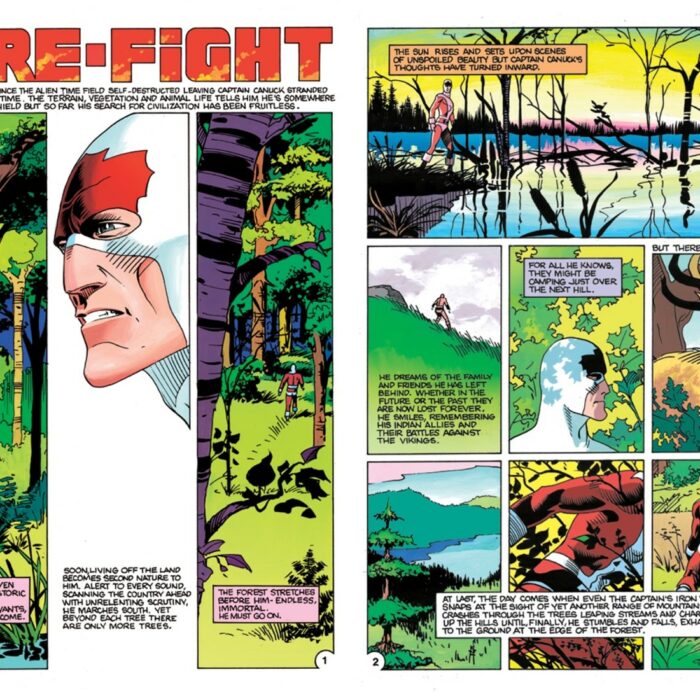
The initiative paid off. Not only was Freeman immediately set to work colouring Comely’s art for Captain Canuck #2, but he also provided the artwork for the Illustration Fundamentals segment of the books, with techniques aimed at others wanting to become artists. The plan to increase Captain Canuck’s readership hit full stride. After issue #3, George began handling the penciling and most of the inking, while Comely focused on writing and administration. “George Freeman was Godsend” said Comely, describing Freeman as a mega talent. With the release of Captain Canuck #4, George Freeman (along with Jean Claude St. Aubin) was responsible for the artwork. Freeman’s take on Captain Canuck expressed a “fresh vision that combined lush, stylized artwork with an unrestrained, tongue-in-cheek heroism.” – Collections Canada.
Enriching the Plot
Richard Comely shifted his energy towards the stories, which now embraced some of the American tropes that the books once eschewed. “Captain Canuck was removed from the future of the 1990s and, like most other superheroes, was relocated into the contemporary timeline by that point, the early 1980’s.” – Ryan Edwardson. This new era was “decidedly less grassroots in feel with a concerted effort made at developing more accessible and conventional storylines, more enticing hooks and plot twists”. – Dittmer and Larsen. “At first I only bought the comic out of Canadian pride,” wrote a fan after the changes, “but now, who can resist?”
By the spring of 1981, a familiar villain returned to haunt Captain Canuck – a lack of profitability. And this time, it delivered a crushing blow. “While Captain Canuck comics can only be called commercially successful by inexorable stretching of the words’ meaning, the iconography of Captain Canuck has been long lasting,” (Dittmer and Larsen) Captain Canuck #14, fully written and drawn by George Freeman, was the final issue.
In the early 1990’s, the Government of Canada began to recognize Canadian national superheroes, “instituting them as representatives and manifestations of national might,” to “validate the national identity and add cultural depth to an institutional hegemonic agent.” -Ryan Edwardson.
Captain Canuck Culture
In 1992, the National Archives of Canada hosted an exhibit titled Guardians of the North: The National Superhero in Canadian Comic Book Art, legitimizing this rich history by treating superheroes as more than just adolescent power fantasies. They are now accepted as national identifiers and ambassadors whose heroic acts “personify the Canadian spirit and identity.” The reverse also proves true. Once a nation officially accepts and promotes superheroes, they gain the heroic traits of the superhero via transference. Positive associations and feelings that people may have with Captain Canuck are now officially associated with Canada.
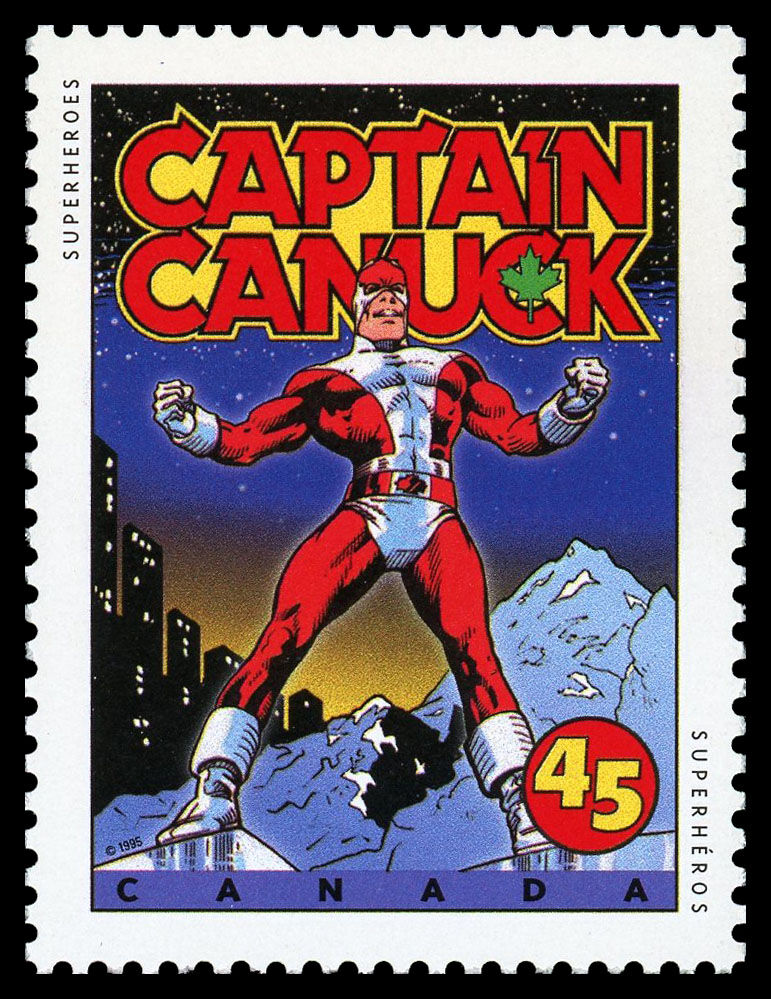
In 1995, Canada Post continued this co-opting of comic book heroics by issuing a “booklet of ten stamps containing the ‘Canadian crusaders’ Superman, Nelvana of the North, Fleur de Lys, Johnny Canuck, and Captain Canuck.” Canada “would not provide funding for Captain Canuck two decades earlier”, but now happily accepted the cultural capital the character had built. The Captain Canuck stamp featured artwork by George Freeman, adding another accomplishment to the Selkirk artist’s portfolio.
In 2018, the Canadian Mint in Winnipeg issued a Captain Canuck silver $20 coin. It sold out on the day of release.
A Symbol of Canadian Nationalism
Fifty years later, Captain Canuck is still going strong, and is finding continued relevance for Canadians and the current state of the world. The threats that helped spawn the nationalist wave in Canada in the 1960’s resurfaced in various forms in the decades that followed. At a first glance, the echoes of the Quebec sovereignty movement can be heard in recent news of Albertan separatism. Fears of colonization by the United States are currently on every Canadian’s mind, the same way they were for the 1988 Canada-US Trade Agreement, and the threat of American cultural domination identified in the Massey Report.
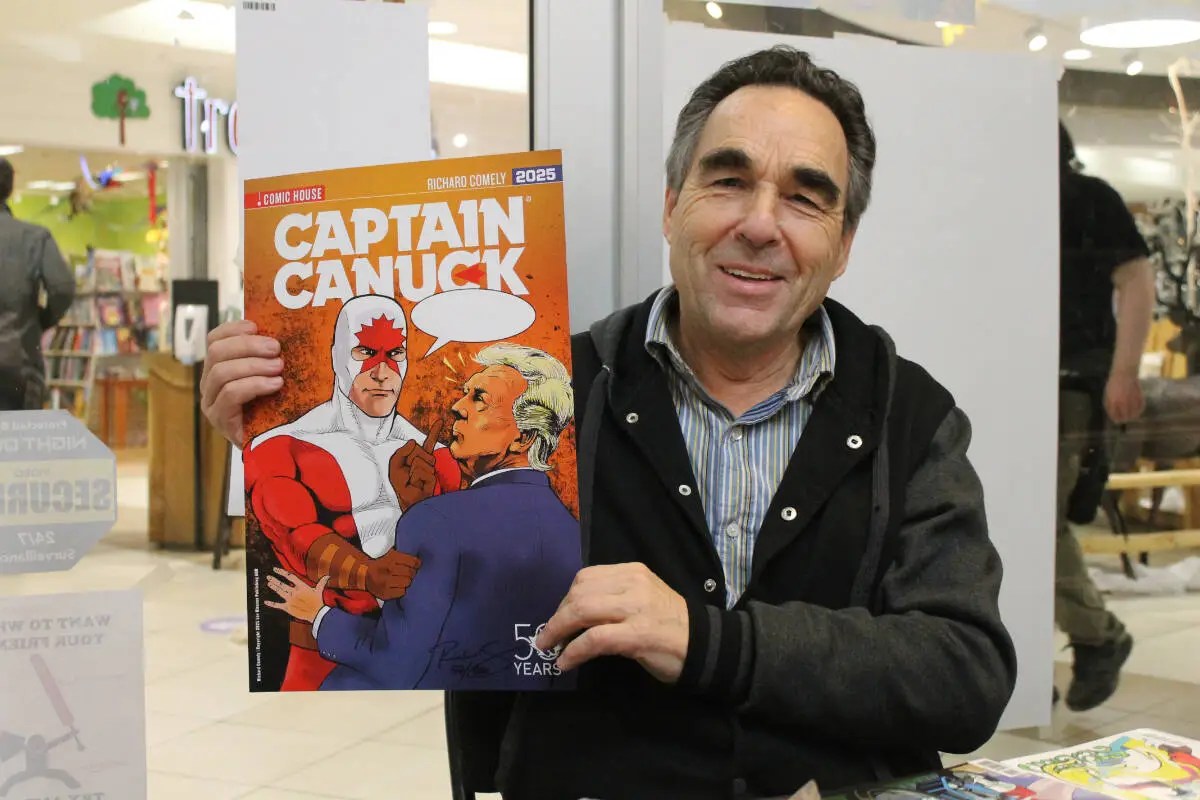
Captain Canuck made national headlines when American President Donald Trump began making threats to annex Canada. Captain Canuck publisher Lev Gleason published a poster and a variant cover featuring Captain Canuck scolding the President, along with an empty word balloon in which Comely would write any message a person would want the hero to deliver.
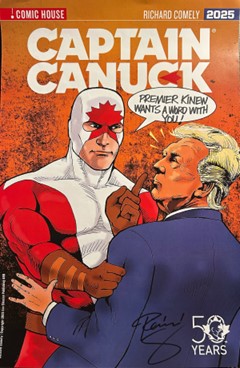
“Captain Canuck is saying what many Canadians want Trump to understand. No, we don’t want to be the 51st state,” Comely said. “Canadians are not happy and we are very puzzled with Trump’s actions and attitude towards our country. Hence the wagging finger.”
Both Richard Comely and George Freeman are still active today. George Freeman is a storyboard artist for Hollywood films, and provided the cover artwork for the upcoming Captain Canuck Crime Stoppers issue. In 2025, Comely did a cross-country tour of comic stores and conventions to promote the 50th anniversary of the character, and wrote and illustrated a story for the 2025 Captain Canuck Summer Special.
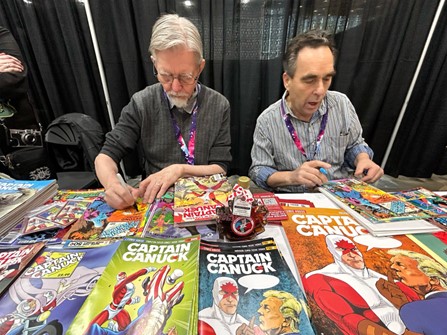
Richard Comely manifested a superhero that immediately resonated with Canadian pride and patriotism. The addition of George Freeman’s art turned Captain Canuck into “one of the finest superhero comics ever published,” (John Bell) increased the book’s appeal, and gave the character a cultural relevance that is still going strong today.
Captain Canuck and His Selkirk Origins Collection
Click on images to enlarge
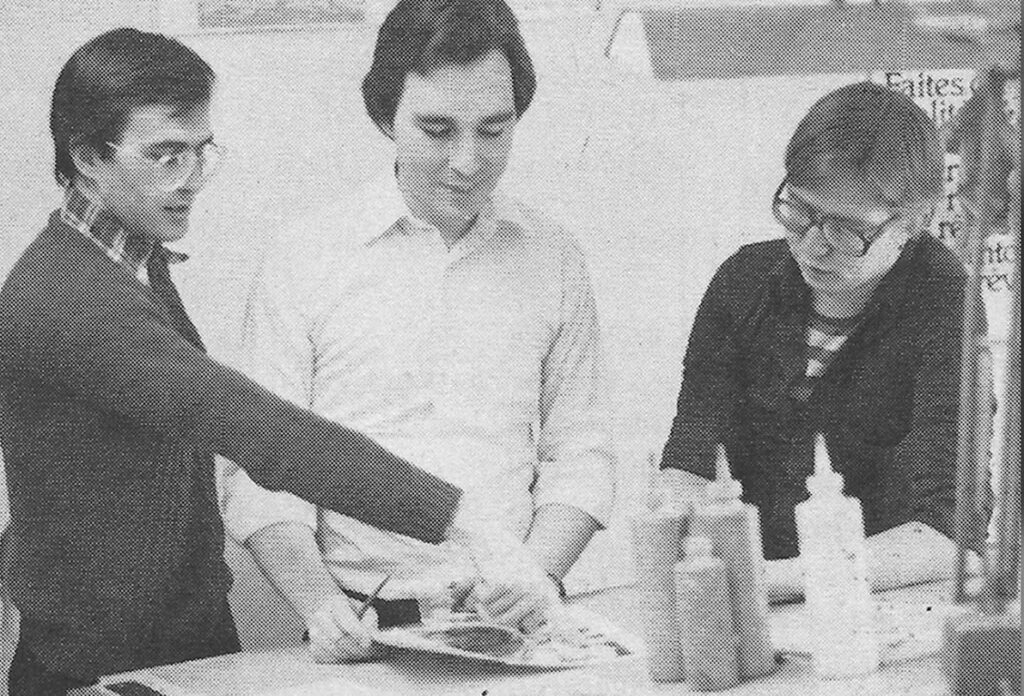
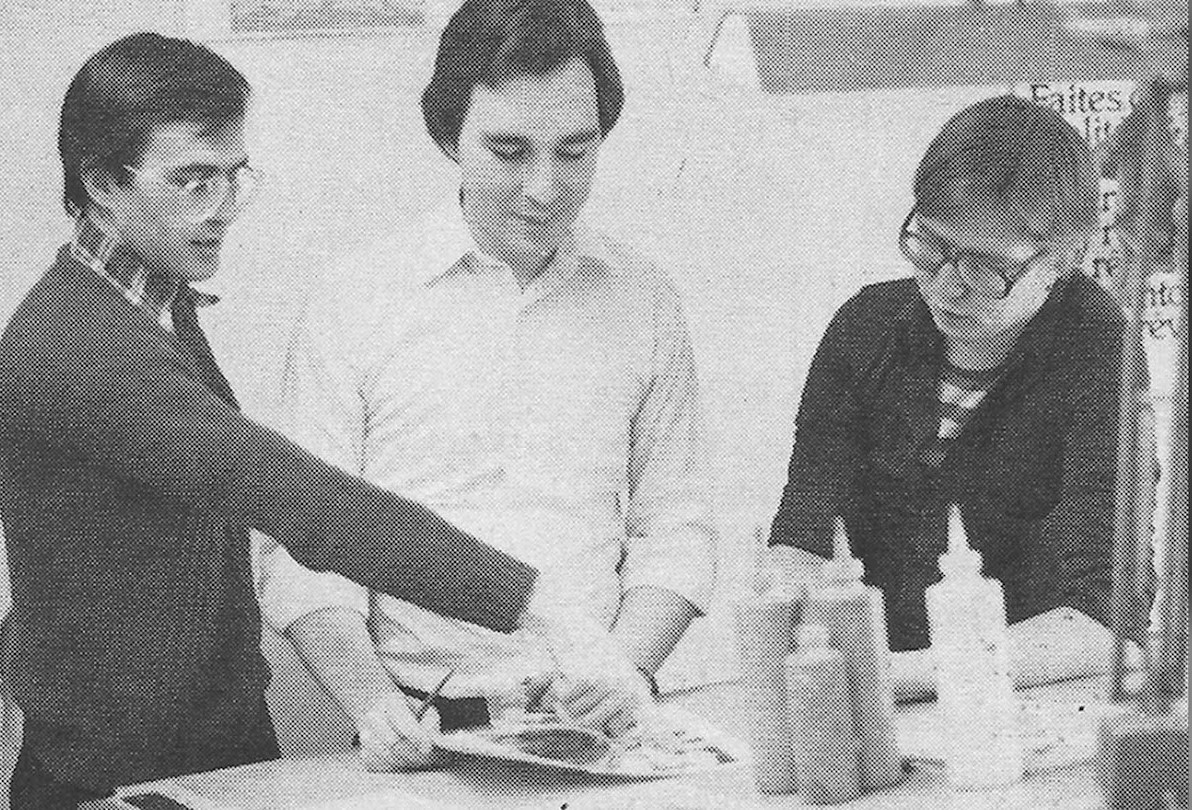
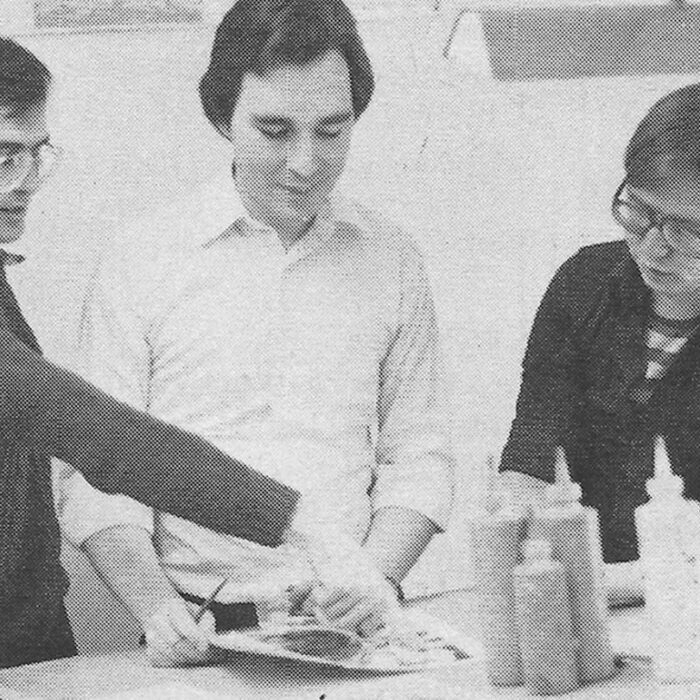 Claude St Aubin, Richard Comely and George Freeman Chased their Comic Book Dreams Across the Prairies, Date Unknown, Richard Comely

Sources
Anderson, Benedict R. O’G. Imagined Communities: Reflections on the Origin and Spread of Nationalism. Verso, 2006.
Bell, John. Guardians of the North: The National Superhero in Canadian Comic-Book Art. National Archives of Canada, 1992.
Busiek, Kurt, and Brent Eric Anderson. Astro City. Homage Comics, 1997.
“Canada in Its Jammies: The Promotional Self-Mockery of Richard Comely’s Captain Canuck: American Review of Canadian Studies: Vol 53, No 3 – Get Access.” Accessed February 21, 2026. https://www.tandfonline.com/doi/full/10.1080/02722011.2023.2246789.
Collections Canada. “Guardians of the North – Background.” Accessed March 1, 2026. https://epe.lac-bac.gc.ca/100/200/301/lac-bac/guardians_north-ef/2009/www.collectionscanada.gc.ca/superheroes/t3-120-e.html.
Collections Canada. “Guardians of the North – Creator Biographies.” Accessed February 21, 2026. https://epe.lac-bac.gc.ca/100/200/301/lac-bac/guardians_north-ef/2009/www.collectionscanada.gc.ca/superheroes/t3-407-e.html.
Collections Canada. “Report of the Royal Commission on National Development in the Arts, Letters, and Sciences. – Chapter II, The Forces of Geography.” Accessed February 27, 2026. https://www.collectionscanada.gc.ca/massey/h5-407-e.html.
Comely, Richard. Captain Canuck #1. Comely Comix, 1975.
Comely, Richard. Captain Canuck Summer Special #1. CKR Productions, 1980.
Comely, Richard. Captain Canuck #2. Comely Comix, 1975.
Comely, Richard. Captain Canuck #3. Comely Comix, 1975.
Comely, Richard, Verne Andrusiek, George Freeman, Claude St Aubin, and Ron Leishman. Captain Canuck: The Complete edition. IDW Publishing, 2013.
CTV National News – CTV Television (Scarborough, Canada). “Captain Canuck.” March 16, 2025. https://www.proquest.com/docview/3177673077/citation/55A6094A7EF94D86PQ/1.
Dittmer, Jason, and Soren Larsen. “Aboriginality and the Arctic North in Canadian Nationalist Superhero Comics, 1940-2004.” Historical Geography 38 (June 2010): 52–69. 55599817.
Dittmer, Jason, and Soren Larsen. “Captain Canuck, Audience Response, and the Project of Canadian Nationalism.” Social & Cultural Geography 8, no. 5 (2007): 735–53. https://doi.org/10.1080/14649360701633311.
Edwardson, Ryan. “The Many Lives of Captain Canuck: Nationalism, Culture, and the Creation of a Canadian Comic Book Superhero.” Journal of Popular Culture (Wiley-Blackwell) 37, no. 2 (2003): 184–201. https://doi.org/10.1111/1540-5931.00063.
Freeman, George. Captain Canuck 14. CKR Productions, 1981.
gasp65. “George Freeman: Red ‘n’ White and All Colours of the Chameleon,” Who’s Out There? (blog), May 27, 2022. https://whosoutthere.ca/tag/captain-canuck/.
Iwasiuk, Donna. “Boy George. . . Are You Good!” The Selkirk Journal, May 22, 1985.
The Joe Shuster Awards. “Freeman, George (1951-).” Updated June 10, 2010. https://joeshusterawards.com/hof/george-freeman-1951/.
“Massey Commission” The Canadian Encyclopedia. Accessed February 27, 2026. https://thecanadianencyclopedia.ca/en/article/massey-commission-emc.
Millard, Gregory, Sarah Riegel, and John Wright. “Here’s Where We Get Canadian: English-Canadian Nationalism and Popular Culture.” American Review of Canadian Studies 32, no. 1 (2002): 11–34. https://doi.org/10.1080/02722010209481654.
Raento, Pauliina, and Stanley D. Brunn. “Visualizing Finland: Postage Stamps as Political Messengers.” Geografiska Annaler. Series B, Human Geography 87, no. 2 (2005): 145–63.
Redford, Jasmine. “Chasing Captain Canada: National Identity Challenged Through Superheroes In Canadian Comic Books.” September 2, 2020. http://hdl.handle.net/10388/12993.
Sylvan Lake News. “B.C. Creator behind Captain Canuck Celebrates Comic’s 50th Anniversary.” February 19, 2025. https://sylvanlakenews.com/2025/02/19/bc-creator-behind-captain-canuck-celebrates-comics-50th-anniversary/.
The Canadian Press (Toronto, Canada). “BR-BOOKS-Captain-Canuck.” September 27, 2025. https://www.proquest.com/docview/3255258910/citation/29A4E3B2D95E404FPQ/1
“The Geopolitical Resonance of Captain Canuck.” As It Happens (Toronto), September 16, 2025. 3251796116. Canadian Newsstream Collection. https://www.proquest.com/other-sources/geopolitical-resonance-captain-canuck/docview/3251796116/se-2?accountid=9705.
TIME. “Canuck to the Rescue”. Canadian edition, 9 June 1975: 10.