
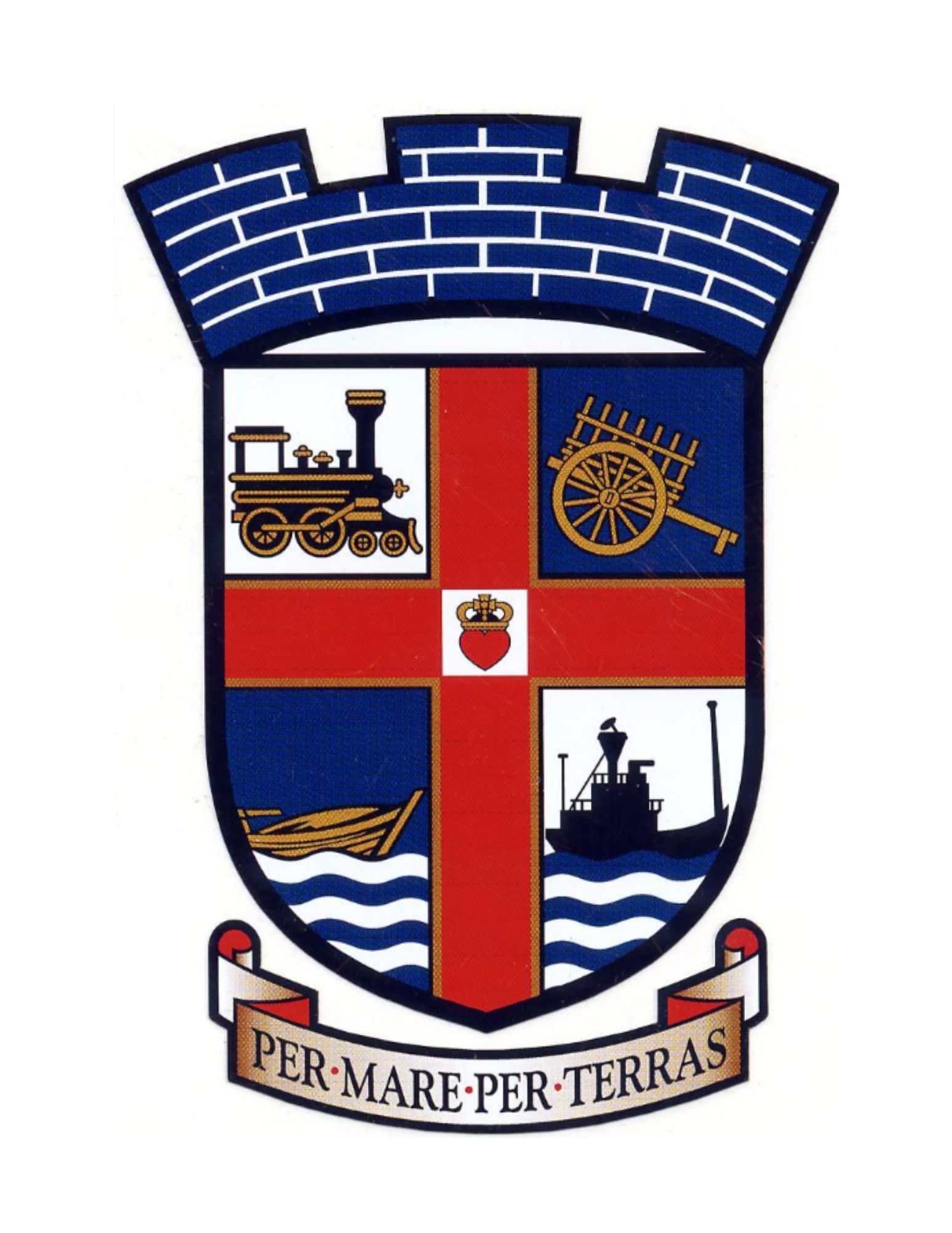
Selkirk’s official coat of arms was granted in 1982 during the town’s Centennial celebrations. The symbol begins with a Masonry Crown, below the Masonry Crown is a shield shape which is broken into four quadrants, and in each quadrant are four symbols. The symbols are a steam train, a Red River Cart, a York Boat, and a steamship. The coat of arms remains an important ceremonial symbol and is prominently incorporated into the city’s flag.
An Official Coat of Arms
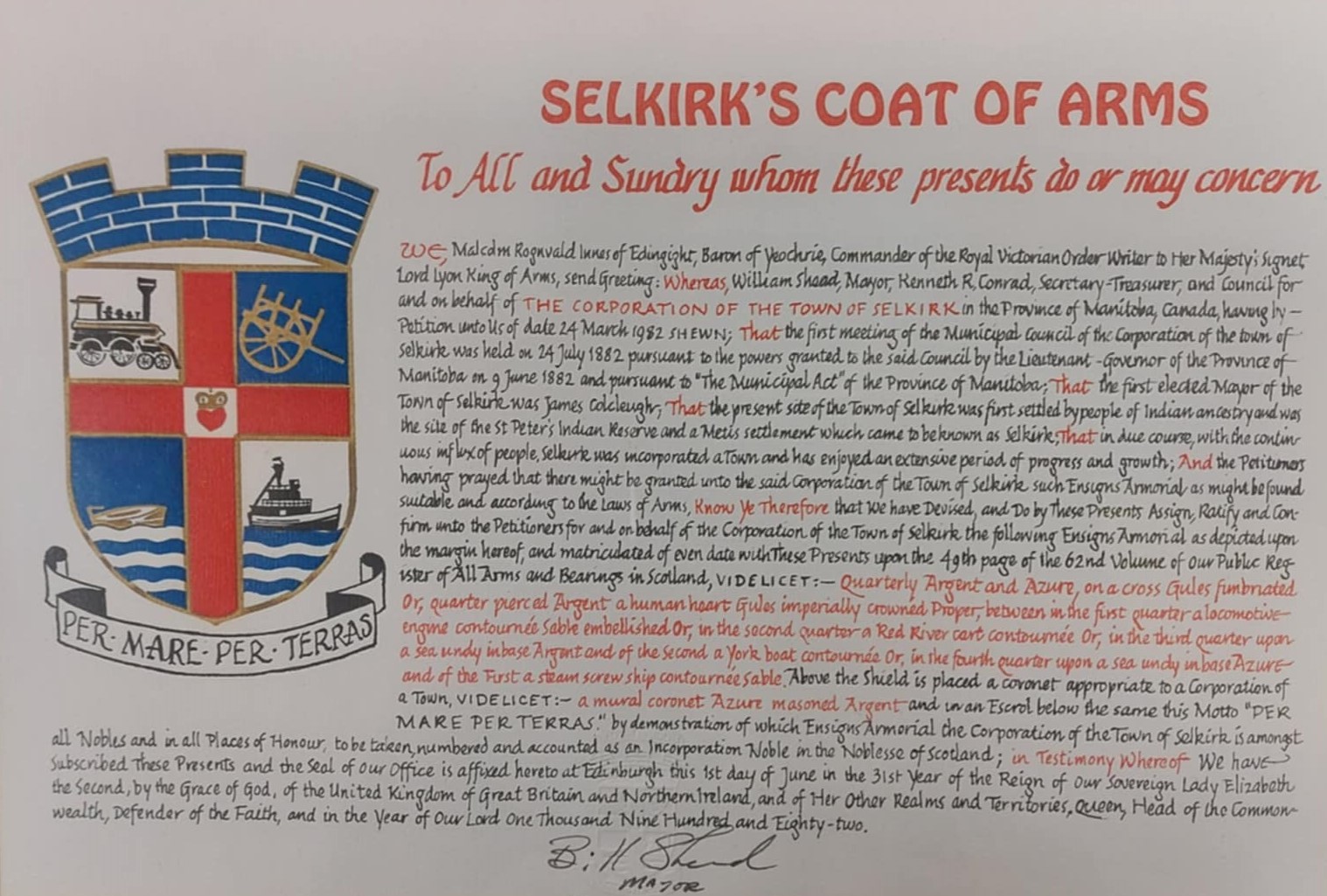
Selkirk’s coat of arms was officially granted to the Town of Selkirk by Malcolm Rognvald Innes of Edingight, Baron of Yeochrie, Commander of the Royal Victoria Order, Writer to Her Majesty’s Signet, the Lord Lyon King of Arms, on June 1, 1982 after Town Council petitioned the Court of Lyon for an official coat of arms. The formation of the coat of arms was part of a series of projects and events organized during Selkirk’s Centennial year intended to promote civic pride and celebrate the progress the town had made over the previous one hundred years.
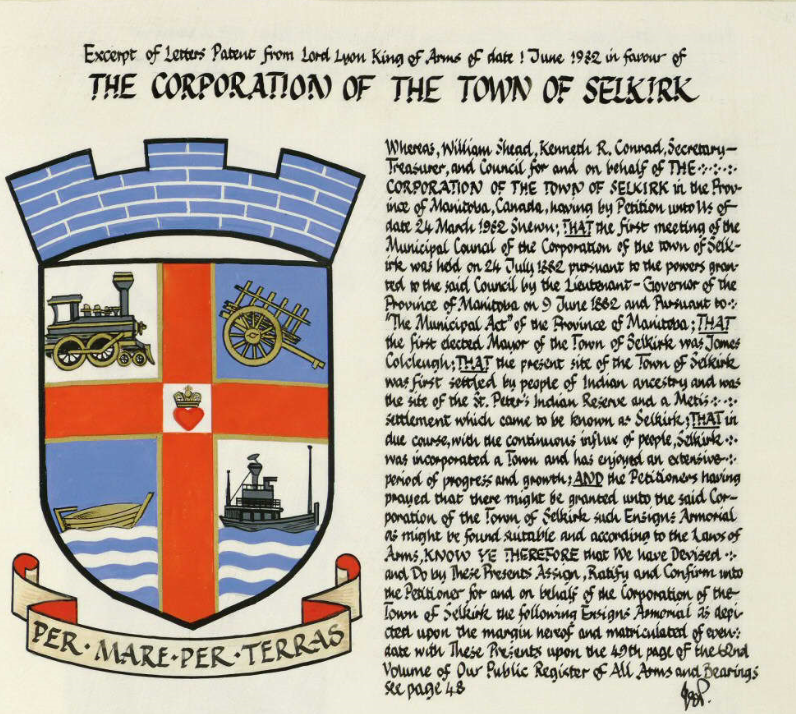
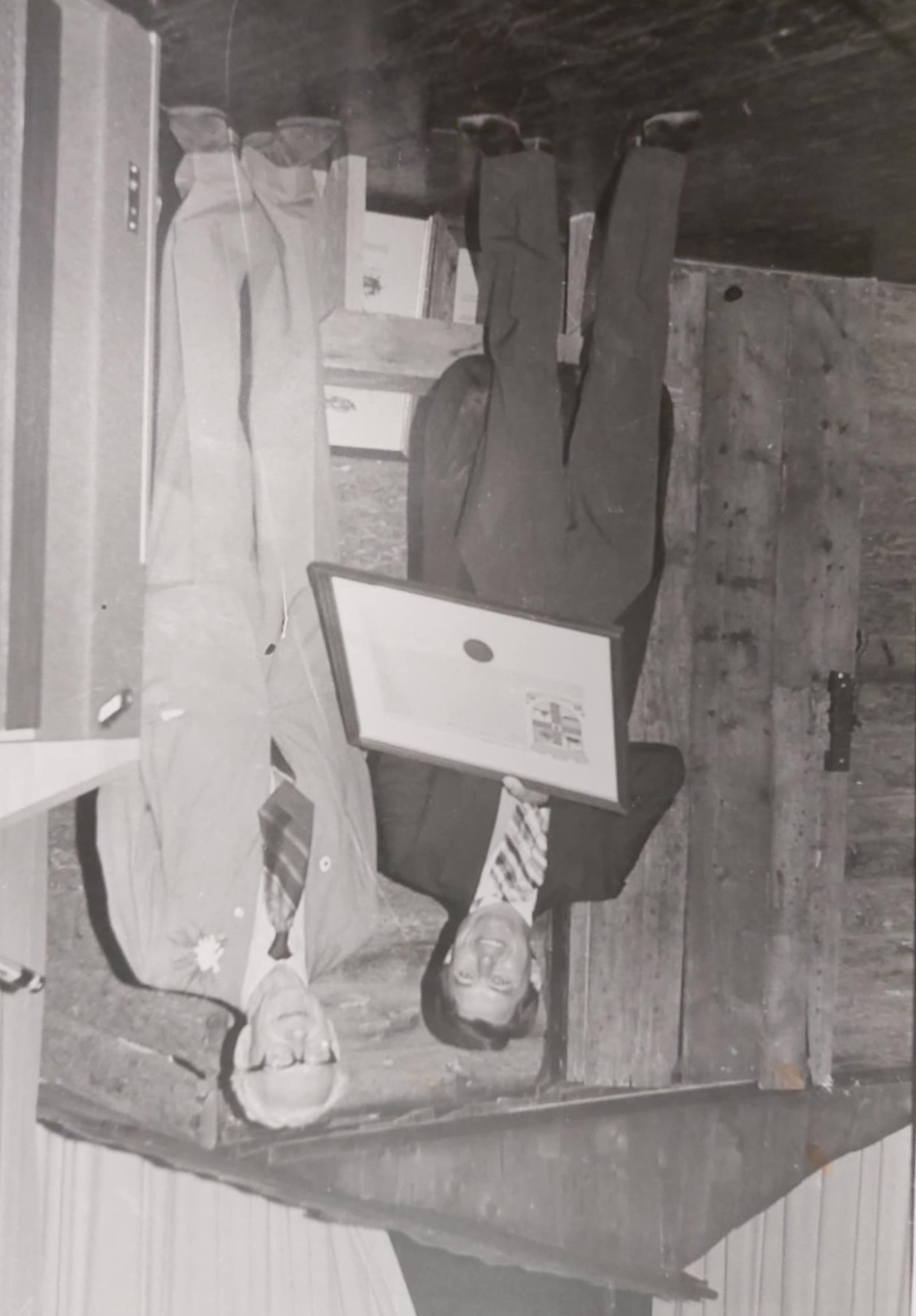
One of these Centennial events, organized by the Centennial Committee, was the First Council Meeting Re-Enactment. The re-enactment took place at the Lord Selkirk Regional Comprehensive Secondary School Theatre and involved the Mayor and Councillors dressed in period costume, each reading a part of the proceedings that took place in 1882. Following the skit, the 10th Earl of Selkirk presented Mayor Bill Shead with the official Selkirk coat of arms.
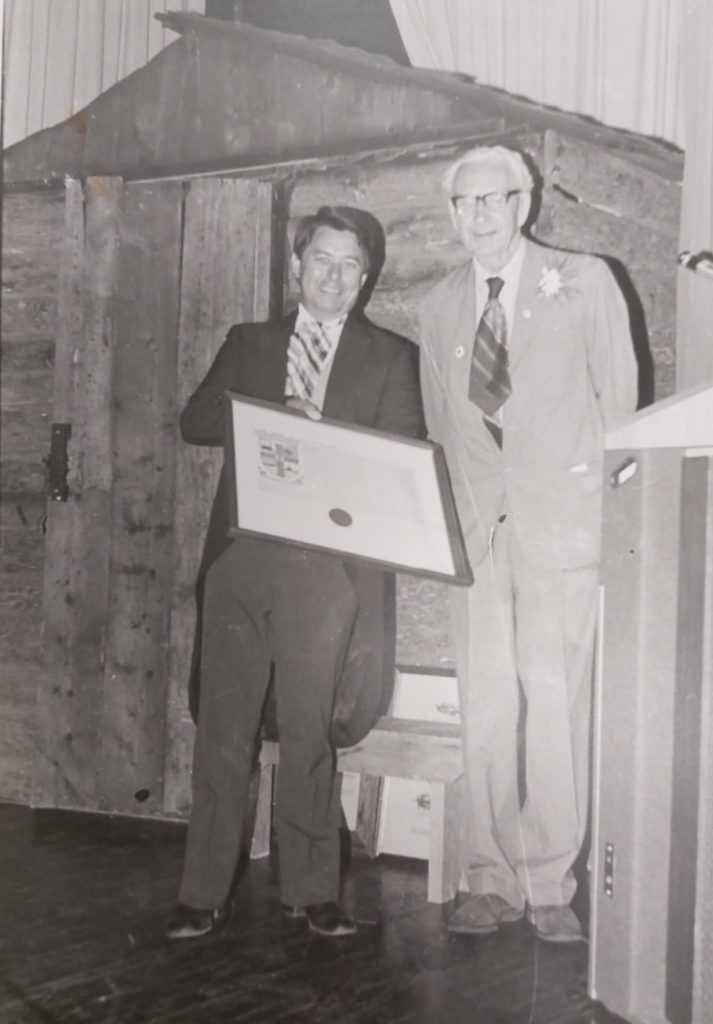
The symbol involves several parts, each of which is heraldic, or symbolic. The coat of arms begins with a Masonry Crown, a traditional heraldic symbol for a town. Below the Masonry Crown is an escutcheon, or a shield shape which is broken into four quadrants. Within each quadrant are four symbols. From top left to bottom right the symbols are a steam train, a Red River Cart, a York Boat, and a steamship. The steam train and Red River Cart symbolize the first and early methods of land transportation and the importance of the railroad. The two types of boats represent the significance of the waterways and developing water transportation systems. The heraldic symbols demonstrate how Selkirk has served as a centre for water and land transportation, industry, and trade.

In the center of the image, is a red cross. The red cross could be representative of Selkirk’s British heritage as the Cross of St. George’s is the symbol of England’s Patron Saint, St. George. However, the known interpretation is that the cross symbolises the Red River on which Selkirk is located and represents the intersection of trade and transportation via sea and by land. This idea is highlighted by the Latin words “Per Mare Per Terras” on the gold banner at the bottom of the shield, which can be translated to “By Land By Sea”. This phrase is also the motto of Clan MacDonald, a clan from which many Scottish Settlers originated when they immigrated to the Red River Valley in 1812.
The motto is not the only allusion to Selkirk’s Scottish history found within the coat of arms. The “Douglas Heart” found at the centre of the red cross is a reference to Thomas Douglas, the 5th Earl of Selkirk, from whom Selkirk acquired its name.
Until 2016, the City of Selkirk used the coat of arms as its logo, which was then replaced by the new branding design. The coat arms, however, continues to be used to represent the city’s governance and appears on very formal or ceremonial documents as the symbol for the Mayor and Council.
The Ultimate Bragging Rights
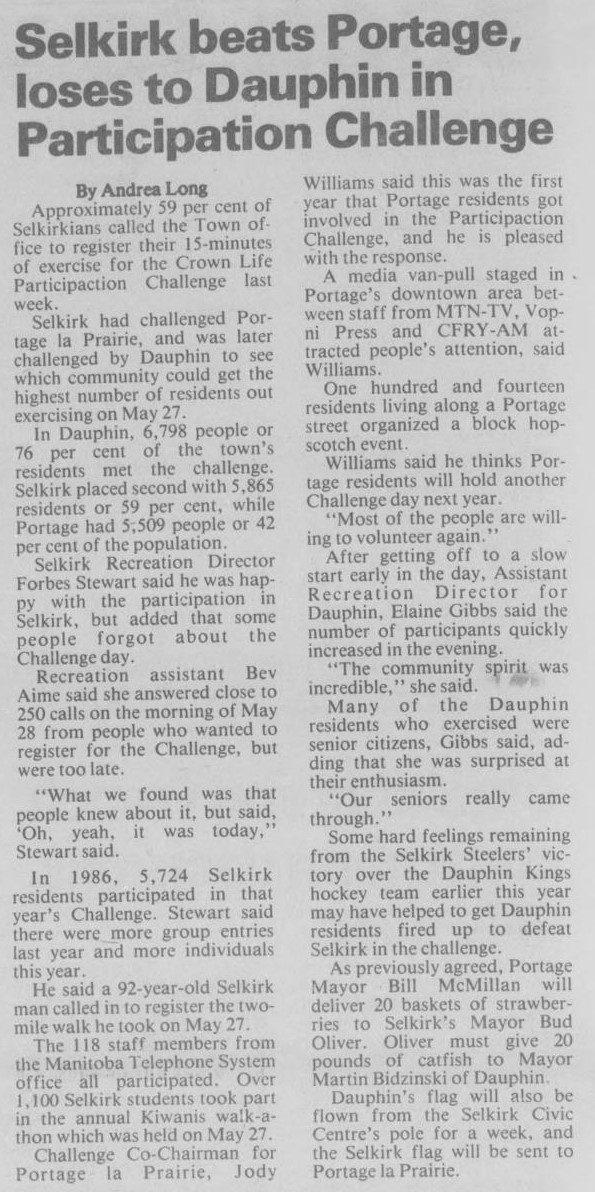
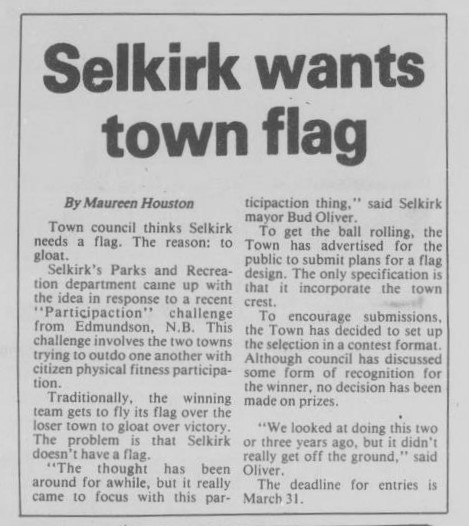
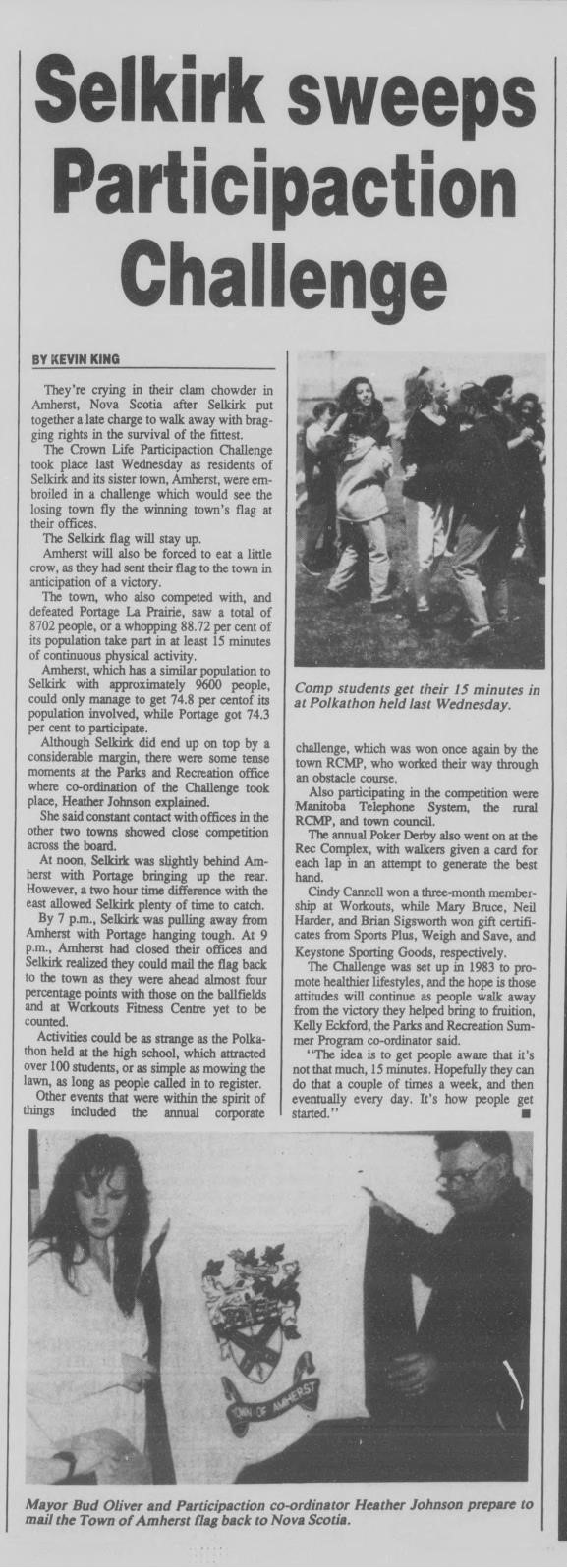
The Selkirk coat of arms also appears on the Selkirk flag which was designed in 1988 as a response to a ParticipACTION challenge. ParticipACTION is a national organization, which is dedicated to promoting physical activity and active living among Canadians.
Communities across Canada challenged each other to participate in a competition to see who had higher citizen physical fitness. The community who won, received the ultimate bragging rights and were allowed to fly their municipal flag from the losing community’s flagpole. Edmundston, New Brunswick, challenged Selkirk to compete with them on May 25th, 1988. This was all well and good, except Selkirk didn’t have a flag.
“The thought has been around for awhile, but it really came to focus with this ParticipACTION event,” said Mayor Bud Oliver.
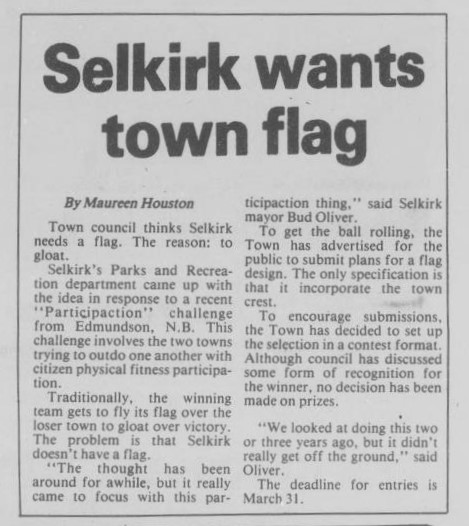
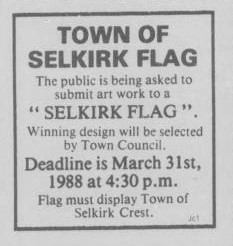
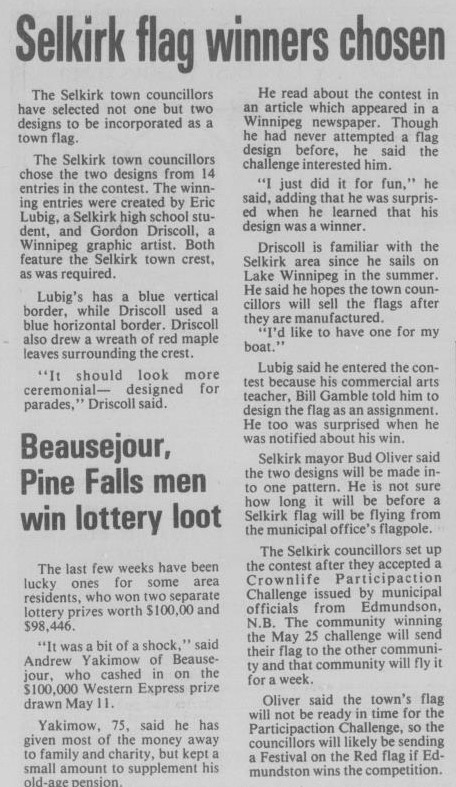
To amend this problem, the Town organized a contest in March, before the challenge in May, to select a design for the Selkirk flag. The only stipulation was that it must include the Town coat of arms. Out of fourteen entries in the contest, two were chosen by a standing committee as the winners. Eric Lubig, a high school student from the Lord Selkirk Regional Comprehensive Secondary School entered the contest with the encouragement of his Commercial Arts teacher, Bill Gamble. His design featured the coat of arms and a vertical blue border. Gordon Driscoll, a graphic designer from Winnipeg, entered the contest just for fun. His design also included the coat of arms, a horizontal blue border, and a wreath of red maple leaves. The two ideas were merged into one design, which became Selkirk’s flag.
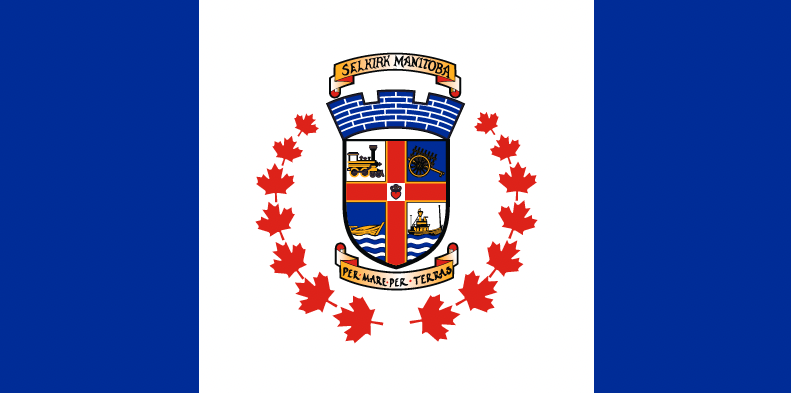
In the end, Selkirk lost the challenge to Edmundston, but a much greater result was achieved. Selkirk had come together in an act of community to celebrate the town, its rich history, and its impact on the future.
While the flag has been used in practice for a few decades since its original design, it was never formally adopted by Council. To amend this, City Council passed a resolution on June 9, 2025, for City Administration to prepare a by-law, which once passed will adopt the flag as the official flag of Selkirk.
Selkirk Flag and Coat of Arms Collection
Click on images to enlarge
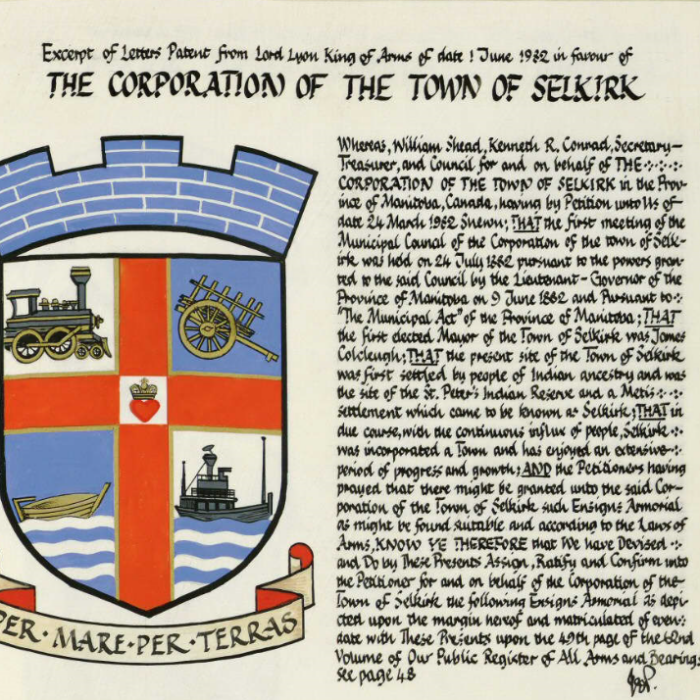 Selkirk Coat of Arms Grant, 1982, Court of Lyon
Sources
Our Brand” – City of Selkirk, 2016
Selkirk, Manitoba (Canada) – Flags of the World
Court of the Lord Lyon
Doreen Oliver Fond, Selkirk Centennial Collection
Lord Selkirk and His Agents, Manitoba Historical Society
Selkirk Journal, 1987, 1988